
How do San Francisco’s wealthiest people sleep at night? Very well indeed.
According to new data published by the Centers for Disease Control and Prevention as part of its PLACES project, which provides health data for communities, parts of the city with the best snoozing habits correlate with the highest incomes. By comparison, people living in Bayview-Hunters Point, Treasure Island, and other neighborhoods with some of the city’s lowest household incomes are not getting enough sleep.
The CDC defines good sleep for adults (opens in new tab) as seven or more hours a night. It’s a lofty goal; 30.1% (opens in new tab) reported regularly getting insufficient sleep in 2022, up from 27.7 (opens in new tab)% in 2020, according to survey data from the National Center for Health Statistics. The agency flagged the national sleep trend as “getting worse.”
No matter where they live, Americans appear to be sleeping less. San Francisco residents are no exception, with 32.5% reporting insufficient sleep, more than the national average.
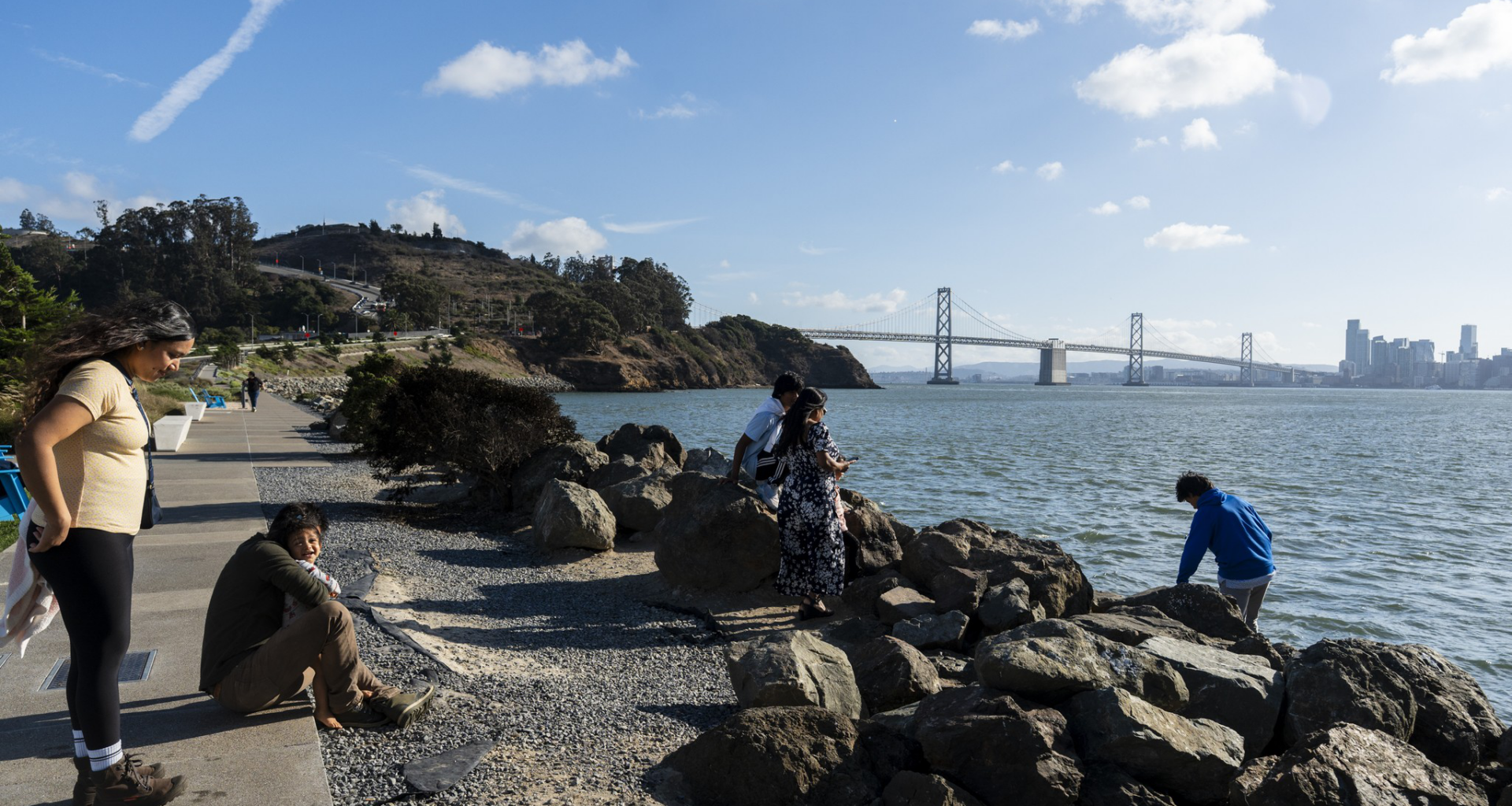
Treasure Island and Bayview-Hunters Point stand out as the most sleep-deprived areas of San Francisco for adults, with 40.5% and 39.1%, respectively, reporting less-than-optimal sleep. Residents of those neighborhoods are also the city’s lowest earners. Households in Bayview-Hunters Point brought in approximately $101,566 in 2023, the most recent figure available, while those in Treasure Island earned $91,750. Treasure Island’s share of bad sleepers rose 4.6 percentage points from 2020 to 2022.
The city’s best-rested neighborhoods are mostly in the north. The Marina reports the lowest rate of poor sleep, at 28.2%, followed by the Presidio, 29.1%. This tracks with higher income brackets: Data USA, a public platform developed by Deloitte, MIT Media Lab, and Datawheel, estimated the combined median household income for the Presidio, the Richmond, and Western Addition as $156,057, and the Marina at $167,445.
The CDC’s data, which is based on a nationwide phone survey conducted in 2022 and released in December 2025, looked at the Bay Area county by county. It found that residents in the poorest county, Solano, fared the worst in sleep quality, with 38.1% of adults getting less than seven hours. Contra Costa County residents were No. 2, with 35.8%, followed by Alameda, with 35.1%. People in San Mateo County were the best rested, at 28.7%.
The Bay Area obsesses over sleep data yet overall still sleeps badly, said Dr. Roger Washington, director of the San Jose-based foundation Sleep to Live Well (opens in new tab). “The most common complaint is ‘I’m tired’ — that they don’t have the energy to do things,” he said. “When you don’t sleep enough, it impairs the way you experience the world the next day.”
The region, famous for tech-obsessive self-optimizing and tracking everything from heart rate to sleep scores, hasn’t managed to turn that data into better snoozes.
Washington said Bay Area culture is partly to blame. “Anxiety is the main reason why people have difficulty sleeping,” he said. “They think that by working more and by working harder and by working more industriously and more passionately, they’re going to make up for their lack of sleep. It’s not sustainable.”
On a state level, California’s sleep clocks in as average, with 35.2% (opens in new tab) of adults reporting fewer than seven hours — less wrecked than Hawaii, at 45.9%, and West Virginia, at 42.6%, but worse than Colorado, at 30.6%, and Vermont, 30%.
Dr. Kin Yuen, a sleep medicine specialist at UCSF and Stanford, said the 2022 shift from remote to hybrid work may have contributed to the sleep deficit by throwing off circadian rhythms. Typically, 4% of people experience this, she said, adding that the Bay Area may “have a higher prevalence” as workers lost the flexibility of remote work but retained the “social responsibilities” of school drop-offs and caring for family members.
Not sleeping well can have serious effects on health. The CDC links insufficient sleep to a wide range of increased risks (opens in new tab), from obesity and diabetes to the propensity for car crashes. And adults aren’t the only ones struggling.
The CDC data excludes anyone under 18, but Bay Area youth report big sleep issues. The CDC recommends (opens in new tab) nine to 12 hours a night for 6- to 12-year-olds and eight to 10 hours for 13- to 17-year-olds.
A study (opens in new tab) published in December in medical journal Cureus surveyed 1,189 Bay Area residents ages 10 to 24. Middle school students reported sleeping an average of 8.3 hours, and high school students averaged 6.68 hours on school nights. Overall, 71% of those between 10 and 18 slept less than the recommended eight to 10 hours a night. The top culprits for insufficient sleep were schoolwork (81.8%), using phones before bed (59.7%), and poor time management (55.5%).
“Sleep affects nearly every system in the body,” said Dr. Amer Khan of Sehatu Sleep (opens in new tab) in Sacramento. “The majority of people need seven to eight hours. … It’s really important [for] longevity and quality of life.”