
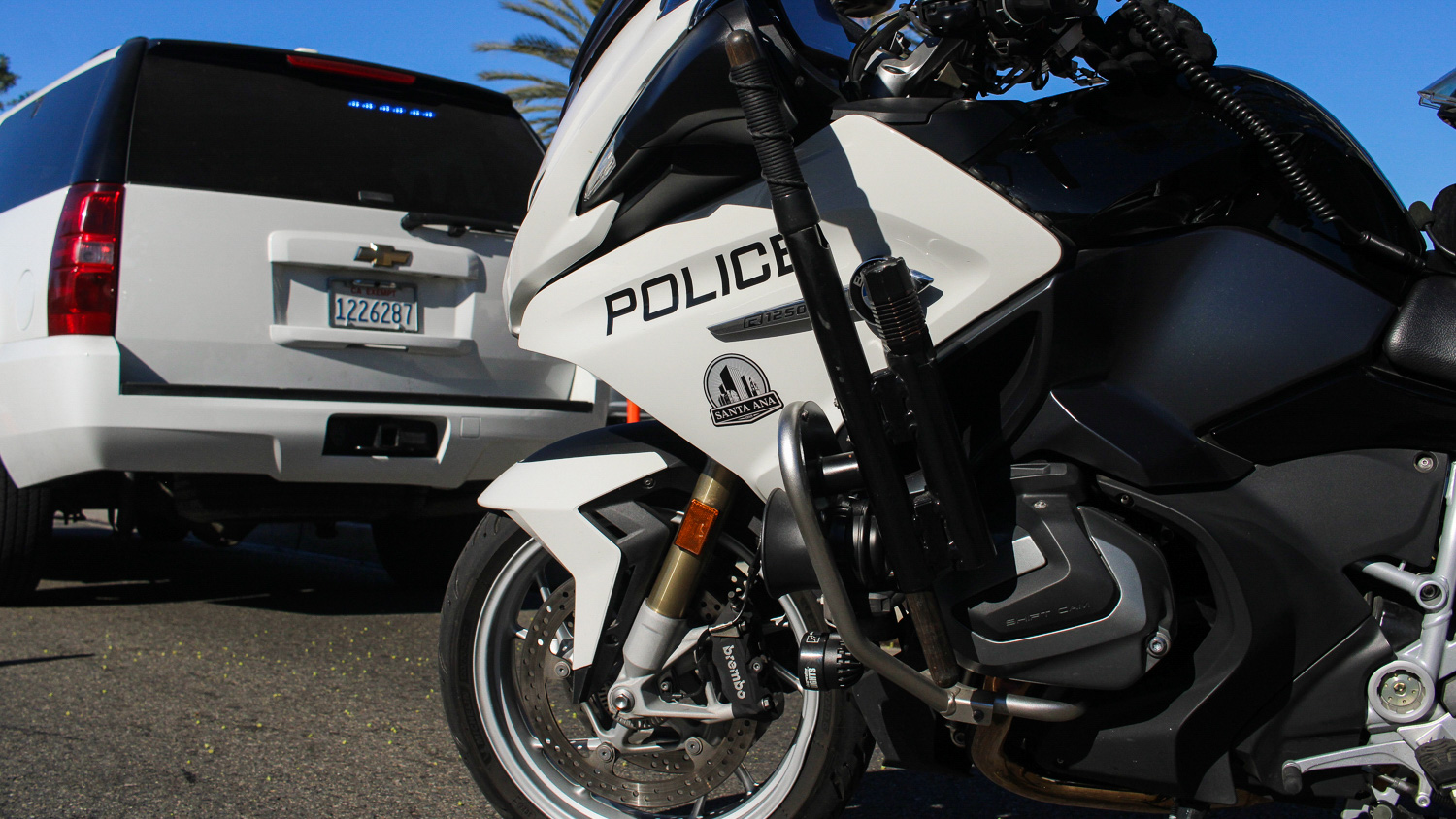
Santa Ana taxpayers have paid out over $5 million since 2019 in lawsuits and claims from over 50 police car crashes – some of which stemmed from vehicle pursuits.
Three of those accidents involved off duty officers driving take home police cars to or from work resulting in a total of $1.2 million settlement payments, according to a presentation on police vehicle pursuit statistics given to police oversight commissioners last week.
It’s an amount that led police oversight commissioners Danny Vega and Evangeline Gawronski to question why officers were taking police cars home
Santa Ana Police officials said it depends on the officer’s assignment.
“There are certain assignments that the officers are afforded a take home vehicle for the purposes of accomplishing their mission,” one police representative said at Thursday’s commission meeting.
Vega asked if such lawsuits could be prevented in the future if officers didn’t take city owned police cars home.
“What I’m trying to get at is, if we wanted to, let’s say, avoid these lawsuits. Is it possible to say all police officers should just use their own vehicles to go home?” Vega questioned.
City staff said generally speaking yes.
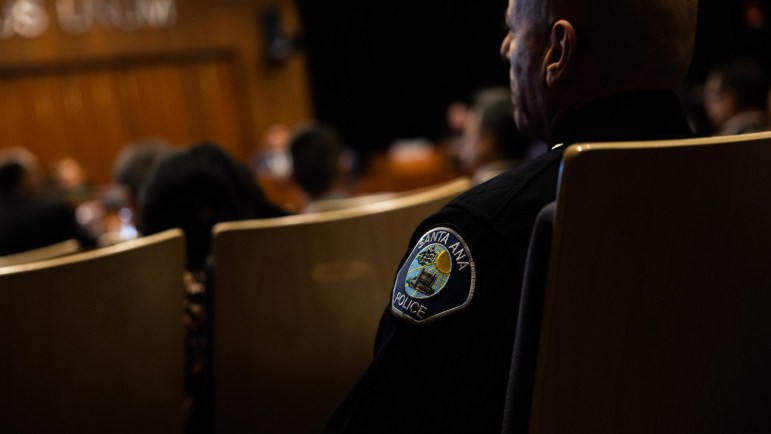 A Santa Ana Police officer attends a May 2025 Santa Ana City Council meeting.
Commissioner Gabriel Castillo Laughton also raised concerns about the $1.2 million paid out over take-home vehicle accidents.
“That’s a little concerning, honestly, that officers were using vehicles, for whatever (reason), to go home off duty and were involved in accidents that resulted in settlements that were this big,” he said, asking for more specifics on those incidents.
“I don’t know what they were using them for, but it’s concerning.”
Commissioner Amalia Mejia echoed concerns and said they should look into policies to prevent such payouts.
Commissioner Carlos Perea said spending on the settlements was concerning.
“I am particularly concerned about the $1.2 million settlement for three collisions. That’s like $400,000 for each collision so I would like to get further information on those,” he said.
“$5.1 million on settlements, that’s a lot of money that, if we can begin digging into and understand what is going on in the way that officers are driving, that can be mitigated will be very important to save money,” Perea said.
Police Chief Robert Rodriguez said in a Tuesday email that collisions involving off duty officers in police cars warrant close examination.
“Preventing these incidents requires a clear policy, strict accountability, regular training, and effective oversight regarding vehicle use. Take-home vehicles offer operational and public safety benefits,” he wrote.
“This approach allows us to manage risk responsibly while preserving the operational benefits that take-home vehicles provide to the community.”
The concern comes as city council members directed city staff last year to research what it will cost and the benefits of installing dashboard cameras on over 50 city police cars at the request of City Councilwoman Jessie Lopez.
Lopez argued the cameras could reduce lawsuits and provide more accountability.
[Read: Roll Camera: Santa Ana Explores Dash Cams for Police Cars]
Staff are expected to come back this month to share their findings on the cameras.
Police Chases in Santa Ana
According to the presentation, there have been 313 police chases between January 2022 and November 2025 in Santa Ana with 90 – 30% – of them resulting in a traffic collision and about 199 – 64% – of the total chases started due to a California Vehicle Code violation.
T. Jack Morse, the oversight director of the commission, said the police department vehicle pursuit was revised to remove a section that discourages “extended pursuits” of non violent misdemeanor violators at the recommendation of Lexipol, the company that generates policy templates for the department.
The change comes after a state law spearheaded by Assemblywoman Diane Dixon (R-Newport Beach) banned police officers from pulling people over solely due to expired registration tags for two months from the expiration date as a grace period.
Rodriguez defended the department’s pursuit policy contending that it should be consistently evaluated to ensure it follows the last best practices.
“Vehicle pursuits are among the most dangerous activities in policing for officers, suspects, and the public,” he wrote.
“Our current policy already places significant restrictions on pursuits and requires continuous risk assessment, supervisor oversight, and termination when the risks outweigh the benefits to public safety.”
Rodriguez added that street cameras and license plate readers can help reduce the need for pursuits.
Laughton questioned how many of the pursuits that led to a collision were justified and asked for a broader breakdown of what the vehicle code violations were that triggered a pursuit – questioning how many were misdemeanors and how many felonies.
One police representative said most vehicle code violations are infractions like speeding or running a stop sign, adding those types of violations could kill or harm someone.
“The fact that it’s a fraction in and of itself doesn’t necessarily minimize that a police officer has a discretion to address that conduct or not once they attempt to stop an officer and the vehicle fails to yield,” he said at the meeting.
Rodriguez echoed similar sentiments in his email adding that the violations can uncover other criminal activity including gun and illegal drug possessions.
Mejia said if most of the pursuits are sparked from code violations, she would like to know more about what they were exactly.
“I understand that if a vehicle is stolen and somebody doesn’t stop, that leads to a pursuit. I think I understand that if somebody is wanted and they don’t stop, that leads to a pursuit. But if the majority are because of vehicle codes, I think that maybe the data shows that maybe we should be looking more into this policy and addressing some of the problems,” she said at the Jan. 8 oversight commission meeting.
Commission Chair Keith Carpenter said the commission does not need all the data requested except for more details on the off-duty collisions, calling the rest “data overload” and a “waste of taxpayer dollars.”
“If we’re doing a policy review, then we request data. Requesting all this data continuously is just burning up your budget. We have more important things, in my opinion, to have you spending your time on and the budget spent on,” Carpenter said at Thursday’s meeting.
Morse said the rate of police pursuits that result in car wrecks is on par with nationwide rates between 2015 and 2020.
But, Morse noted, the city’s pursuit car wreck rate is 10% higher than California’s statewide rate in 2021.
About 38% of Los Angeles Police Department vehicle pursuits between 2018 and 2023 resulted in a wreck, according to Morse.
Morse also said when a pursuit results in a crash the police department will generate a report detailing the pursuit and that report will be reviewed by the supervisor to determine if the pursuit was justified.
He said an administrative investigation will also be conducted if the police pursuit results in a crash.
Under the police department’s vehicle pursuit policy, the Police Chief is supposed to call for a documented review and analysis of vehicle pursuits on an annual basis to check for policy compliance and to check for training and equipment needs.
Morse said former Police Chief David Valentin didn’t call for those reports to be completed and that his successor current Chief Robert Rodriguez is evaluating if the department needs these types of reports.
Rodriguez said he supports such reviews.
“Annual analysis allows us to identify trends, training needs, policy gaps, and opportunities to reduce risk.”
Hosam Elattar is a Voice of OC reporter. Contact him at helattar@voiceofoc.org or on Twitter @ElattarHosam.
Related