
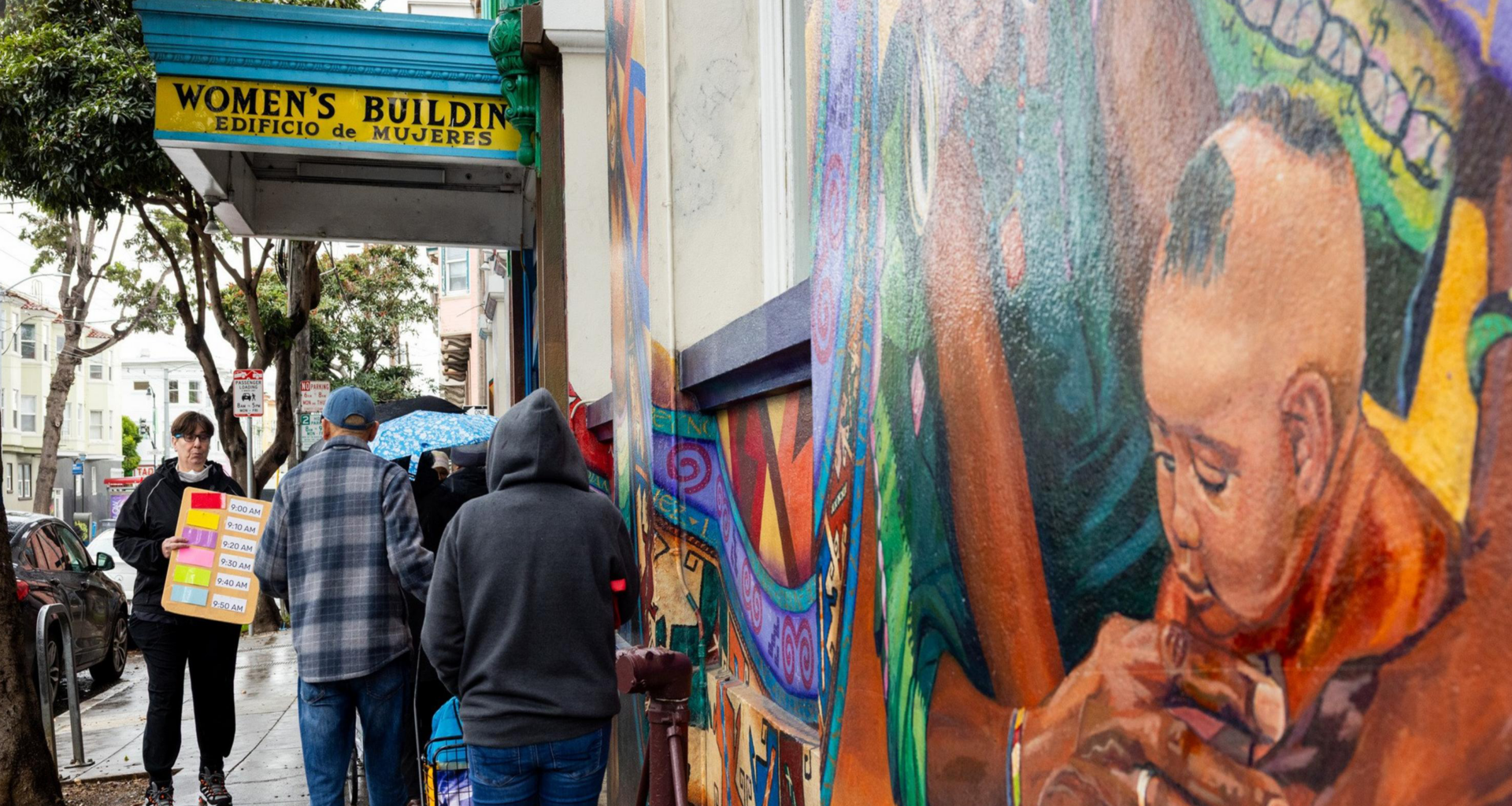
With murals of activists, heroines, and deities spreading over its walls, The Women’s Building at 3543 18th St. has shone as a beacon of humanity and affirmation for more than 50 years.
The building’s facade projects what contains a nurturing space where women — particularly, women of color — can thrive.
But it’s hanging on by a thread. The structure in the Mission was constructed just after the 1906 earthquake. On rainy days, the roof appears to be verging on collapse. The wood floors in the downstairs auditorium, the site of weekly food pantries, are the same ones that used to squeak under German American gymnasts (the first users of the property) a century ago.
But moving is simply not an option, according to Tania Estrada, executive director of the community nonprofit that owns and operates TWB. “Too many people count on this,” she said. “The need is only growing.”
Under the federal immigration crackdown, the building has hosted more legal support and family reunification services. Meanwhile, poverty in San Francisco has surged (opens in new tab), meaning there’s more need for low-income households, aging seniors, at-risk youth, and domestic abuse survivors.
“We’ve been dragging along all these years,” Estrada said. “Now is the time to level up and do more, not less.”
The roof will soon be covered in silicon in preparation of the installation of solar panels. Tania Estrada is overseeing the renovation of the century-old building on top of her duties as executive director.
Doing more has meant a multiyear project to modernize the property’s aging infrastructure. Two years ago, the nonprofit started working with the city’s Environment Department and identified two federal programs to finance such a transformation.
One was a tax credit that would refund a third of the costs needed to install solar panels; the other was a tax deduction for energy efficiency and HVAC improvements. Fully decarbonizing the building, Estrada said, would not only save energy costs and improve performance but enable additional emergency response services, such as storing and distributing medical supplies.
However, those incentives were products of the Biden administration. Under President Donald Trump, many clean energy and efficiency tax credits are being phased down or sunsetted earlier (opens in new tab), putting TWB on an accelerated timeline.
The solar panels, for instance, need to be in operation by 2027 if TWB is to qualify for the federal cash-back incentive. This credit could be treated as future revenue that the nonprofit could borrow against to pay for some construction costs upfront.
 A tapestry in the building says “Freedom to choose.”
Diane Santana, chief development officer at TWB, said the cost for the solar project, including roof replacement and administrative fees, is roughly $300,000. The nonprofit has raised $121,000, which has allowed it to start buying materials for construction. Once the rain subsides, workers will begin covering the roof in silicon.
Santana said TWB intends to launch a fundraising campaign Jan. 29 to make up the gap. If it can’t complete the project within the deadline, then the same upgrades will cost the organization more out of pocket.
Once the solar project is complete, the team hopes to electrify the building’s commercial kitchen next, which currently runs on gas. The facility is used to prepare and distribute more than 300 hot meals daily to those who can’t cook for themselves.
Next are restroom and water filtration improvements, the HVAC upgrades, and internet connectivity enhancements.
 A small industrial kitchen serves more than 300 hot meals daily.
 A neon sign in the shape of a vulva hangs inside the 115-year-old building.
 The “MaestraPeace” mural was painted in 1994.
“There are a lot of new technologies emerging in this space that I hope they can explore,” said Chris Kohlhardt (opens in new tab), a tech entrepreneur who donated $134,000 to TWB two years ago to fund the feasibility study of its decarbonization project.
The natural erosion of the structure is not the only thing dragging down this community institution. Many of its programs were hit by federal funding cuts. The nonprofit rents office space to SF Women Against Rape, SF Parents for Public Schools, and other groups and continues to provide housing, employment, financial, tax, and wellness services.
Last year, TWB had to shut down two of its family reunification programs for migrant children after Trump ordered the suspension (opens in new tab) of the U.S. Refugee Admissions Program, which funded those efforts, during his first month in office. A federal court granted a preliminary injunction (opens in new tab) on the president’s freeze after several nonprofit organizations sued, but the uncertainty of funding made it “impossible to plan for capacity” for the year, Estrada said.
“Killing any funding is just a complete lack of recognition of the actual need,” she said. “We are so many people’s last stop.”