
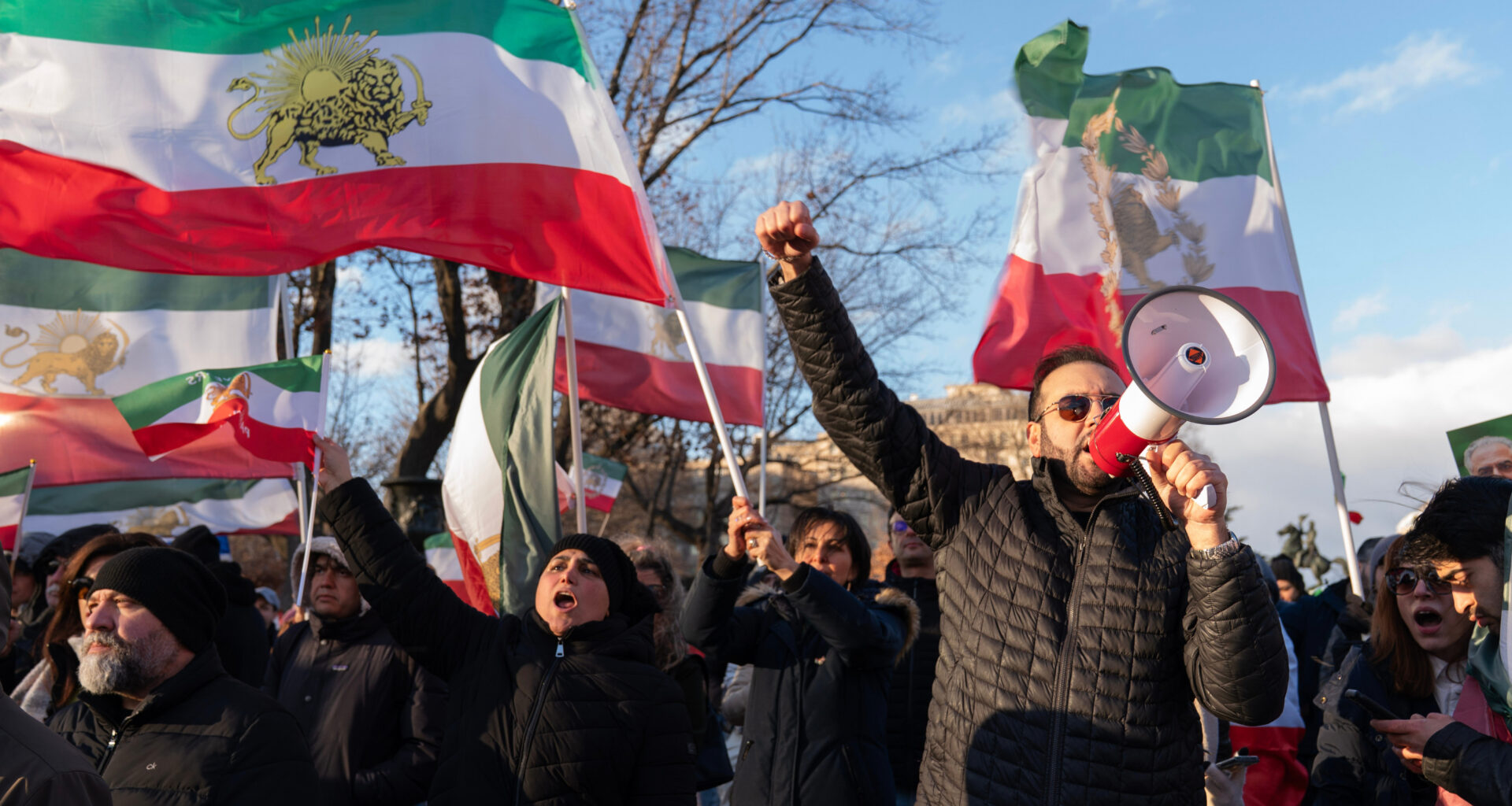
Anti-government protests in Iran are entering their third week, amid a countrywide communications blackout and an increasingly violent crackdown by the Iranian government.
Solidarity demonstrations have emerged around the world, including over the weekend in California, which is home to the largest Iranian diaspora in the country.
People gathered in front of the Roseville Galleria in Placer County to show their support for the Iranian people and call for regime change. Hundreds more protested in Los Angeles, where a U-Haul truck drove through a crowd of demonstrators.
The protests and crackdowns have also led President Donald Trump to threaten military action against the Iranian government, in support of the demonstrations.
Professor Sahar Razavi is the Director of the Iranian and Middle Eastern Studies Center at Sacramento State. She spoke with Insight Host Vicki Gonzalez about the latest protests, different perspectives within the Iranian diaspora, and the complexities over what the country’s future could look like.
This interview has been edited for length and clarity.
Interview highlights
What triggered the current protests that are unfolding in Iran?
In late December, there was a sharp devaluation of the currency, the Iranian Rial, against the dollar. This just capped off a long process of devaluation — inflation has been high, the price of goods has gone up… 72% just in the last year. When the currency drops, it reduces purchasing power dramatically.
In protest of this drop, shopkeepers, merchants closed their shops and walked out. After that happened many groups started to join… first students joined, then other civil rights groups. Then it started to pull in more swathes of society. Now it’s a broad-based uprising with a lot of different interests, and a lot of different visions for the future of Iran.
These protests have grown and expanded in just the matter of a couple weeks. How did that evolve in such a relatively short period of time?
It began in the capital and then within a few days, the more the protests spread and escalated, the more the government pushed back. It was the pushback that really spurred more growth. At the same time we have seen encouragement of the protests from outside forces, including the United States and Israel.
This has a mixed effect on the protesters. There are very strong opinions both inside and outside Iran about what kind of impact that encouragement has had, what kind of role those external forces should play, as well as what kind of outcomes that could have for the movement.
Has there been an evolution in how the Iranian government has responded to the protests and demonstrators over the past several weeks?
Yes. The first couple of days, the most immediate response from the government was relatively restrained. They came out and they said, “we hear you, we understand your concerns. We are also feeling the effects of economic pressures because we are just like you.” They tried very hard to take a conciliatory and understanding tone, and in fact they introduced a subsidy. They wanted to ease the pressure a little bit, but this gesture was kind of too little too late, which we’ve seen before as well. The more protesters escalated their demands, the more of an existential threat the regime perceived to itself, and the more they cracked down.
Another reason I think for the initial reserved tone, compared with the Woman, Life Freedom movement which was extremely significant in 2022… the geopolitical situation in the region has shifted. They had kind of a buffer in their own minds against potential foreign intervention from the United States, Israel and US allies in the region. With Hezbollah and Hamas significantly weakened, the Assad regime completely gone and with Russia bogged down in Ukraine… they were feeling between a rock in a hard place, and that conciliatory gestures were probably safer at that time.
But as protests have escalated I think that they’ve perceived their backs to be against the wall, and that has spurred this sense that they have to crack down in order to prevent the protests from gaining momentum… even though there is a risk now of foreign intervention escalating.
The crackdown has become violent, there’s a communication blackout. When it comes to the estimated number of people killed or arrested, how can we be accurate about those totals?
I think it’s going to take a lot of time for us to get any accurate numbers, if ever. I think we can assume that there have been at least several hundred confirmed deaths, probably closer to a couple of thousand at this point. That’s probably an undercount as well, based on the reports that we have.
A video clip has circulated, both on state media and independent outlets, of hundreds of bodies at the morgue in the hospital in body bags. People were wondering, “why is the state media showing this? This doesn’t seem to fit their narrative.” In fact it serves a very effective purpose for the government because they are trying to deter protesters from joining the demonstrations.
I think we also need to be kind of wary of the function of these kinds of death tolls. Even one is too many. There’s not going to be a threshold below which there’s no justification for any kind of intervention, and above which we have to intervene. There are so many different factors at play.
There is a large Iranian diaspora in California, including the Sacramento region. What should people better understand about Iranians and Iranian Americans who live here?
As far as the breakdown of who supports which kind of outlook, regime or government for a post-Islamic Republic government… the proportions are different in the diaspora than in Iran. I think it’s important that we integrate diaspora voices, but I do believe truly — because Iranians are the ones who are living under those conditions and who have to deal with the consequences of any internal or external upheavals in the region and in their country — we should be centering Iranian voices. Iran is full of very brilliant, inspiring and visionary leaders… many of them in prison. It’s important for us to recognize that Iranians outside of Iran and Iranians inside Iran don’t necessarily always align with what they’re asking for.
That said, I also think it’s important for people outside of Iran to understand that like any country with a robust civil society and a long history of democratic activism, and Iran has an incredibly rich history of movements for democracy going back 125 years, there is a wide array of opinions. There’s not one group outside Iran who may be organizing, leading protests, waving this or that flag that represents all Iranians, whether inside or outside Iran. Iranians should be given the space, inside and outside, to determine for themselves what that society is going to look like, no matter what shape the government takes.
Even though there have been solidarity demonstrations around the world in support of Iranian protesters, including in California, they don’t all have the same message or views of what Iran’s future should be.
Exactly. This might be an unpopular thing to say, but among the factions there’s a small but strong, vocal base of support for the current government in Iran for various reasons. If we want to talk about a democratic vision for a post-Islamic Republic society, we have to also contend with that fact… rather than being in denial about this particular segment existing.
By the same token there are also some folks who would like to dismiss the protests as completely the product of foreign agitation. Unfortunately the Trump administration and the Israeli government have both put out public messages that add fuel to that kind of narrative, which only helps the regime. It muddies the waters in ways that make it very difficult for us to be realistic about a viable path forward.
Again, I would defer to Iranians to make space for themselves to decide what their society should look like. As a member of the Iranian diaspora I have very strong feelings and very strong opinions about what that should be, but I don’t live there and I don’t think that I, or any of us in the diaspora, should really be leading the charge on what that should look like.
President Donald Trump has threatened military action in support of the demonstrations. What interest does he have in Iran today?
The first answer everyone always gives is the oil. But it’s not necessarily that the United States needs Iranian oil — I’m sure it wouldn’t mind — but one of the Trump administration’s top objectives has been to sideline China. China’s growth economically has surpassed the United States growth. The two main sources for China to get their oil cheaply are Venezuela and Iran., so in order to starve China of its cheap oil, it is very beneficial for the United States to cut off its access to Venezuelan oil… and Iran’s number one oil export is to China.
These are things that you have to layer on top of the regional reality, which is that the Trump administration and Saudi Arabia are very close… and Saudi’s biggest rival in the region is Iran.
With your experience, what is the likelihood that the US could intervene again?
If you’d asked me this question two weeks ago, one year ago I would have given a different answer. I think that the 12-day war between Iran and Israel, with the United States involvement, over the summer really shifted a lot of things. The likelihood of intervention right now is higher than it was a week ago, but I think the Trump administration and Iran have both expressed that they would prefer a diplomatic solution over a military intervention.
I think military intervention is possible, it’s certainly not off the table, but more likely we will see targeted covert operations and cyber attacks to cripple infrastructure before we see a direct military confrontation. Confronting Iran has been a very last resort for successive US presidential administrations going back 20 years, because they know that it would be difficult.
Demonstrations and protests have happened in Iran for decades, but given the weakening of allied support, do you think this latest uprising could successfully overthrow the Iranian government?
As an academic I can tell you what’s most likely based on my study of the Iranian Revolution and comparative revolutions across the region and the world. I can tell you what are the next next steps that are possible and likely.
What we have seen thus far, to my mind, points to a more likely scenario of compromise. An uneasy entente rather than a full-blow collapse of the current regime, and that’s for a couple of reasons. We have not yet seen mass defections of the military. Another thing we haven’t seen is the fracturing of the regime itself. There are factions inside Iranian politics, especially in the elites. But the terms of the debate are extremely circumscribed, they’re very constrained between reformists and hardliners.
If the regime sees the Islamic Republic’s survival as only possible if they concede some ground to the reformists, then I think they’ll do that before they make a last stand. We’ll have to see a couple of other things shift before we can say that regime change is imminent and I haven’t seen those yet, although they’re not impossible.