
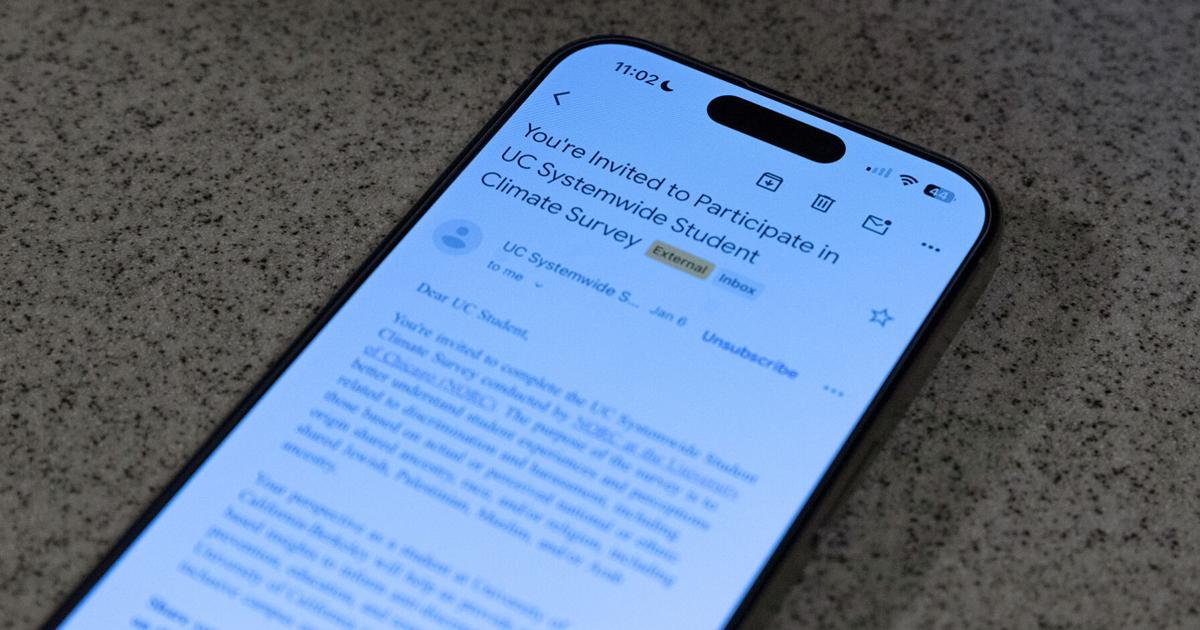
UC students are being asked to voluntarily complete a survey regarding their perception of discrimination on campus as a requirement of a December 2024 resolution between the federal government and the UC system.
Launched in partnership with NORC at the University of Chicago, an independent research organization, the survey is an effort to “better understand student experiences and perceptions related to discrimination and harassment, including those based on actual or perceived national or ethnic origin, shared ancestry, and/or religion, including shared Jewish, Palestinian, Muslim, and/or Arab ancestry,” according to a campuswide message sent Nov. 5, 2025.
UC Berkeley students received a voluntary UC Systemwide Student Climate Survey, which was sent to students across all 10 UC campuses.
According to NORC’s website, the survey is required by the UC’s Voluntary Resolution Agreement with the U.S. Department of Education’s Office for Civil Rights, or OCR, which promises to settle complaints of discrimination based on actual or perceived national origin filed with the OCR.
The agreement arose when the OCR received multiple complaints alleging that five UC campuses, not including UC Berkeley, failed to address complaints of discrimination and bias against Jewish, Israeli, Muslim, Arab and pro-Palestinian students.
The complaints originate from protests and advocacy regarding the genocide in Gaza and the Oct. 7, 2023, attack, as well as individual alleged instances of discrimination. A September 2025 United Nations legal analysis found that Israel is committing genocide against Palestinians in Gaza.
The survey will “help UC identify needed support resources; strengthen anti-discrimination training, policies, and procedures; and foster more inclusive campus environments,” according to the email sent to students. The email additionally noted the survey will investigate students’ sense of safety and belonging regarding other personal identities, as well as their cultural and political expression.
Participation in this survey is confidential, meaning that names and demographic characteristics can be linked to responses, according to the campuswide message. Zaid Yousef, a campus law student and Students for Justice in Palestine, or SJP, media liaison, said opting for a confidential, as opposed to an anonymous, survey only exacerbates existing mistrust many community members have in the survey process and the UC.
Yousef added in an email that he chose to take the survey, though he understands and has spoken to dozens of students who have chosen not to because of privacy concerns, as well as the “complicity of the UC system in creating hostile environments for Palestinian, Arab, and Muslim students.”
“I have very little trust in the UC system,” Yousef said in the email. “Despite this, I realize that this survey will likely have real-world impacts on the Palestinian, Arab, and Muslim communities, as well as on campus activism. As such, I believe the choice that will minimize harm to these communities is taking the survey to prevent its monopolization by pro-genocide voices.”
Campus previously turned over the personal information of roughly 160 students, staff and faculty to the OCR. However, the campus email assures students that findings will be presented in ways that protect participants from being identified.
To do so, findings will be reported in aggregate, the email said, summarizing results for particular groups, or withheld altogether when respondent groups are small enough that individuals could potentially be identified.
The survey’s project director, Erin Knepler, said the UC Office of the President, or UCOP, asked NORC not to respond to The Daily Californian’s questions about the survey’s data privacy.
According to an Instagram post from SJP and other campus groups, none of the organizational representatives of the Arab, Muslim or Palestinian communities on campus were consulted in the development of the survey. The Daily Cal reached out to several Jewish and Israeli student groups and has not received a response as of press time.
UCOP spokesperson Stett Holbrook confirmed no student groups were consulted, instead stating they turned to experts within Graduate, Undergraduate and Equity Affairs, Institutional Research and Academic Planning, and NORC.
“It is not far-fetched to anticipate that the results of this survey may be similarly released in the future,” Yousef said in the email, in reference to UC Berkeley releasing 160 names to the federal government in its antisemitism investigation. “When answering the survey questions, I will be forced to consider the very real possibility that a federal investigator may one day read my answers, and adjust them accordingly.”