
Every San Francisco politician has to pretend to know how to solve the homelessness crisis. Now you can too!
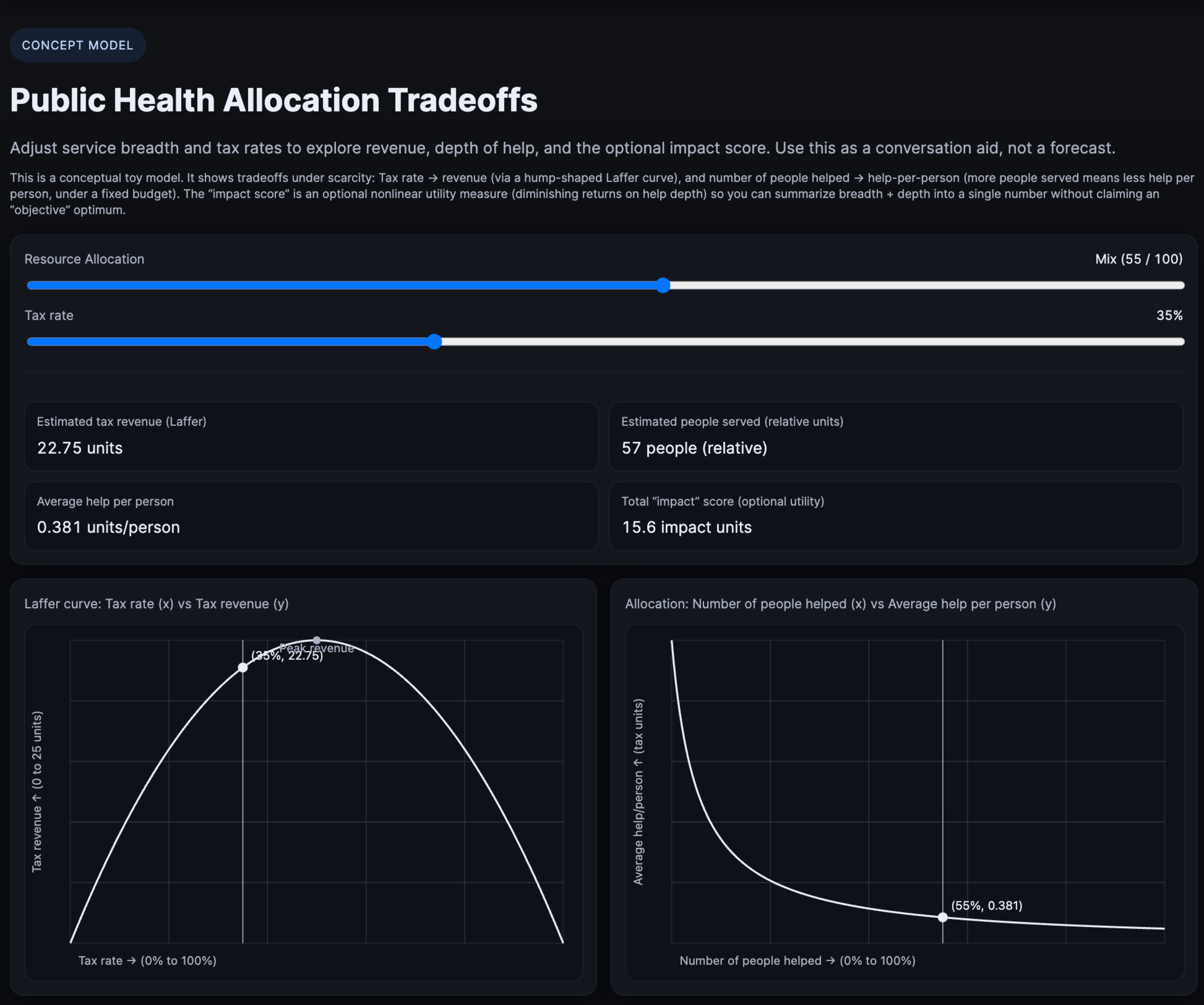
A new website created by Homelessness Oversight Commission member Sharky Laguana allows users to turn the dials on inputs like tax rate, resource allocation, and annual housing growth rate to see how each would affect the city. The website has two interactive models, one focused on permanent supportive housing (opens in new tab) and one on public health (opens in new tab).
Laguana said the site was inspired by The Standard’s reporting on the challenges of escaping homelessness in California. He used data from the Department of Homelessness and Supportive Housing but emphasized that the models are conceptual, not skeleton keys to a solution. He described his simulation of permanent supportive housing as “a gross simplification to illustrate basic concepts.”
That simulation displays the relationship between the per-unit cost of operating permanent supportive housing, the number of units added per year, the monthly flow of people into those units, and the average length of stay.
As you would expect, shorter stays and lower inflow lead to a lower occupancy rate, meaning more units are available for people on the streets.
 Sharky Laguana built the interactive tool. | Source: housing-sim.com
The public health model has a related conclusion: The more people SF helps with its limited budget, the less help each person gets. For example, if the city serves 10 people, each receives 2.283 “units of help.” If the city helps 100 people, each receives only 0.215 units. Increasing the tax rate — and, therefore, the budget — means the city can help more people.
Laguana has an analogy: “Imagine you have a pizza, and you’ve got 10 kids who are all very hungry.”
You can see where he’s going. Either you can have a few kids who are satiated and the rest are starving, or you can give all 10 a fraction of a slice. One option is to order more pizza, and indeed, San Francisco’s homelessness budget trended upward for years until 2025.
But we also keep adding kids. In 2024, the Department of Homelessness and Supportive Housing estimated (opens in new tab) that three people become homeless for every person the agency puts into housing. Meanwhile, the number of unhoused people has hovered around 8,000 since 2019, according to the city’s controversial biennial headcounts. That number may stay flat because some people get housing on their own and some leave San Francisco. Laguana says the city has been able to tread water because its budget increased with the inflow of new homeless people, but that figure is now set to decline.
The budget for the Department of Homelessness and Supportive Housing fell from nearly $850 million in fiscal 2024-25 to $786 million in fiscal 2025-26 and is on track to lose $80 million (opens in new tab) for fiscal 2026-27. These cuts make it imperative that San Francisco figure out how to use its remaining resources effectively.
In this new fiscal reality, Laguana identifies what he believes should be the city’s two main policy priorities. One is preventing people from falling into homelessness in the first place. The other is cycling more people through existing supportive housing.
“If we help people become self-sustaining and leave the permanent supportive housing portion of the response system, then we are also helping ourselves by freeing up resources to help other people,” Laguana said.
Laguana’s fellow commissioner Whit Guerrero agreed on the first effort but pushed back on the idea that SF should boost its level of churn through permanent supportive housing. He had not yet used Laguana’s tool when The Standard called.
“PSH is for people who are so disabled, so mentally unwell,” Guerrero said. “Those are the people that you don’t want to see on the street, because you feel unsafe.”
Those who are more eligible to graduate from reliance on city funds, Guerrero continued, are people in short-term treatment who are more likely to gain employment and get their own apartments.
But the principle of the pizza resonated with Guerrero, who has run a homeless shelter and a transitional home. He emphasized the importance of emotional support and ongoing relationships between caseworkers and people trying to get on their feet. Often, that requires investing a greater amount of time into fewer people.
His broader point is that escaping homelessness is an individual journey, not a math problem.
“We have self-driving cars,” Guerrero said. “If we could have solved homelessness with data, we would have done that.”
Guerrero suggests more specialized care, perhaps administered by small nonprofits. (Trying to offer care at a mass scale is “a fast way to burn cash without results,” he said.)
Imagine, instead of one big pizza, a budget split across foods tailored to specific diets. There may not be enough to keep everyone completely full, but it’s more efficient than the system we have now.