
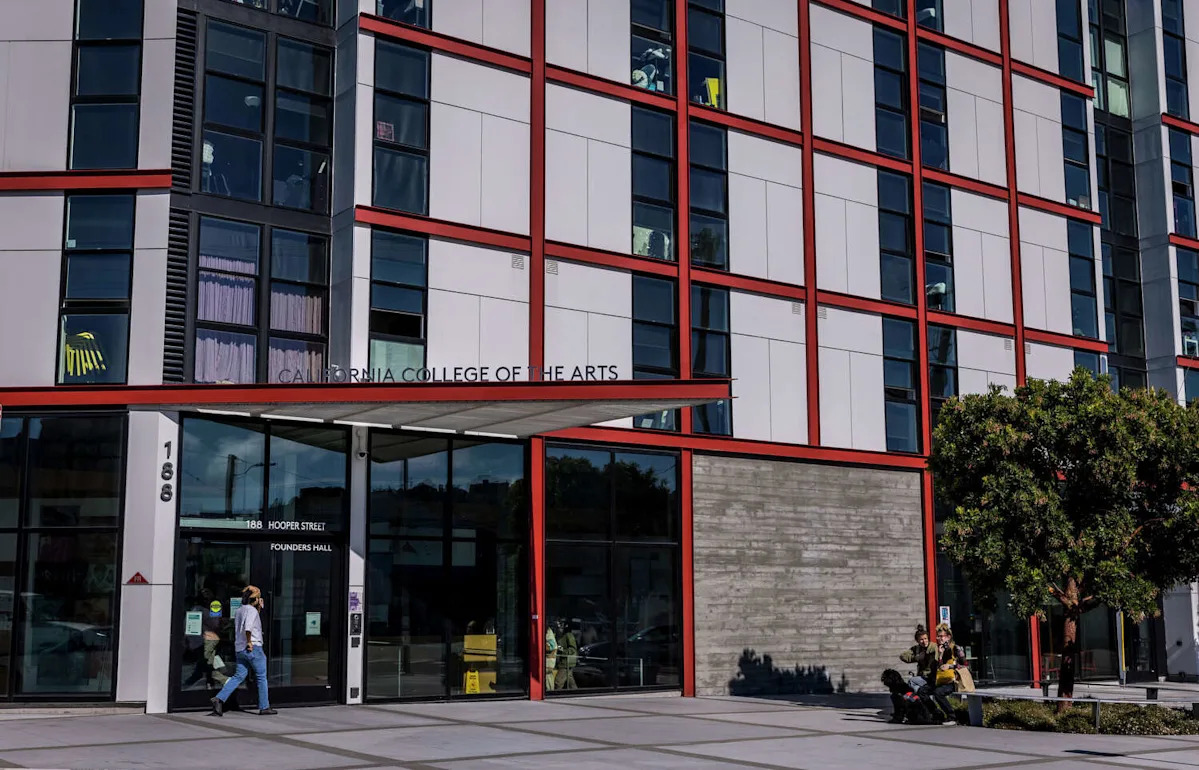
Though San Francisco’s mayor urged major academic institutions to open a campus in the city’s faltering downtown, Vanderbilt University chose instead a fast-growing pocket of the city a mile or so to the south.
The prestigious, Nashville-based research university confirmed Tuesday that it has snapped up the 4.5-acre campus of the California College of the Arts campus in Showplace Square, the city’s design district, which sits on the edge of the Mission, Potrero Hill and Mission Bay neighborhoods. The announcement coincided with the news that CCA will be closing when it transfers its campus to Vanderbilt in 2027.
The deal was celebrated as a win for the city: The art school had faced financial struggles for years, and the transaction offset a “gut punch of an institution like CCA going away” and its facilities sitting “vacant,” said downtown Supervisor Matt Dorsey.
“This feels to me like it was a great save,” Dorsey told the Chronicle.
For Mayor Daniel Lurie, Vanderbilt’s deal represents the successful culmination of his office’s nearly year-long hustle to draw a major university and thousands of students to San Francisco.
But there is a problem: Vanderbilt’s new campus is not downtown as Lurie hoped. Nor is it in the struggling Mid-Market neighborhood, where office buildings and retail spaces remain empty and vacancy continues to rise even as other parts of the city thrive.
Instead, the university will be piggybacking on the success of a part of the city that has already come roaring back from the pandemic, with UCSF buying buildings, Chase Center drawing millions to concerts and sporting events, AI companies gobbling up space and restaurants opening from Mission Rock to Thrive City to the brick warehouses along Third Street.
Since Lurie took office last year, his team has touted plans to reinvigorate downtown – where office vacancy has hovered at historic highs for nearly six years, the storefronts of major retailers sit dark and a 1.5 million-square-foot mall is nearly vacant – with a national university that would fill downtown’s streets with students who would “live, work and play” in the area. Lurie and his predecessor, former Mayor London Breed, pushed tax breaks and economic incentives to lure investors willing to convert vacant office buildings to housing, but so far not a single conversion project has moved forward.
More recently, city leaders were hopeful that students in need of housing near their downtown campus could be a catalyst.
“One of the wonderful components of a university is that it reinvigorates a neighborhood because people live, work, play and learn right there in that area,” Ned Segal, Lurie’s chief of housing and economic development, said in October.
At the time, Vanderbilt was confirmed to be in talks to take over the Chronicle’s longtime headquarters at 5th and Mission streets in SoMa, an area in dire need of resurrection. New York-based Hearst Corp. owns the property as well as the Chronicle and SFGATE, which is also headquartered at 901 Mission.
That plan appears to have changed sometime in the last month, according to a local real estate insider who has been tracking Vanderbilt’s San Francisco campus expansion and described the university’s shift from a downtown location to Showplace Square as unexpected.
“I know how much time the owners of the Chronicle building spent with Vanderbilt…that whole thing is really shocking,” said the individual, who requested anonymity to preserve business relations. The source described the 5th and Mission area as “incredible from a location perspective” – but noted that its battle with “perceived safety issues” continues.
“The comment that tenants in the area have is ‘it isn’t safe for a 22-year-old girl right out of college to go from the BART station to the building…with a laptop in a backpack,'” the source said. “But, there has been some improvement.”
University of the Pacific’s school of dentistry is located across Fifth Street from the Chronicle building.
A spokesperson for Vanderbilt confirmed that the two institutions “entered into a definitive agreement earlier this month.” The terms of the deal, including what Vanderbilt paid for CCA’s campus, are not known.
Responding to questions about whether safety downtown was a factor in Vanderbilt’s site selection, Chancellor Daniel Diermeier said Tuesday that the opportunity to move into a “ready-made campus” in Potrero Hill was too good to pass up.
“It’s not the neighborhood so much,” he said about the SoMa area.
Diermeier said that Vanderbilt looked at “different opportunities” that “would have been possibilities had the opportunity to work with CCA not arisen.”
“There was a moment that they had to make a decision to wind down their operations,” Diermeier said. “It was something that made it much easier for us to be able to operate on a shorter timeline. If you have to renovate a building or something like that, it takes longer and is more expensive.”
Diermeier confirmed that the Chronicle’s building was a serious candidate. Hearst announced plans last year to relocate both publications into a building it purchased at 450 Sansome St. The move is now slated for the spring.
Diermeier said Vanderbilt now needs to raise the funds for its Showplace Square campus and is still working out the programming, but said it will have a technology as well as a creative focus.
As a “residential college,” Vanderbilt will fill the 750 existing housing units that are currently part of CCA’s campus with up to 1,000 of its undergraduate students, Diermeier said.
“We have learned that students love to be on campus the first two years and by the fourth year, they like to spread their wings a little bit,” Diermeier said.
Colin Yasukochi, research directorfor real estate firm CBRE, said that downtown could have used an institution like Vanderbilt to activate it. But he said the Third Street corridor near Vanderbilt’s future campus is “emerging as a premiere education corridor,” with UCSF’s sprawling campus already located nearby.
“That’s a newer part of the city and it’s gained a lot of prominence among tech and AI companies. With UCSF continuing to grow there, and adding another prominent education institution to that corridor … it will still end up being a pretty big boost for the city.”
The area around Fifth and Mission has been dealt one blow after another since the pandemic. Once the centerpiece of a much-celebrated 5M redevelopment, the intersection now boosts an empty mall on the verge of closing. It has a newly constructed office building at 415 Minna that is 90% empty. A 400-unit condo building slated to be built to the south of the Chronicle building on Fifth Street is stalled. The historic Chronicle building, with its signature clock tower, will be mostly unoccupied come spring.
Developer Eric Tao, who’s built about 1,000 units and a hotel in the Mid-Market and Central SoMa neighborhoods, said “it’s really disappointing that (the Vanderbilt campus) is not happening at 5M.”
“Right now Mid-Market is hurting – apartments, condo sales, leasing. The hotel is not doing great,” he said, referring to the Timbre Hotel, which he helped build. “The recovery has not spread to Mid-Market yet. We are nowhere near pre-pandemic levels.”
David Seward, CFO of UC College of the Law, which opened a 656 bed housing complex in the Tenderloin in 2024, said the CCA deal is welcome even though a 5M campus would have helped the “academic village” his school is building a few blocks away.
“We are just thrilled they are coming to San Francisco,” he said. “They are coming in with 1,000 full-time students and it makes a lot of sense for them to acquire a turn-key operation.”
Dorsey, the SoMa supervisor, said that he understands that Vanderbilt had to do what is best for its bottom line.
“Initially I liked the idea of them being in the Chronicle building. I would really love something for the mall,” he said. “We also have to defer to the institution about what’s best for them.”
But other city leaders were reluctant to comment on whether there are plans for other academic institutions downtown. The Chronicle asked Segal, the city’s head of housing and economic development, at Tuesday’s news conference about whether the effort to resurrect downtown with another university of Vanderbilt’s caliber continues, but did not receive a response.
Charles Lutvak, a spokesperson for Lurie, did not confirm whether the city is in active talks with other university partners.
“We would be happy to have more academic partners,” he said. “If we have another university to announce, we will do it.”
This article originally published at Booming S.F. neighborhood will be home to new college campus – a blow for downtown.