
This article is adapted from an episode of our podcast, “Civic.” Click the audio player below to hear the full story.
A four-day festival of solo performances by formerly incarcerated people is coming to Berkeley Repertory Theatre’s main stage this week. The Jan. 15-18 festival culminates the theater’s first-of-its-kind partnership with the Formerly Incarcerated People’s Performance Project, a Bay Area theater company working to expand public understanding of its members’ life experiences.
“I didn’t even know I had the dream until I got here,” said Tony Cyprien, a performer with the group. “It’s literally a dream come true.”
Berkeley Rep’s shows have received international recognition. Many productions have advanced to Broadway, and the theater has won eight Tony Awards. Cyprien first connected with Berkeley Rep as an audience member, and then as a student in an acting workshop. He never thought he would be performing on the main stage.
Establishing the project
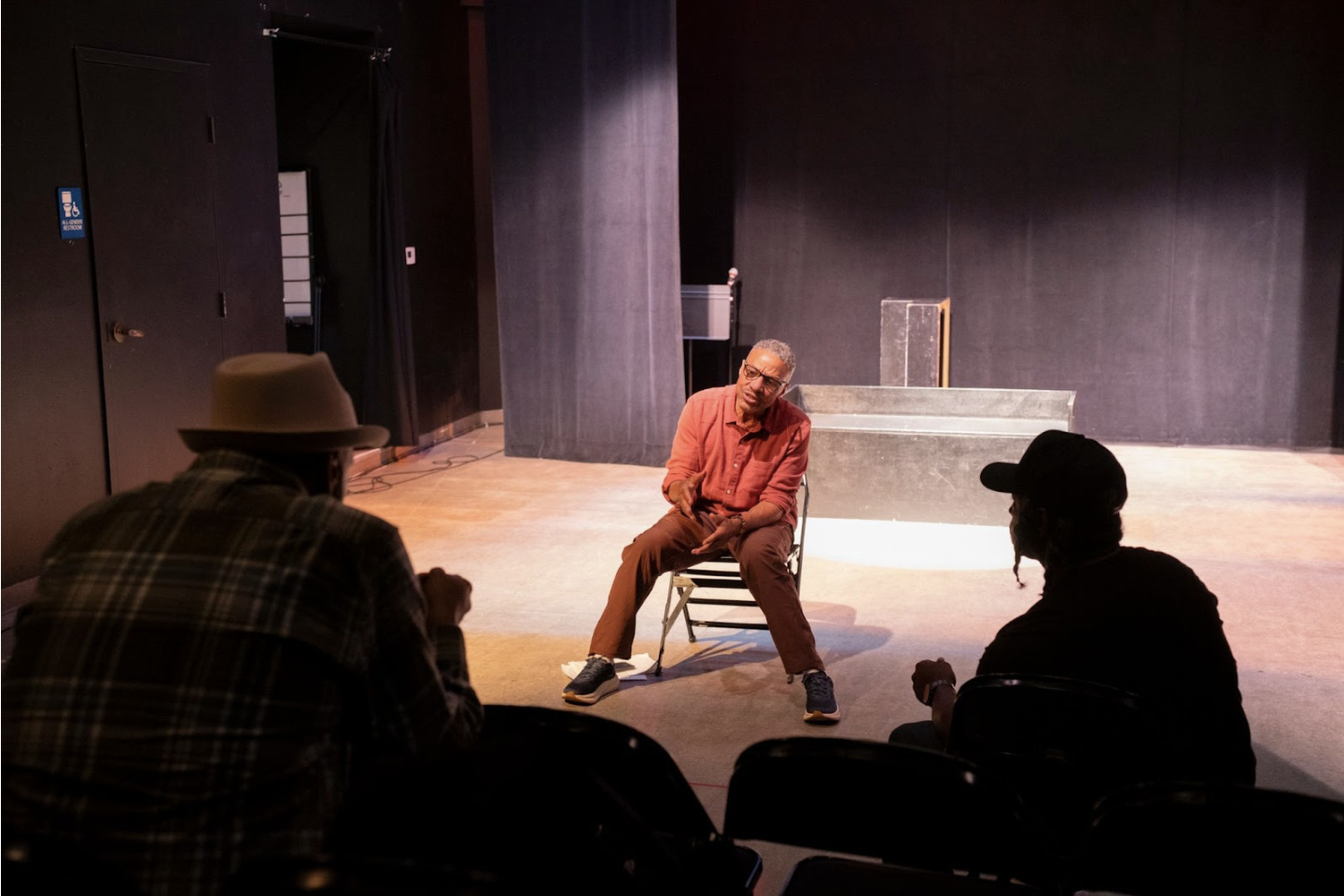
Mark Kenward, co-founder and director of the Formerly Incarcerated People’s Performance Project, started the company six years ago after years of directing solo performances around the Bay Area.
“It’s just some of the most powerful experiences I’ve ever had in the theater,” Kenward said about rehearsing with the project’s performers.
This episode of “Civic” profiles the Formerly Incarcerated People’s Performance Project, a Bay Area theater company working to expand public understanding of its members’ life experiences.
Kenward said he and the performers hope their stories go beyond entertainment and can dispel stereotypes about people leaving the criminal justice system.
“The way that formerly incarcerated people are depicted in the media, I believe, is sensationalized and superficial,” said Al Sasser, one of the organization’s original performers.
Some participants, like Gerald Cypert, center their work around topics most people can relate to, regardless of their involvement with the carceral system.
For Cypert, a key theme is fatherhood. “It’s not just all about the hard-guy stuff on the yard,” he said. “It’s about the heart, because we all care about our kids.”
Systemic injustices
Other performers highlight difficulties they encountered navigating the legal system and the conditions of California prisons.
Anthony Michael pleaded guilty to felony criminal threat when he was 21 years old. When he was convicted for subsequent offenses, his initial sentence snowballed due to California’s “three strikes” law. Adopted in 1994, the mandatory-sentencing law lengthens punishment for people with felony criminal backgrounds, and includes a minimum 25-years-to-life sentence for three-time offenders.
Michael reflected on the effect of the three strikes law in his performance. “This law only makes sense when dealing with people who are calm and rational,” he said. “And at 21, I was neither of those things.”
The three strikes law is not unique to California, and was initiated as part of a national tough-on-crime push under President Bill Clinton. While two-dozen states passed similar policies between 1993 and 1995, California’s law is considered the most stringent and affects the most people.
From 1994 to 2006, the California prison population grew steadily, and prisons became severely overcrowded. Critics cited the three strikes law, which lengthened the sentences of more than one-third of incarcerated people, especially for Black Californians. Resentencing policies and other measures have reduced the prison population in California considerably in recent years — it’s now at its lowest point in 30 years — but prisons are still overcrowded.
Cyprien and Scott Schell both highlight the effects of this overcrowding in their performances for their Formerly Incarcerated People’s Performance Project.
Schell said he was shocked by the living conditions when he first arrived in prison. “Unsanitary is an understatement,” he said. “There’s feces on the wall, dust on top of ducts, stains that would need to be carbon dated.”
Cyprien’s favorite character in his performance is his personification of “close quarter disease,” representing the sicknesses that spread rapidly in a cramped prison environment. He said he sometimes laughs about the term now, but noted that unsanitary conditions and neglectful health care caused him to lose a friend in prison.
“At this time in the mid-’90s, from like ’96 to maybe ’98, inmates were dying for things that were preventable,” he said. “If a person gives you early warning signs that they’re having chest pains, you’re supposed to attend to that person and see what that person needs. But the prison system was — no, everybody was a malingerer.”
Cyprien said his friend Jackie died due to inadequate care. In response, Cyprien and others organized a peaceful protest demanding reform to the prison health care system.
Cyprien said the prison eventually listened. But changes were short-lived: “That lasted for about 18 months,” he said. “And then it was back to business as usual.”
People who are incarcerated are not the only ones expressing concern about prison conditions. In September, California Attorney General Rob Bonta sued Los Angeles County over jail conditions, citing broken plumbing, rodent infestations and lack of basic hygiene supplies.
Performance facilitates reentry
Formerly incarcerated people often encounter challenges when they rejoin society. Some find making everyday decisions overwhelming. Others have trouble getting jobs, especially those who were incarcerated at a young age and lack job skills.
Performer Chirstina Anistad hasn’t been incarcerated since she was 21, and is now 47 working as a journalist at KPFA Radio in Berkeley. To this day, she said she often thinks about what she experienced in jail.
“Big traumatic experiences — and being incarcerated is a traumatic experience — those things just don’t go away,” she said.
Community reentry programs that support formerly incarcerated people with things like housing, substance-use disorder treatment and job opportunities, can help with the difficult transition. These programs have proven to reduce recidivism rates and increase employment prospects for formerly incarcerated people.
Joseph Bell Jr. served 24 years, 10 months, in prison on a falsified felony murder charge and was released in 2020. He now works for the Reentry Engagement Program at the Felton Institute in San Francisco.
For Bell, emotional support was a crucial part of his transition. “I got a lot of spiritual support, a lot of emotional support,” he said. “And I think that’s what’s lacking for a lot of individuals inside that are incarcerated.”
In his work today, Bell has observed that expression through art can help facilitate hope.
“Once they can feed their creativity, it makes them feel better,” he said, adding that making art can feel empowering.” It changes people as a whole and lets them feel the humanity of somebody that shouldn’t be defined by a bad decision that they made.”
To purchase tickets and learn more about the Formerly Incarcerated People’s Performance Project’s four-day festival at Berkeley Rep, see fippp.org/fipppfestival.
Related