
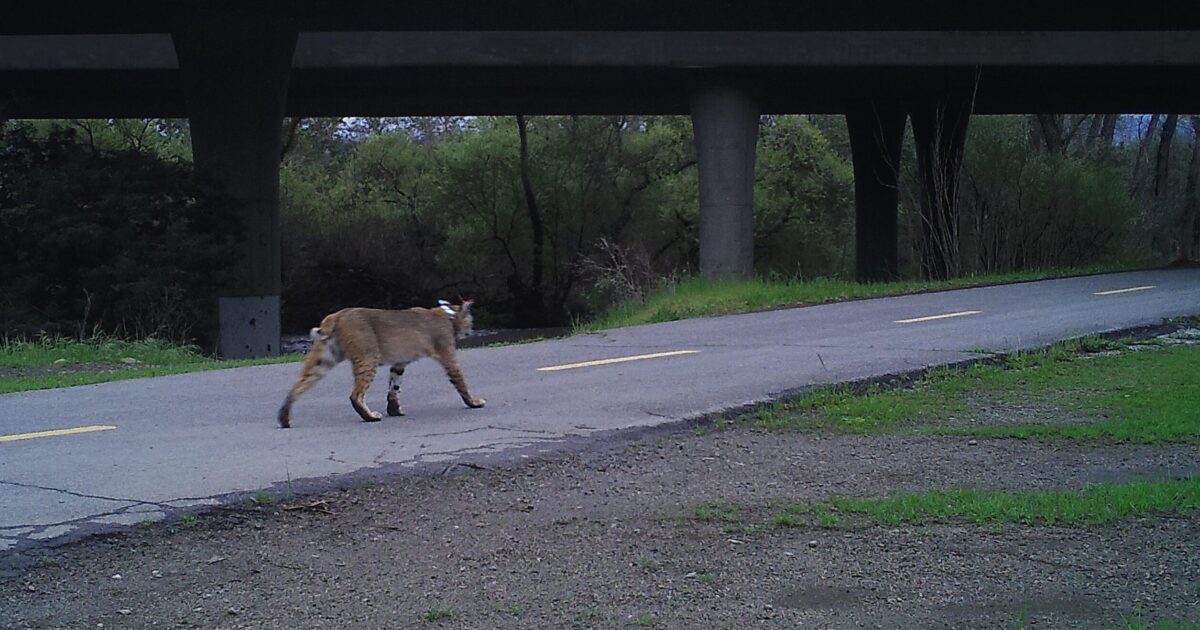
A land preservation nonprofit and a public transit agency in Santa Clara County are creating wildlife crossings to protect animals and motorists along Coyote Valley’s busiest corridor.
In response to wildlife-vehicle collisions, Peninsula Open Space Trust (POST), in partnership with VTA, is constructing underpasses for animals at key points along Highway 101, Monterey Road and Union Pacific Railroad tracks.
Coyote Valley is critical for wildlife connectivity between the Santa Cruz and Diablo mountain ranges for species such as mountain lions, bobcats and American badgers. After POST partnered with the Santa Clara Valley Open Space Authority to protect land on both sides of the roadway barriers, it focused on wildlife crossings to complete connectivity between the mountain ranges.
“It’s not possible without the land protection, without the habitat restoration, without the wildlife crossings,” Taylor Jang, senior land manager for Peninsula Open Space Trust, told San José Spotlight. “It’s one small part of a very integrated project, with each part depending on the other for its success.”
Construction costs are estimated between $80 million to $90 million. The project is slated to start sometime in 2029-30 and take about two and a half years to complete. Funding comes from POST, San Jose, Caltrans, federal and state grants and private donors. The city contributed $100,000 to the project.
Coyote Valley has received more than $3.1 billion in public and private investment for land conservation.
The first wildlife crossing will be constructed at the intersection of Fisher Creek and Monterey Road. The conceptual dimensions for the Monterey Road underpass are up to 100 feet wide and 15 feet high. Fencing will direct wildlife toward the crossing structure, which will include tunnels, vegetation, rocks and a combination of wet and dry conditions to facilitate animals.
“There are currently more than 1,500 wildlife crossing structures in 43 states, including California,” Jennifer Norris, executive director of the California Wildlife Conservation Board, said in a statement. “We must create safe passages for their survival and ours. Restoring a functional wildlife linkage in Coyote Valley will help to reduce the regional impacts of a changing climate, preserve the biodiversity of the greater Bay Area and prevent the local extinction of these species.”
Wildlife crossing structures paired with wildlife exclusionary fencing results in an 80% to 90% reduction in wildlife-vehicle collisions, if fencing is designed correctly and maintained, Jang said.
“It’s an exciting project right outside the city of San Jose’s doorstep,” Jang said. “Investing in Coyote Valley as a conservation priority has multiple benefits for wildlife, for people, for flood control and climate resiliency over the long term.”
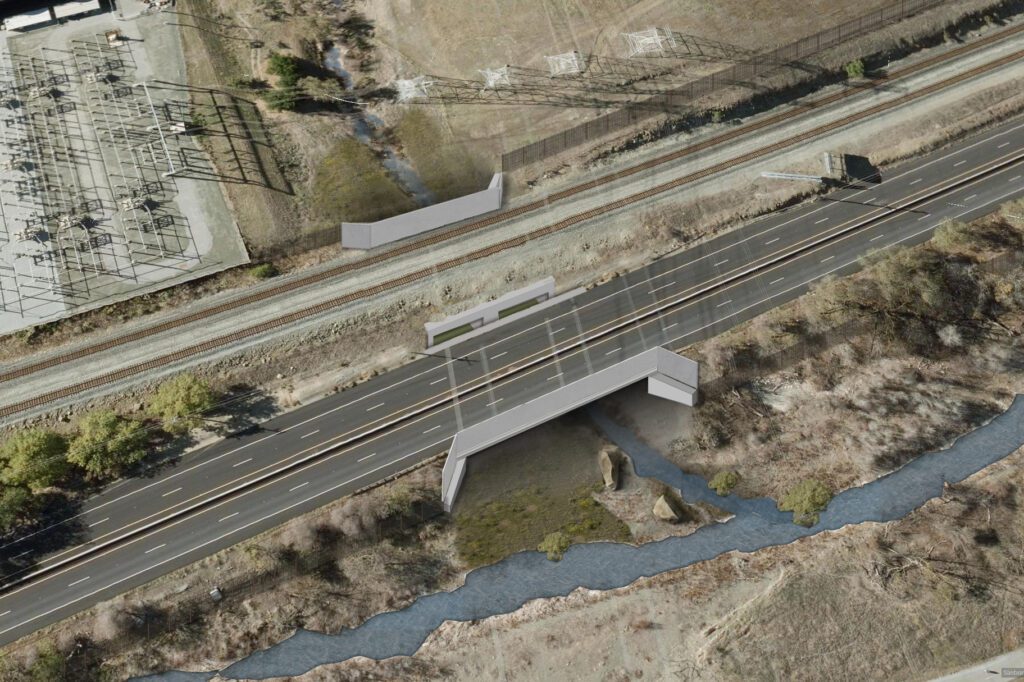 The first wildlife crossing project will be constructed at the intersection of Fisher Creek and Monterey Road. Image courtesy of Peninsula Open Space Trust.
Alice Kaufman, policy and advocacy director for Green Foothills, said the wildlife crossings are important for traffic safety as well as protecting wildlife.
“If a car hits an animal, that can cause harm to property or cause accidents where people can get hurt,” she told San José Spotlight. “This is a great investment and one that’s worthwhile.”
Kaufman said protecting isolated pieces of wildlife habitat isn’t enough to preserve biodiversity.
“They need to be able to move, to roam, to be able to migrate,” she said. “Larger animals like mountain lions need to be able to move for miles and miles to find new territory, to find mates. So, these kinds of wildlife crossings are critical to ensure the continued survival of animals in our region.”
Coyote Valley is an area of statewide significance, Helen Chapman, prior chairperson of the Santa Clara Valley Open Space Authority, said.
“I’m pleased to see so many partners coming forward,” she told San José Spotlight. “Sometimes we look at the negative side of government. This is a story where everybody’s coming together for the greater good.”
VTA provided the partnership needed to realize Midpeninsula Regional Open Space District’s vision for the wildlife and trail crossings on Highway 17.
On the Coyote Valley wildlife crossing project, VTA will be responsible for designing, managing and building the crossing structures and coordinating agreements with Caltrans, Union Pacific Railroad and local and state agencies.
Zahir Gulzadah is the deputy director for the VTA Highway Program. He lives in the Coyote Valley area and is personally invested in the wildlife crossings.
“This is going to be a wonderful project, not just for the wildlife, but for the community,” he told San José Spotlight. “It will provide real connectivity through here and allows wildlife to flourish in this area.”
Contact Lorraine Gabbert at [email protected].