
What’s at stake?
The coalition aims to secure at least 22,000 signatures from Fresno County residents between now and April in order to qualify the Measure C renewal plan for the November 2026 ballot — the last opportunity to put the measure back in front of voters before it expires.
The years-long effort to find consensus on fixing Fresno County’s roads has taken a new turn.
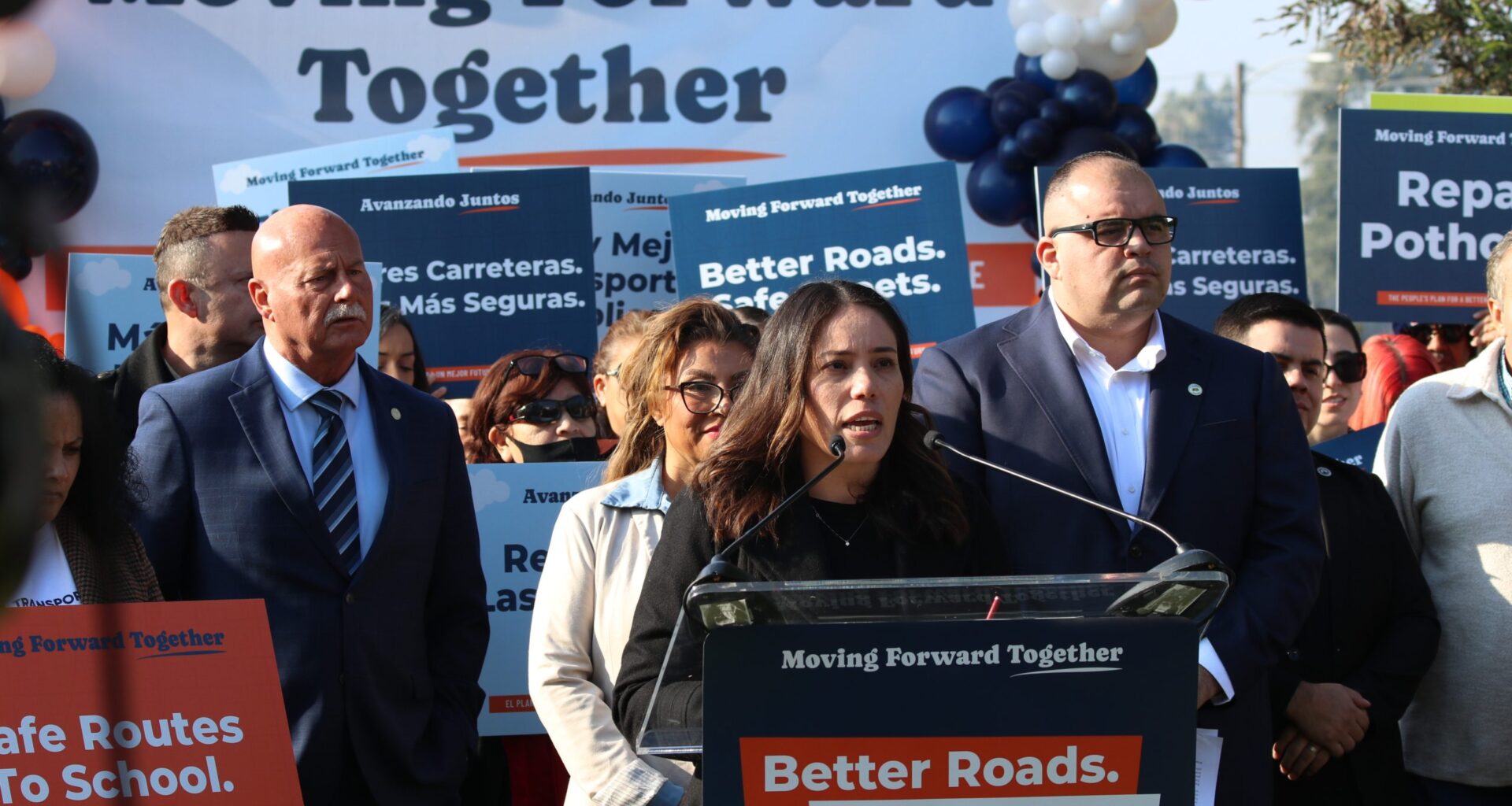
A diverse coalition of mayors, city councilmembers and advocates from Fresno, Clovis and the county’s west side gathered Wednesday morning along a fractured road behind Bulldog Stadium to announce their intentions to collect thousands of signatures from residents over the coming months to qualify a renewal of the county’s transportation sales tax, Measure C, for the November ballot.
“In the next week, we intend to formally file a citizen-led effort to qualify a transportation measure on the November 2026 ballot,” said Veronica Garibay, a leader with the Transportation for All community coalition working toward Measure C’s renewal. “Once we qualify the measure, a transportation plan that was created by all of us — by the people standing behind me and the people that aren’t here today — will be brought directly to the voters.”
Measure C is Fresno County’s half-cent sales tax that residents have been paying for since 1986. It’s set to expire in June 2027.
County leaders and transportation equity advocates have been debating for four years on the best vision for the next generation of regional transportation spending, after the last formal effort failed in 2022.
The coalition — and the plan they’re backing — represents a major shift in transportation policy for Fresno County, adopting a “fix-it-first” mentality to roads, along with a more optimistic approach to public transit.
But the group’s main obstacle — besides now convincing over 22,000 registered voters to sign a petition to place their renewal plan on the November ballot — has been the Fresno County Board of Supervisors.
After a months-long effort consisting of community meetings, surveys and tense debates by a steering committee, a majority of the county’s mayors in December overrode the opposition of a county supervisor and a handful of mayors at the Fresno Council of Governments to greenlight a plan that accelerates investments in local roads and transit.
Supervisors Buddy Mendes and Garry Bredefeld have both vocally pushed to scrap the favored plan, highlighting an alternative pushed by former county transportation leaders that would significantly reduce public transit funding in favor of more money for county road and freeway expansions.
About 65% of funds in the new plan would be spent to fix local roads — a significant increase from past versions of Measure C. But supervisors like Bredefeld want at least 75 to 80% allocated to local roads, plus even more specifically designated for regional roads outside of the cities.
“I’m not supportive of the plan because there’s not enough money being spent to repair streets,” Bredefeld said in an interview Wednesday. “They spend significant amounts of money on public transportation, and the plan essentially is to get people out of their cars and to force them to ride buses, bicycles or electric scooters. This is simply unacceptable to me, as somebody who knows my constituents want their roads fixed.”
Proponents of the renewal plan had asked that the Board of Supervisors put the plan up for a vote at a meeting in early January to gauge their level of support. But Bredefeld, the board’s new chair, declined to add it.
“I said very clearly, the county doesn’t take orders from the COG,” he said. “The process, typically, is that it goes before all the 15 cities — all the city councils have to vote on this — and the county would typically go last. They were insisting the county go first, and that was unacceptable.”
And despite an eleventh-hour plea from Bredefeld calling for the mayors of Fresno and Clovis to meet with the county to hash out a new deal at a special Jan. 7 Fresno Council of Governments meeting, the mayoral majority was resolute that the county missed their opportunity to negotiate as the steering committee’s work concluded in November.
“The supervisors have failed to engage in the preservation and the renewal of Measure C,” said Councilmember Miguel Arias, “and left the community no other option but to pursue its own initiative with a bottom-to-top process, one that focuses on local roads and local communities.”
Both Mendes and Bredefeld disputed Arias’ characterization of recent events Wednesday, saying the coalition and mayors refused to negotiate.
“It’s pretty hard to negotiate with people when they don’t want to negotiate,” Mendes said.
Without a majority of supervisors in support, the mayoral majority’s plan couldn’t get on the ballot through official channels. So they voted, in the messy and contentious special meeting earlier this month, to officially end the government-sponsored approach to renewing Measure C, which would have required a supermajority, or two-thirds of voters, of support at the ballot box in order to pass.
If the new transportation plan gets enough signatures to qualify for the ballot, it just needs a simple majority of voters — 50% plus one — to pass.
Mayor Jerry Dyer, one of several mayors speaking in support of the citizen-led effort Wednesday, said that his preference would’ve been to follow official channels to get Measure C renewal on the ballot until it became clear in recent weeks that that was unlikely.
“I don’t think we can wait around for another jurisdiction to decide what they’re going to do. I think we take matters into our own hands, and that’s what you’re seeing here: a citizen-led initiative,” Dyer said, “people saying we’re going to make sure that we continue to have safe streets, safe roads, potholes filled and public transit for all throughout Fresno County.”
Arias said the change in strategy isn’t necessarily a bad thing.
“I think it’s good for us,” he said. “I think the days of three old guys dictating the future of public transit and transportation for a million people are behind us.”
In order to qualify for the November ballot, the coalition needs roughly 22,000 signatures from residents. But it’s shooting for closer to 35,000, said Andy Levine, a Fresno Unified trustee and member of Transportation for All, the coalition of community groups and leaders.
They’re going to aim to secure those signatures by April, Levine added, to allow enough time for the Fresno County Clerk’s Office to qualify the measure by the August deadline.
“It’s going to be a sprint,” he said. “Honestly it’s going to be a 24-7 kind of thing because normally, you know, you hope to have a little more time than we’re going to have.”
But “the fortunate thing” is they have a dozen community-based organizations and several Fresno County mayors in their corner to help lead the signature-gathering, Levine added.
It’s unclear whether the renewal plan’s opponents on the Board of Supervisors are going to help pursue a rival ballot measure in November, a possibility that proponents of Measure C fear could jeopardize its renewal.
Bredefeld said he’s not yet sure whether that will happen.
“I think there may be other members of the community that share the same view as I do, and several other mayors do, that this plan that they’re supporting doesn’t address the needs that they have in their cities in terms of fixing streets and roads,” Bredefeld said. “So there may be another citizens group. We shall see if that unfolds.”
Officials at Wednesday’s news conference acknowledged the possibility but asserted that only their renewal measure will reflect the needs of Fresno County residents as expressed through a robust public engagement process.
“If they do put together another measure, it’s going to be just to help their own groups,” said Mendota Mayor Victor Martinez, “their own people, not for the entire county of Fresno, not for every city, not for every community, but just to serve themselves. And that’s not what Fresno County residents deserve.”
Related