

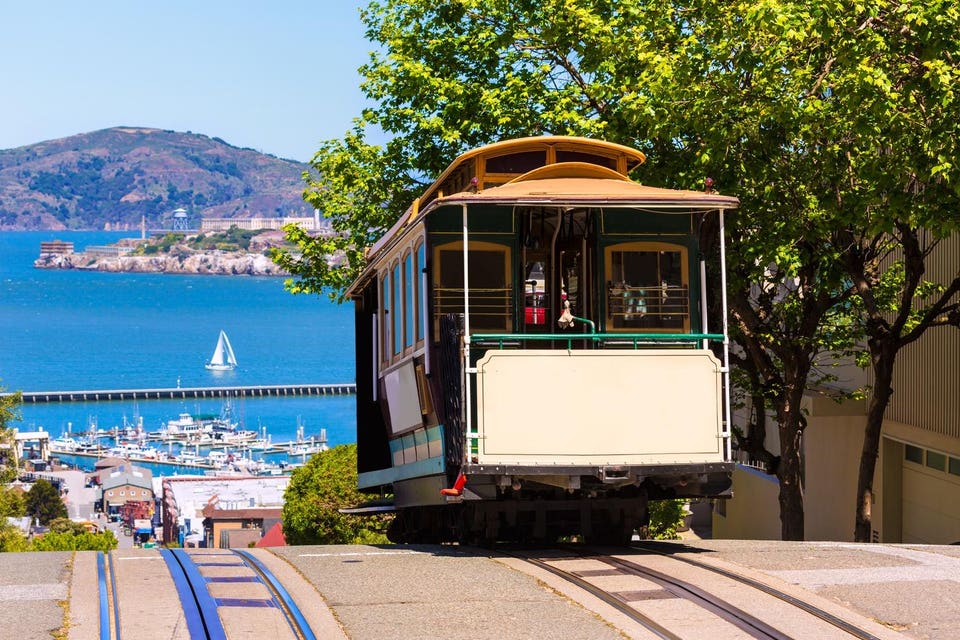
San francisco Hyde Street Cable Car Tram of the Powell-Hyde in California USA
getty
For years, San Francisco’s economic narrative has been dominated by what it lost. Tech layoffs, empty offices, and an unforgiving cost of living fueled a storyline of decline. But by 2024, that picture began to shift. Venture funding stabilized, major tech employers slowed layoffs, and the city saw renewed business formation—even as affordability challenges persisted.
Still, San Francisco’s recovery hasn’t been driven by a simple return to its old tech monoculture. Instead, a quieter, parallel economy has been gaining momentum—one rooted in outdoor experiences, wellness, and place-based entrepreneurship.
That shift mirrors a broader national trend. According to new data released by the U.S. Department of Commerce’s Bureau of Economic Analysis, outdoor recreation generated $1.2 trillion in economic output in 2023, accounting for 2.3% of U.S. GDP and 5 million jobs. The sector now represents 3.1% of all U.S. employment—its largest recorded share since the federal government began tracking the outdoor recreation economy in 2012. Since then, the sector has grown 36% in real terms, contributing more to the economy than farming, mining, and utilities.
In San Francisco, where access to natural infrastructure is embedded into daily life, that growth is translating into a new class of businesses—ventures that monetize experience rather than scale alone.
One of them is SpinOut Fitness, a water-biking company founded by local entrepreneur Damien McCloud.
McCloud launched the business in response to a personal reckoning.
“I was a very sick kid growing up,” he says. “I always needed to be very active. Otherwise, I’d be in the hospital all the time.” A serious car accident in 2017 halted his career across tech, photography, and creative services, forcing him to focus exclusively on recovery.
That pause reframed how he thought about work, and where it should happen.
“My happy place was to be outdoors,” McCloud says. “I was inside on the computer all the time. I wasn’t doing the things that really made me happy and healthy.”
Living just blocks from the Bay, he found himself staring at the water daily, searching for a form of movement that didn’t feel isolating. “I was on my Peloton for eight months, every single day,” he recalls. “I was bored to tears. I just kept thinking, ‘I wish I could cycle on the water.’”
When he discovered floating water bikes manufactured in the Bay Area, the concept immediately clicked. “Within five minutes, it changed everything for me,” he says. “It was the most amazing thing I’d ever done.”
Turning that experience into a business required uncommon financial risk. McCloud liquidated retirement savings, sold equipment, refinanced his car, and took out loans to purchase his first $6,000 bike. “I sold everything,” he says. “I had to liquidate every single asset.”
There was no venture capital cushion—only bootstrapping and reinvestment. “I started with one bike,” he says. “Then I scrounged up enough to buy a second. I’d take one person out at a time.”
What followed was organic demand driven by spectacle and word-of-mouth.
“People were losing their minds when they saw it,” McCloud says. “They wanted to be part of it.”
Spin Out Fitness expanded slowly but steadily, with McCloud reinvesting nearly every dollar earned back into the business. Today, he’s preparing to expand into multiple Bay Area locations—including Oakland, Sausalito, and Marin County—with plans to move into Southern California next.
The business works because it’s inseparable from San Francisco’s geography. The waterfront isn’t a backdrop; it’s the core asset.
As tech companies reassess office footprints and remote work reshapes professional life, ventures like SpinOut underscore a counterpoint: place still matters. Particularly when place enables experiences that can’t be replicated on a screen.
McCloud’s longer-term vision reflects that thinking. He’s developing a membership-funded model that would allow certain water-bike sessions to be free for San Francisco residents—treating outdoor recreation as civic infrastructure rather than a luxury offering.
That philosophy also reflects a generational shift among founders navigating high-cost cities. McCloud recalls hitting a ceiling early in corporate environments.
“I was too innovative,” he says. “Or I didn’t have the right degree. Or I wasn’t taken seriously because of my skin color.”
Instead of forcing himself into institutions that limited his growth, he chose autonomy. “I decided I needed to work for myself and create opportunities for people like me,” he says.
At the center of that decision is a question he still asks daily: “Am I in my happy place?”
It’s a question that resonates at a time when many workers—especially in cities like San Francisco—are weighing economic security against fulfillment. McCloud doesn’t deny the tension. But he reframes it. “It’s not about being resilient,” he says. “It’s about being anti-fragile. Every time you get hit, you rebuild stronger.”
San Francisco’s outdoor economy is operating under a similar logic. Rather than attempting to resurrect a singular tech-driven identity, the city is diversifying—leaning into experiences, health, and natural assets that were always there.
If San Francisco’s comeback is real, it may not arrive through the next breakout app. It may come from founders building businesses around how people actually want to live now—outside and rooted in place.