
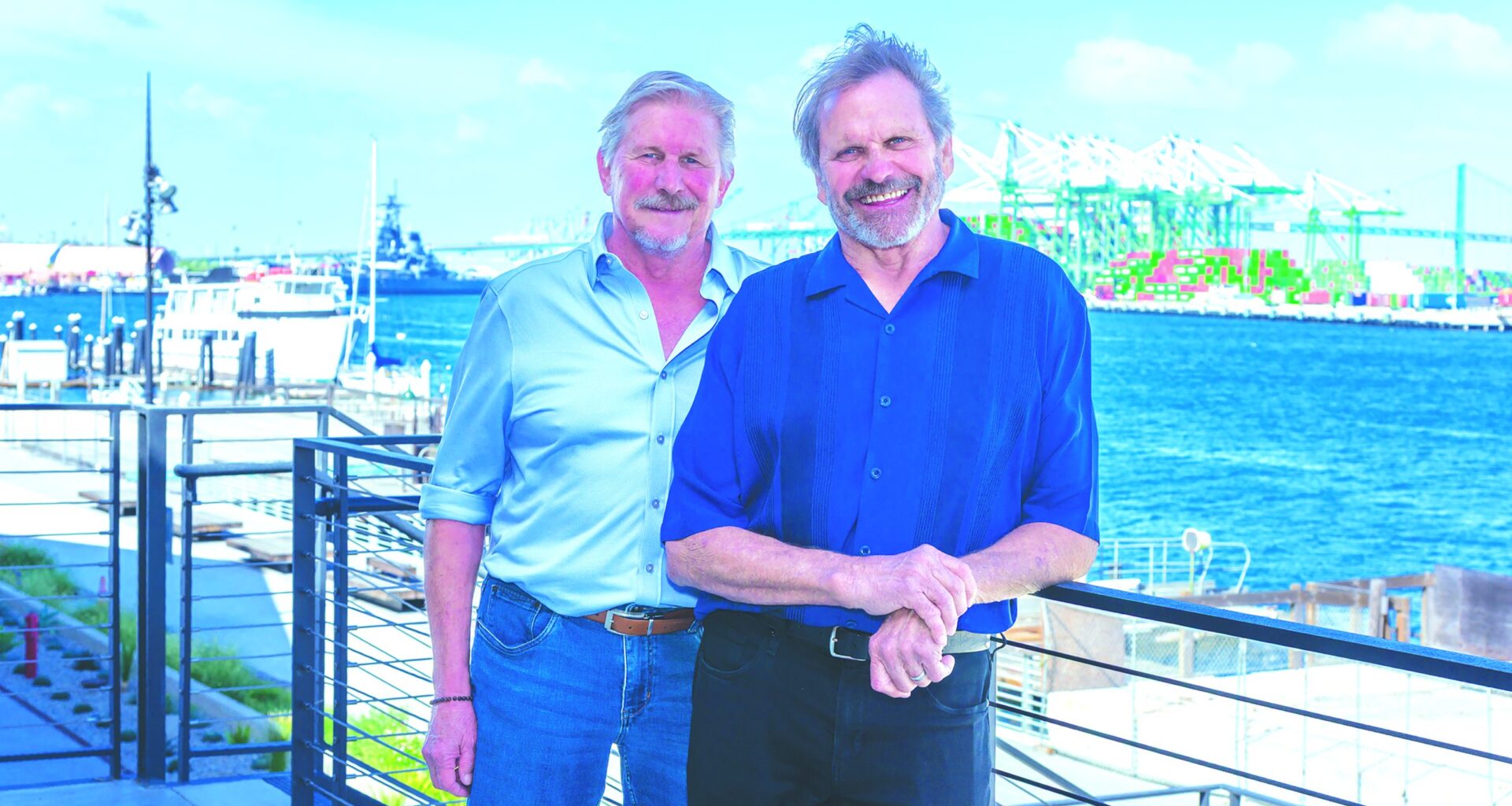
by Mark McDermott
When Eric and Alan Johnson were grade school kids growing up in Palos Verdes in the early 1960s, they had a favorite adventure. They’d bicycle down the Hill into the industrial wilds of San Pedro, all the way to the Port of Los Angeles, a land of towering cranes, big ships and barges. At the water’s edge awaited Ports O’ Call, a sprawling, new entertainment district was built in the style of a 19th Century New England fishing village — with a few odd Polynesian touches — but to the wide-eyed amazement of the Johnson boys contained a whole world of wonders.
“There was so much activity,” Eric Johnson said. “We’d ride our bicycles down and spend all day. We’d have five bucks to spend, get ice cream and go to the joke shop, and leave your bike in front of the store while you went inside. Nobody stole it.”
 Ports O’Call, circa 1963, not long after its opening. Courtesy Jerico Development/Port of LA
“They had these Japanese pearl divers,” Alan Johnson said. “You’d buy an oyster, open it up, and there’s a cultured pearl inside. They would just have these long lines. They had a glass blower who would build these little ships…I mean, there was so much for kids there, just so much visual attraction that didn’t cost anything.”
It’s easy to forget, because Ports O’ Call did not age well. But when it opened in 1963 the development helped put San Pedro on the map. This was before malls had proliferated and way before malls became “lifestyle centers.” Ports O’ Call was both a vibrant community hub and a tourist attraction. Newspaper accounts from August, 1963, reported 85,000 visitors for a “folk music hootenanny.” Walt Disney World Village would later take inspiration from the Ports O’ Call restaurant. For a few decades, Ports O’ Call thrived, and kept evolving, pulling new magic tricks out of its sleeve, such as the “Skytower,” the odd but cool 375 ft. needle-like ride that was built in the ‘70s and lifted people up for a sweeping view of the waterfront.
The Johnsons grew along with the Ports O’ Call, regularly visiting throughout their teenage years.
“It was a great place to meet girls,” Eric Johnson said. “As I got into the tweens and my teenage years it was like, ‘Oh, this is great hunting grounds.”
“Alan and I are lifelong boaters, and I love to sport fish, so those are the exciting things I remember as a kid that you could go and do. Then it had that space needle for a while. It had this energy to it, that it was growing. It had wild restaurants, but you know, as a kid, I couldn’t have cared less — we went to the Carnation restaurant because they had a great burger and soft serve ice cream. Why eat anywhere else?”
“That BBQ place,” Alan Johnson said.
“You had Texas Lucy’s,” Eric said. “It just kept evolving. There was always something to do, from when we were in elementary school until, really, when it got torn down.”
Ports O’ Call suffered a long decline, and by the early 2000s had ceased to be much of a destination, except for dedicated locals like the Johnsons. Its demolition became inevitable as regional leaders began to envision how to revitalize the waterfront. After a decade of discussions, in 2013, the Los Angeles Board of Harbor Commissioners selected Jerico Development, in partnership with the Ratkovich Company, to undertake the massive task of rebuilding the San Pedro waterfront.
The selection was an unusual choice, given that Jerico was relatively little known, a small, family owned company that had begun as crane and trucking company a little over a century ago, then got into oil and gas exploration and production, and in the last few decades had operated restaurants before jumping into real estate and development.
The reason the selection of Jerico made sense was that this is the company led by Eric and Alan Johnson. Several big name developers sought the opportunity to redevelop the San Pedro Waterfront, many with much more extensive experience with large-scale projects. But none of them knew San Pedro like the Johnsons. They’d been researching and preparing for this since they were seven and eight years old.
“We just didn’t know it,” Eric Johnson said.
Now, a dozen years later, their project is coming to life. It’s called West Harbor, and it’s already creating a buzz the likes of which the waterfront has not seen since Ports O’ Call opened six decades ago. West Harbor includes over 200,000 square feet of restaurants, shops, and attractions, a brewery, a mile-long waterfront promenade, a 6,200-seat music amphitheater, a 175-ft Ferris wheel (the tallest in California), an expanded San Pedro Fish Market (with 3,000-person capacity), a dog park, pickleball/padel courts, an immersive cutting-edge art gallery, and an array of waterside activities, including harbor cruises, a 1,200 ft. courtesy dock (the longest in Southern California), fishing, water taxis, and floating attractions, such as a spa on a barge, and a tiki bar on a barge. Some of West Harbor is opening now for business, and the rest is expected to be fully operational in 2026.
Though West Harbor looks nothing like Ports O’ Call, the exuberance of the former waterfront’s heyday animates the project.
“Alan and I were in elementary school when Ports O’ Call was built,” Eric Johnson said. “It was just this crown jewel of town, this amazing thing to be proud of, to go spend all day and just have a unique adventure in a place that used to be basically industrial facilities. We knew West Harbor would work, because we saw what the original Ports O’ Call did, and we wanted to sort of recreate that lightning-in-a-bottle effect that we remember as young people.”

A rendering of West Harbor in San Pedro. Parts of the project are opening now, and it will be fully open by this time next year. Courtesy Jerico Development
New Crown Jewel
West Harbor may take inspiration from the former waterfront but it is a complete departure from the old Ports O’ Call.
Where the original development tried to transport visitors to a fantastical New England fishing village that never really existed, West Harbor embraces exactly what and where it is: a modern waterfront development in an active, working port. The project speaks San Pedro’s language.
“We decided we were not going to be a faux New England fishing village or Polynesian village,” Alan Johnson said. “We are building modern warehouses, which are in line with what would be built on the site in the 21st century. They’re light, functional and don’t have columns in the interior spaces. We want to make sure each element of the project is unique, authentic and fun. The old Ports O’ Call was definitely unique and fun, but not so authentic.”
The warehouse aesthetic is more than just honest — it’s beautiful. Designed by Studio One Eleven, the buildings are pre-engineered metal structures with clean lines, expansive glazing, and a rhythm that feels right for the location. At night, they glow against the industrial theater of the port’s lit-up cranes and the silent parade of 300-foot container ships gliding past in the main channel.
“Our job was not to screw up this amazing site,” Eric said. “We have 42 acres, a mile of water frontage on the main channel where you can throw a baseball and hit a container ship silently going by. That’s something Long Beach doesn’t have — a really direct relationship with the water.”
The brothers give a virtual tour of the site with an almost giddy enthusiasm that belies the more than dozen years of grinding labor they’ve put into the project, pointing out details and explaining the organizing logic behind every decision. Eric described it as a “curation exercise” — assembling interesting components and figuring out where they should go and how the adjacencies would work.
“We’ve carefully curated these activity and energy nodes,” Eric said. “At the south end of the site is our amphitheater. That’s a big activity node centered around entertainment, but it’s also a two-acre park when there are no shows. As you move north, you have Building A, which is predominantly food and beverage, and Building B, which is more retail. Then Building C is next to the amusement park and dog park — that’s where the San Pedro Fish Market is going.”
They’d hoped to have the Fish Market as part of the project all along, but for a few years it appeared it wouldn’t be a part of the project because its owners were exploring a standalone site. But once West Harbor began to cohere, and the Fish Market saw the challenges of a separate project — the environmental impact report for West Harbor’s amphitheater, for example, took almost three years to complete — they joined the larger project. The Johnsons were ecstatic. They’d always believed Building C was the perfect fit for the Fish Market, which is more bustling than a typical restaurant, the waft of fresh fish mixing with the mariachi bands serenading diners. Now, the market will be next to the amusement park, with its Ferris wheel, merry-go-round and yelping kids.
“We put them there because mariachis next to a calliope makes sense,” Eric said. “That cacophony actually works well together.”
The San Pedro Fish Market gives West Harbor both a major attraction and a sense of continuity. The beloved institution, which has been a regional draw for 50 years, lost its original location when the Port tore down the building as part of the redevelopment. The Johnsons put them up in a temporary outdoor space, and remarkably, the Fish Market’s sales remained robust.
“They were doing $30 million a year before they closed,” Eric said. “The following year in the interim space, they did $16 million in sales. That $30 million put them in the top 5 percent of restaurants in the U.S. They’re going to be building a permanent facility for themselves located next to the amusement park, with capacity for 3,000 diners.”
Building A, the first completed structure, at about 73,000 square feet, houses some of West Harbor’s most anticipated tenants. Mike Hess Brewing will operate a 15-barrel brew house (comparable to Stone Brewing at Liberty Station in San Diego) with a 20,000-square-foot beer garden. King and Queen Cantina will feature a massive 9,000-square-foot over-water deck and bar. Yamashiro, a revered Japanese restaurant, will open its first location beyond its famous Hollywood Hills spot. A food collective will feature more than a half dozen smaller operators. There’s also Hopscotch, an experiential art gallery where high-tech installations change quarterly, offering the kind of Instagrammable moments that draw crowds.
In early December, the development added six new culinary concepts totaling over 10,000 square feet of newly leased space. Mike Hess Brewing expanded its West Harbor footprint to include Mike Hess Distilling, introducing signature cocktails and packaged spirits alongside its seaside beer garden. The Food Collective welcomed four new operators: Tacos El Franc, a Michelin-recognized Tijuana taqueria featured on Netflix’s Taco Chronicles; Glass Box, a high-concept Asian dining experience making its LA debut; Paraná Empanadas, serving authentic Argentine fare; and LoZio Pizza, a spinoff of the Redondo Beach-based LoZio Osteria. Central Park will also feature Freska Bar, offering fruit-forward agua frescas and comfort food favorites.
“These additions reflect our commitment to curating authentic and diverse experiences,” Eric said. “Each concept tells its own story through signature flavors and character, reinforcing West Harbor as a destination that will resonate with locals and global visitors.”
“We want to have a lot of programming so you don’t have to plan what you’re going to do,” Alan said. “You go down there because you know something’s going on — with the Ferris wheel, with the amusement park, with the amphitheater. But we also have stages in our central park area at the very north end, which is the connection to downtown. We just want to kind of recreate that modern activity and hub and energy.”
They also utilized a special provision for public lands granted by the California Department of Alcohol Beverage Control.
“ABC has agreed to treat the entire site, except for the parking lot, as a single area of common consumption,” Eric said. “So it’s kind of like going to Mexico. You can take your adult beverage, go out to the park, go hang out. That’ll help both drive sales, but it also provides something of a unique environment that you can’t get other places.”
About 30 to 40 percent of West Harbor’s restaurants come from San Diego, operators with coastal experience looking to expand without cannibalizing their existing business. Eighty percent of the tenants are family businesses — a deliberate choice that reflects the Johnsons’ own values.
“Val and I basically negotiate every lease,” Eric said, referring to Valerie James, the company’s Chief Operating Officer. “We know every tenant, we know their kids, we know their stories. We’re really looking forward to having them all meet each other because it is an ecosystem. It took each and every one of those players to fit that block into the big Jenga that we’ve created.”
“We looked at Long Beach’s Rainbow Harbor as a cautionary tale,” Eric said. “It was populated basically with national brands — PF Chang’s, Bubba Gump, Gladstones. We said, ‘That’s not what we’re going to do.’ We’re going to seek out best in class, independent operators from Southern California and use this coastal property to really attract the best.”
The waterside is equally ambitious. Dan Salas of Harbor Breeze Cruises serves as the master waterside tenant, managing the slips and coordinating everything from traditional whale-watching tours and dinner cruises to more unconventional offerings. The docks will be a world unto themselves, with a waterside bar, the long courtesy dock, and a dock for the Los Angeles Maritime Institute’s tall ships.
“The main channel is where the Maritime Institutes tall ships live,” Eric said. “So they are our nautical eye candy as you enter the site.”
The brothers are working on what they call “waterfront attractions” — unique experiences that get people physically out on the water.
“Think of a pool on a barge, a barge full of sand with a tiki bar at one end, and even a spa on a barge, inspired by a successful concept operating in Montreal,” Eric said. “My wife and I discovered it on a research trip. We spent 10 years after we got selected for this project, and all of our vacations were in redeveloped urban ports throughout the world, just trolling for inspiration.”
The amphitheater, being developed in partnership with Nederlander Concerts LA, a family business that has operated for over 100 years and owns nine Broadway theaters and numerous music venues, including the Greek Theater in Los Angeles. West Harbor’s amphitheater, will be comparable in size to the Greek and will host up to 100 large-format shows each year, and even more smaller performances.
“Growing up in PV, we always had to drive a long way to see quality acts—to the Hollywood Bowl, the Greek, or Irvine,” Eric said. “The drive was a pain, and the parking worse. The South Bay is like the donut hole in concert venues. We wanted to fill that geographical void.”
And then there’s the Ferris wheel — a 175-foot structure with LED lighting around the perimeter and in the center, capable of putting on light shows that will be visible from across the harbor and up the hill in Palos Verdes.
“It’s going to be the last image on every network news 11 o’clock newscast,” said Alan, “and opening the morning news.”
 West Harbor features a mile-long waterfront promenade. Courtesy Jerico Development
The Perfect Fit
The story of how the Johnsons won the West Harbor project is a study in why local knowledge matters.
When Geraldine Knatz became Executive Director of the Port of Los Angeles in 2006, she inherited a stuck project. A massive master plan for the waterfront — calling for a million square feet of retail and multiple hotels — faced significant community opposition and seemed destined for limbo.
“We looked at the project and said, okay, what are the important elements that bring the waterfront together?” Knatz recalled. “Maybe we focus the project on that. So we reframed it in terms of the promenade, the open spaces, the connecting pieces, and renovating Ports O’ Call. We dropped all the million square feet of retail and hotels because we said the market would dictate if those should be there over time.”
The strategy worked. The environmental impact report was finally approved in 2009 — in the middle of the recession, terrible timing for attracting developers. But the Port pressed forward, and by 2013, the Board of Harbor Commissioners was ready to select a development partner.
“A lot of big name developers came in,” Knatz said. “But this proposal stood out among the pack.”
Knatz didn’t know much about Jerico Development at the time.
“I have to be honest, I was not familiar with Jerico development until the proposal came in,” she said. “But I was familiar with Wayne Ratkovich and his work. He was known for historic preservation — at the time, he was working on the Wiltern Theater. When somebody is interested in historic preservation, they understand the significance of being in tune with the local community.”
The partnership between Ratkovich and Jerico was the key differentiator. Ratkovich brought institutional credibility and sensitivity to historic preservation. The Johnsons brought a century of South Bay roots and four decades of investment in downtown San Pedro.
“It was brilliance on his part to link up with Jerico development,” Knatz said. “They were the perfect fit. Even though they may live in Palos Verdes, their offices are in San Pedro. They’re very well connected to the community there. It was a marriage made in heaven when those two firms came together.”
The Johnson family’s story reads like California history. Their company began in 1921 in Long Beach as a crane and trucking operation. Eric and Alan’s grandfather moved to Redondo Beach in the 1930s. Their parents met at Redondo Union High School in the 1940s. The family business evolved from cranes and trucks into oil and gas drilling, then oil and gas exploration and production. They sold the last of their operating oil assets in 2011-2012.
“We ended up with property in Long Beach, Signal Hill, Torrance — we owned these oil field properties,” Eric said. “When the oil got depleted, we would directionally drill the wells and create developable acreage. We’ve been doing brownfield development (remediation) since before there was a word for it.”
In the 1990s, the family operated five Courtney’s restaurants across the South Bay, giving them insight into the restaurant business that would prove invaluable for tenant curation at West Harbor. About 30 years ago, Alan convinced his siblings to move the company’s offices from Long Beach to San Pedro.
“San Pedro had a bright future,” Eric said. “We knew the real estate was less expensive. Alan created the first business improvement district, started the First Thursday events. Our retail and office space in downtown San Pedro has been pretty much full for at least 20 of those 30 years.”
The Johnsons also restored two of downtown San Pedro’s most historically significant buildings — the 1918 John T. Gaffey Building and the 1929 Brown Brothers Building. These projects established their credibility as developers who understood and respected San Pedro’s character.
“We came to appreciate the fascinating story of the founding and development of San Pedro and the historically important role it has played in the story of Los Angeles,” Alan said.
San Pedro has also maintained its unique sense of place. It’s a working class town that has also always attracted and produced artists, including poet Charles Bukowski, novelist Louis L’Amour, dancer Misty Copeland, and punk rock pioneer Mike Watt. It proudly lacks any of the glamor LA prides itself on.
San Pedro is also on an upswing.
“There’s so much energy coming into town,” Alan said. “We always beat trends here. We’re always going the opposite direction the rest of the economy is going. When it’s a Golden Age for us everyone else is pulling their horns. We just have our own time frames. We have our own everything. And there is a sense of community that I think is really unique to Los Angeles, and even welcomes new people coming into town. It embraces you. There’s an old saying, which I think is fairly accurate, that a San Pedroan will give you the shirt off his back, but then tell you what day you are to wear it. That in a way sort of sums up the ethos around here.”
An example is in housing. Many coastal California cities are fighting the State of California’s dictates to create more housing. San Pedro has added 5,000 units in the last five years, much of it spurred by the West Harbor development. Real estate remains much cheaper than many nearby communities but home values, particularly near the waterfront, are rapidly increasing.
“You walk up to San Pedro and say, ‘Gentrification?’ San Pedro responds, ‘Yes, please,’” Eric Johnson said. Because there used to be this weird inversion where real estate values got lower the closer you got to the water. So historically, you worked on the waterfront, but as you became successful, you moved up the hill to get away from the smell and the noise.”
When the opportunity came to redevelop the waterfront, the Johnsons weren’t just developers submitting a proposal. They were locals with deep roots, a track record of community investment, and childhood memories of what made Ports O’ Call magical.
“It’s very important to us that we really become a community asset,” Eric said. “We wanted to create a connection with downtown San Pedro and that blossoming community that Alan was sort of the principal architect of 30 years ago.”
Because the Johnson family has deep ties to Redondo Beach, the brothers paid careful attention to the failed attempts to redevelop King Harbor, particularly the Centercal project, the 15-acre, 525,000 sq. ft. project that was approved by the City Council in 2012 but ultimately withdrawn in 2018 due to legal, electoral, and popular opposition.
“We got this bid in enough time for me to go to every one of their public presentations to get a sense of it,” Alan Johnson said. “It was quite enlightening. One of my takeaways was that although people were welcoming it, there was kind of a worry about it being too successful…The more I learned, the more I really appreciated and loved the fact we were doing this in San Pedro, which had a really strong hankering for it and wanted it to be fabulously successful and really showcase the town in a really positive light.”
The community response in San Pedro has been unlike anything either brother has experienced in development.
“Generally, anything of this scale has significant opposition,” Eric said. “We have had exactly the opposite. The complaint we get most often is, ‘Why is it taking so long? When are you going to open?’ It’s rare to have this level of community engagement and support. It’s really a dream come true.”
Not that this level of expectation comes without pressure. At the meeting where Jerico was officially selected, a Harbor Commissioner who was a longtime friend leaned over and whispered in Alan Johnson’s ear: “Don’t f*** this up.” The commissioner reminds Alan of that advice every time they see each other.
“It’s an honor to have this project,” Alan said. “We took it so seriously. It’s so important to us and to the company and to everyone involved and the community that this turned out right.”
The partnership with the Port has been equally crucial. The Port has invested roughly $180 million to $200 million in infrastructure improvements — rebuilding Harbor Boulevard, contributing to electrical infrastructure, and creating the promenade. It’s a true public-private partnership of the kind that rarely works.
“We couldn’t have afforded to spend $200 million on top of our investment,” Eric said. “We couldn’t double the price of the project and make it work at all. But that’s what the city should do — they should build the roads and contribute to infrastructure.”
What makes the Port partnership work is an assured funding source. The Port sets aside 10 percent of its net income every year for community-serving purposes — somewhere between $40 million and $100 million annually.
“That’s what kills most public-private partnerships,” Eric said. “The public entity doesn’t have an assured funding source and is constantly not holding up their end of the bargain. Over this decade-plus, we’ve developed a genuine sense of trust and respect between the counterparties. That’s pretty rare.”
Knatz, who retired from the Port in 2013 and is now a professor at USC, remains impressed by the Johnsons’ commitment to the broader waterfront, not just their own project. Eric serves as chair of the Los Angeles Maritime Institute board. Both brothers, through their family foundation, the Crail Johnson Foundation, are major donors to AltaSea, the pioneering blue tech campus occupying historic warehouses nearby.
“Eric was the one who called me after I retired and said, ‘Hey, come back to AltaSea,’ and I became a board member and then the chair,” Knatz said. “He’s not just looking at West Harbor, he’s looking at the whole thing. If AltaSea is successful, that’ll help West Harbor be successful.”
Krantz has seen this vision unfold from even before its beginning. She is galvanized by how it has come to fruition.
“I’m telling you,” Krantz said, “it’s like, I have to move back to San Pedro.”
LA County Supervisor Janice Hahn, a San Pedro native, said attempts to revitalize the waterfront go back to when she was an LA councilperson at the turn of the century. The Urban Land Institute did a study that identified the harbor as the town’s greatest asset, and its most underutilized.
“Our town has been waiting for this waterfront development for decades,” Hahn said. “It took the Johnson brothers to get it done.”
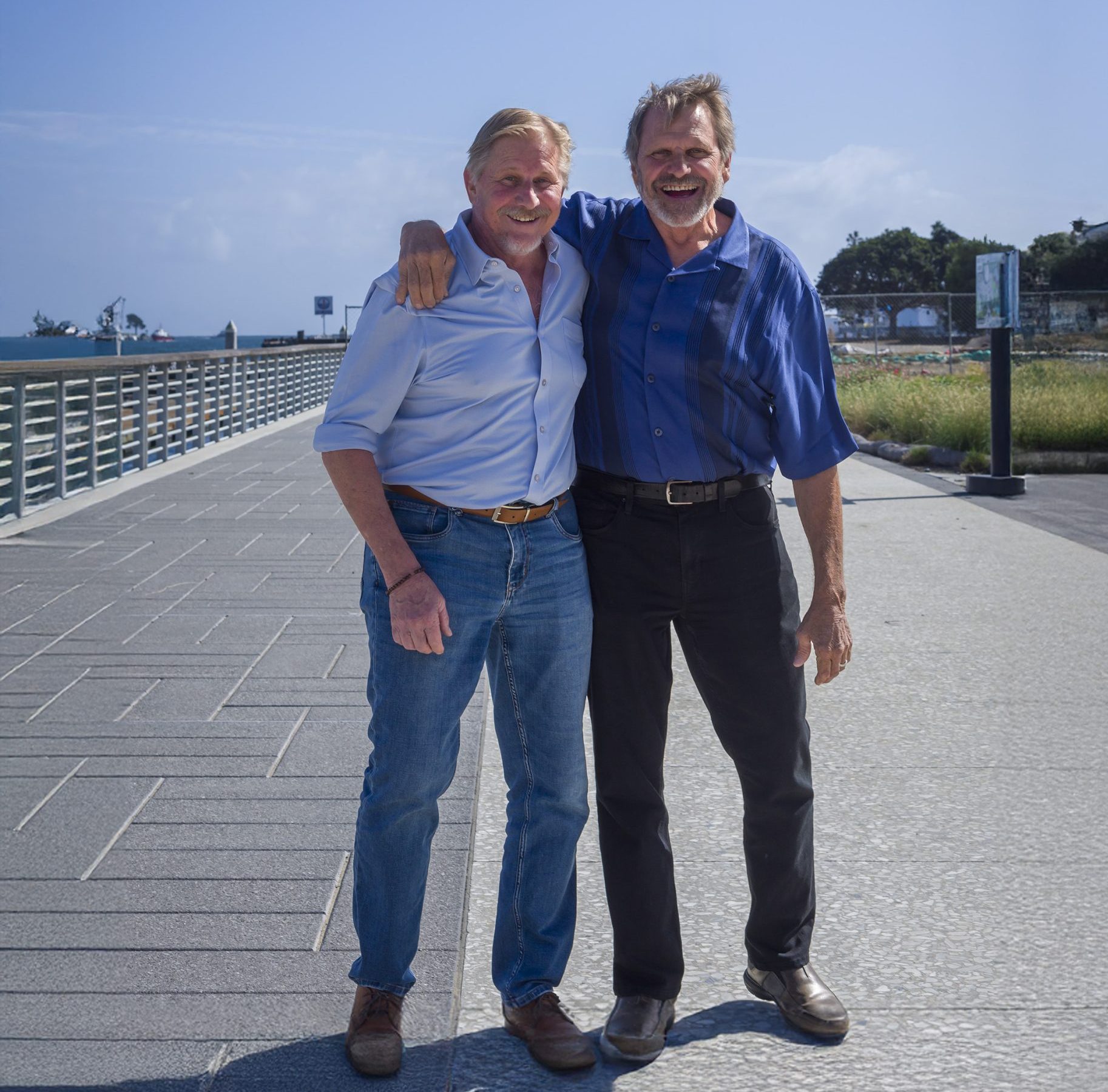 Eric and Alan Johnson. Photo by Tony LaBruno (TonyLaBruno.com)
The Playground
For a guy who spent decades in the oil business, Eric Johnson’s late-career field of inquiry has broadened to include many unexpected things.
During the virtual tour he hosted of West Harbor, Eric at one point grabbed his cell phone and pulled up a set of new renderings of the Ferris wheel — LED lights blazing in patterns, the structure glowing against the nighttime port.
“How cool is that?” he said, turning the phone to show the images. This is a man nearing 70, running a fourth-generation family business, managing a $200 million development project with hundreds of moving parts and stakeholders.
It’s this quality — this preservation of childhood wonder alongside hard-earned and extremely varied development expertise — that may be the key to the Johnson brothers’ vision. They never lost the sense that waterfronts should be playgrounds.
“We judge each element by whether it’s unique, authentic and fun,” Eric said. “Because to me, that was the old Ports O’ Call. It was unique, it was inauthentic, but it sure was fun. That’s kind of the change we’ve made here—we’ve kept unique and fun, but we’ve made it authentic.”
Then there’s the story Knatz tells about Alan.
Last year, Alan emailed Knatz with what he called an “unusual question.” The waterfront promenade includes an environmentally projected area, a sensitive mudflat habitat. Alan wanted to know: What are the worms that live there? Could they name that area of the development after the worms?
Knatz went into the biological survey and found the Latin names. They were impossibly long. She and Alan exchanged emails brainstorming alternatives: “Worm Haven” and other variations. Whether the idea ever went anywhere isn’t the point.
“Can you imagine a developer even caring, even asking that question in the first place?” Knatz said. “’Teach me something about what’s living in that habitat here, so that we can celebrate it as part of the development.’ I thought the fact that he asked the question is a little bit telling about these two guys.”
The Johnsons are stewards of a 104-year-old family business now in its fourth generation. Eric, as well as Alan’s daughter Lauren formerly served as chair of San Pedro’s Chamber of Commerce. Other family members are active throughout the company and the community. They’ve built a small but powerful team — fewer than a dozen people running the entire West Harbor project — with many employees who’ve been with the company for 30 or 40 years.
“This project could never have been developed by a REIT or institutional money,” Eric said. “It really took private capital that was willing to spend a decade-plus before getting anything back. But now we’re at the stage where we’re attracting institutional investors, so we’ve essentially de-risked it.”
Eric Johnson acknowledges that this is a culminating moment in the brothers’ careers.
“This is definitely a legacy opportunity,” he said. “It’s the biggest thing we’ve done and one of the more involved and riskier things we’ve done. I want to make sure we finish everything we start.”
“This project is more than just business for us,” Eric said. “It’s about having the opportunity to make a difference and create something lasting for the community you live in. Creating a place where people of all ages will get together, have fun on the water, enjoy great food and entertainment, and create memories of unique experiences on the San Pedro waterfront for generations to come.”
But even as they talk about legacy and next generations, the brothers sound less like developers winding down and more like kids plotting their next adventure. They talk about lighting up the old shipyard cranes across the channel. They talk about the hotel they plan to build, and about the trolleys connecting downtown to West Harbor, AltaSea, and to the Cabrillo Marine Aquarium.
“We want this to be thought of as a single destination that warrants multi-day visits,” Alan said. “Through enhancing connectivity and marketing all the great attractions along the LA Waterfront, we’re creating a compelling built environment that will attract residents, tourists and cruise passengers.”
The Ferris wheel will spin. The amphitheater will rock. The mariachis will play next to the carousel’s calliope. The container ships will glide silently past on the main channel. And somewhere, two boys will pull up on their bikes and head into West Harbor to see what adventures await.
Redondo seeks to ‘revitalize, not
supersize’ Harbor improvements
by Garth Meyer
In 2021, a $400 million public-private partnership between the City of Redondo Beach and CenterCal Properties neared its end, another failed effort to redevelop the Pier and the adjacent waterfront area. As lawsuits remained pending, the city formed a Harbor Amenities Working Group.
Its mission was to “revitalize, not supersize,” the waterfront, as anti-CenterCal residents had argued when they voted to stop the project.
From the working group, a plan grew to finally pick a spot for a Redondo Beach public boat launch, and a proposal for an ambitious educational facility run by Marine Mammal Care Center at the site of the closed Joe’s Crab Shack, along with upgrades to Seaside Lagoon.
A long-in-the-works skate park opened on the Pier in 2023. Two years later, private investors Allen Sanford, Rob Lissner (co-founders of BeachLife Festival), and Jeff Jones (Quality Seafood) combined ownership in two shuttered waterfront buildings, the former Ruby’s and the former On the Rocks/Chiller’s Pancho’s and Wong’s, to build the California Surf Club.
New leases at the Pier include Deep End Live, a music venue to open in the subterranean former Brixton’s space.
In addition, the main harbor parking lot was repaved last year, received a new parking system, and new wayfinding kiosks were installed at the Pier entrance. ER