
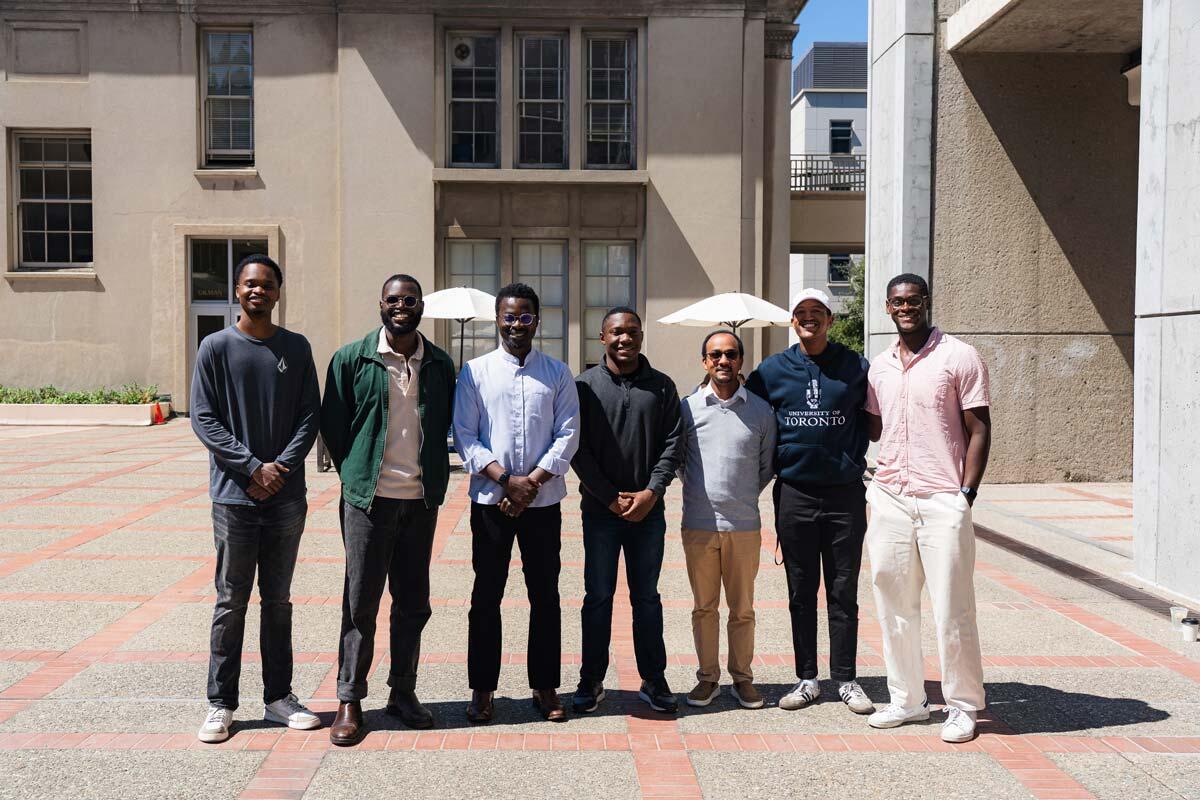
From left to right: Matthew Amoako (Graduate Student in the Sarpong Group), Daniel Chabeda (Graduate Student with Eran Rabani), Prof. Richmond Sarpong (Faculty Member), Isaac Kaba (Graduate Student with Ziyang Zhang and Bobby Saxton), Prof. Kwabena Bediako (Faculty Member), Atang Peloewetse (Graduate Student in the Sarpong Group), Richard Darkwa (First year; plans to join the Sarpong Group)
A record number of students and faculty in Berkeley’s College of Chemistry have ties to Africa, and the continent is inspiring their science and career paths.
Growing up in rural Congo, Isaac Kaba spent much of his childhood with his grandparents, watching them treat ailments with traditional plant-based medicines. The remedies seemed to work, and Kaba wanted to understand why and how.
“I was really interested in understanding the magic, the chemistry behind those traditional plant-based medicines,” he recalls.
That childhood curiosity led Kaba to his study of pharmaceutical chemistry—first as an undergraduate in Congo and then transferred to the University of Toledo in the US. Today, as a second-year PhD candidate in the College of Chemistry at Berkeley, he is developing new chemical tools to study the immune system and treat autoimmune diseases and cancer.
Kaba isn’t alone in bringing his African roots to his research. In its 150-year history, Berkeley’s College of Chemistry has never seen anything quite like this moment: at least seven chemists from across the African continent and diaspora affiliated with the school. Two faculty members—Richmond Sarpong and Kwabena Bediako—and graduate students Matthew Amoako, Daniel Chabeda, Atang Peloewetse, Richard Darkwa, along with Kaba, are pursuing everything from organic synthesis to computational chemistry, each carrying stories of how Africa shaped their scientific vision.
“I think it’s really unusual and exciting to have this many Africans in one department,” says Sarpong, the Executive Associate Dean and Maxine J. Elliott Professor of Chemistry. “Having people from different backgrounds brings different perspectives to the table and can bring a unique approach to solving problems in science.”
Roots in Africa
For Sarpong, the power of chemistry revealed itself in childhood. Born in Ghana and moving between African countries as his father worked with governments and the World Health Organization, he witnessed the devastating effects of river blindness and the transformative impact of ivermectin, a drug developed by chemists.
“I saw how chemistry could make a difference in the lives of hundreds of thousands of people,” Sarpong says.
That observation fundamentally shaped his career path. Today, his Berkeley laboratory focuses on designing chemical compounds that could become new drugs.
Bediako’s path to chemistry began with a different kind of wonder. Growing up in Ghana, he remembers musing about why—when the country had so much sunlight and electric power was constantly being rationed—there wasn’t more solar energy.
“It was a very naïve question but it led me to start learning about the factors that contribute to the deployment and cost of renewable energies,” says Bediako, an associate professor of chemistry. “I was motivated strongly by the sense that if I could come up with technologies that allowed the efficient harvesting of solar energy, it would be extremely impactful in Ghana and other African countries.”
Today, his lab works on developing advanced materials including ultra-thin magnets and twisted two-dimensional materials that explore the fundamental chemistry and physics underpinning key processes in energy conversion and computing and electronic technologies.
Africa’s influence runs just as deep among the graduate students. Amoako, whose family is from Ghana, is interested in studying the chemistry of natural products from Africa. At Berkeley, he works in the Sarpong lab on developing new ways to synthesize natural compounds.
And Chabeda says his computational chemistry approaches all tie back to his family’s heritage.
“My dad was raised in national parks throughout Kenya and Tanzania because his dad was pioneering environmental advocacy and ecological surveying programs there,” he explains. “My mom grew up in Nigeria where these concepts are baked into how you live and engage with nature. And so when I first began to do chemistry, it always felt like it had roots in these ideas about sustainability.”
Building Bridges
For the students in the African community in the College of Chemistry, the continent is not something in their past, but also woven into their plans for the future.
“We should really aim as Africans to develop methodologies that are necessary and applicable in the African context,” says Peloewetse. “Because I think we believe that Africa as a continent is on the rise and now is the time for us to give back to a continent that raised us.”
Peloewetse works with a scholarship program in Botswana that helps support students studying abroad. He has helped new students in the United States and Canada get acclimated and has given talks at his high school in Botswana to students interested in education abroad.
“You rise by lifting each other up,” he says.
Kaba is involved in similar efforts—he has volunteered time mentoring talented STEM senior students and recent graduates in Africa on how to prepare competitive graduate school applications and to write quality abstracts and research papers.
in 2024, Chabeda visited Kenya and gave a talk on his work at the University of Nairobi. He recalls being struck by the sophistication of the students’ questions and the quality of the research, even as conversations highlighted the uneven global access to large-scale computing resources. The experience pushed him to think more seriously about collaborative infrastructure-focused work that could support scientific research in Africa. “It actually completely switched my perspective on what’s next for me,” he says now. “I’m probably eventually going to leave academia and be more directly involved in building out infrastructure and financial systems that can help good science thrive over there.”
Similarly, Darkwa—who previously worked in a biotech startup in Cambridge, Massachusetts and is now a member of the Sarpong lab—has always been driven by drug discovery. But recently, he’s started considering how to get involved in government policies in Ghana—especially those related to healthcare and medicine.
“My family is moving back to Ghana and so I’m going to be going back more often,” he says. “I hope that I can establish ties there and work toward my goal of making medicines more accessible.”
The Gift of Community
The two African faculty members and five graduate students at the College of Chemistry come from all walks of life and have varied paths to Berkeley. Amoako and Darkwa both grew up in the United States but maintained strong family ties to Ghana; both also learned to speak Twi, the Ghanian language, in college. Kaba, on the other hand, didn’t move to the United States until midway through his undergraduate degree. But despite their diverse stories, they are finding common ground at Berkeley.
Sarpong, who joined Berkeley’s faculty 21 years ago, says that the convergence of the students wasn’t entirely accidental. He has actively recruited students from underrepresented groups throughout his career.
“That’s always been important to me,” he says. While he emphasizes that candidates must be exceptional and “above the bar,” he works hard to convince top talent to choose Berkeley over other institutions.
For some of the students, knowing that there were other African faculty members and students helped them make that choice.
“The fact that Richmond [Sarpong] was here really inspired and motivated me,” says Peloewetse. “To be able to look at someone with a similar background and see that they’ve risen through the ranks is very powerful.”
For many of the students, the impact of finding each other at Berkeley came as a surprise—even to themselves.
Chabeda says that in high school, he was one of the few—or the only—African in his classes. He was used to being in the minority and didn’t choose Berkeley with any goal of seeking similar faces. But as the community of African students around him grew, something shifted. Daniel discovered what he calls “the secret sauce”—a shared understanding and a natural connection to heritage that he hadn’t realized he was missing.
“There’s an ease of talking about things that are important to you and your family and future vision and the other person being like, yeah, me too,” he explains.
For now, there are no official “Africans at Berkeley Chemistry” meetups, but the students often get together and the group has been attempting to schedule a lunch (Amoako offered to cook Ghanaian food).
In the meantime, they’re focused on their chemistry—synthesizing molecules, running computations, and designing ultra-thin materials. Each project could have implications in Africa and beyond.
“Science is done by people,” Sarpong says. “We learn from each other, both scientifically and also culturally.” And this community is ensuring that learning flows in both directions—from Berkeley to Africa and back again.