
The Port of Long Beach (POLB) set an all-time record for container volumes in 2025, despite the hurdles to global trade caused by President Trump’s expansive “reciprocal” tariffs.
The gateway, which represents one half of the nation’s busiest port complex alongside the Port of Los Angeles, moved 9.9 million twenty-foot-equivalent units (TEUs) last year, surpassing the 9 million mark for the first time.
The first four months of 2025 saw the port surpass the TEU movement volumes of all U.S. ports, in fact, with apparel among the top three categories for imports alongside furniture and electronics.
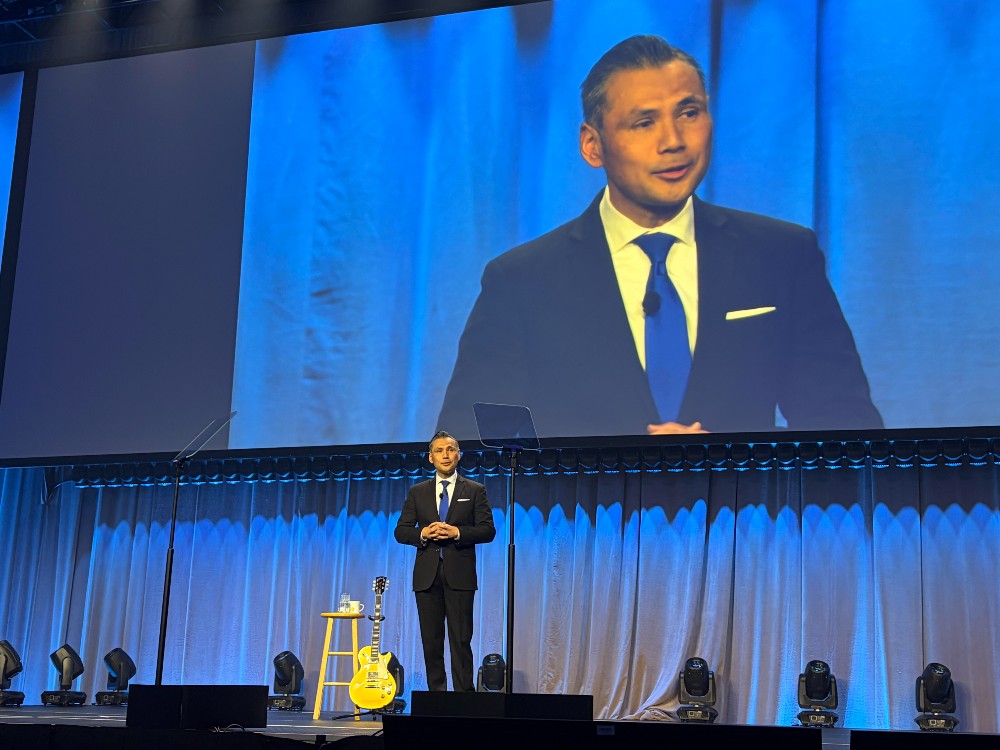
At the State of the Port Address in Long Beach on Thursday, newly appointed POLB CEO Noel Hacegaba, who replaced Mario Cordero earlier this month, said the port’s import volumes made up much of the volume increase, reaching an unprecedented 4.8 million TEUs “thanks to all the frontloading of cargo by importers wanting to get ahead of new tariffs” especially during the first half of the year.
“We also exported over one million TEUs—not our highest ever, but still strong considering all the retaliatory tariffs imposed on U.S. exports,” he added. Five of the POLB’s six container terminals handled more than 1 million TEUs each, and two terminals processed over 2 million, helping the port to increase its share of cargo movement within the San Pedro Bay complex to 48.9 percent.
“I don’t want to minimize the impact of the tariff uncertainty. Certain segments in the supply chain felt the impacts more than others, like our drayage providers,” Hacegaba said.
Tariffs have had “an immediate effect,” including “reshap[ing] trade patterns,” he added. “Six years ago, about 70 percent of all our cargo—imports and exports—was tied to China. Today, that’s down to 60 percent.” Instead, more cargo is traveling through the gateway from Vietnam, Thailand and nations throughout Southeast Asia.
Hacegaba also noted the “mixed picture” of consumer spending illustrated in 2025, with growth on a downswing from the prior year but “remaining resilient.”
“Despite all of the frontloading of cargo, the inventory-to-sales ratio trended downward last year, meaning inventory will have to be replenished in 2026,” he added.
The port, like importers, exporters and virtually all players that make up global supply chains, is waiting with bated breath on the Supreme Court’s decision on Trump’s International Emergency Economic Powers Act (IEEPA) tariffs case.
“The Supreme Court’s opinion is poised to rule on the legality of the tariffs, but it will not remove the uncertainty already created by tariffs,” he said. “The only certainty is more uncertainty.”
However the tariff ruling shakes out, the port is projecting another high-volume year. Hacegaba said he believes the POLB expects to handle another 9 million TEUs this year, which would make 2026 one of the top five busiest years of all time.
The new CEO expressed confidence in the continued acceleration in the flow of goods, especially in the long term. “We are setting our sights on 2050,” he said. According to the port’s latest cargo forecast 2050 will see container volumes reach 20 million TEUs.
Environmental progress
Additionally, 2050 represents a landmark year for the maritime industry at large, with the International Maritime Organization establishing a legally binding framework to reduce greenhouse gas emissions from ships across the globe to net-zero.
The POLB, which has dubbed itself “The Green Port,” is “exploring” the development of the first conventional, zero-emissions terminal in the world, Hacegaba said.
The Harbor Commission approved an exclusivity agreement with Brookfield Infrastructure Group, which he said would work with Nautilus International on construction of a Metro Express Terminal which could handle 1.8 million TEUs annually for express vessels of up to 9,000 TEUs.
“Their plan is to use zero-emissions, human-operated equipment and a streamlined ‘peel off’ model supported by 24/7 gate access, free flow cargo stacks and zero-emissions trucks—aiming to provide shippers with fast and reliable service while delivering cleaner air and less traffic congestion to surrounding neighborhoods,” the CEO said.
Last year represented the 20 year anniversary of the POLB’s Green Port Policy—its plan become the first zero-emissions gateway in the U.S.
Hacegaba said the goal is still on track. “The development of modern, sustainable infrastructure is all part of our 10-year, $3.2 billion dollar Capital Improvement Program, the largest of any seaport in North America,” he said.
The focal point of that plan is the $1.8 billion dollar On-Dock Rail Support Facility at Pier B, which received a $52.3 million grant from the U.S. Department of Transportation’s Maritime Administration in 2022.
Construction began on the project in 2023, and it’s slated for completion in 2032. The pier will provide terminals with a facility where they can direct smaller segments to join into full-size trains, which has already increased the velocity of cargo and will ultimately eliminate about 7.3 million truck trips, Cordero said upon the project’s confirmation.
“Currently, the average time from ship to train is just under four days,” Hacegaba said Thursday. “With Pier B, our goal is to get that down to 24 hours.”
2026 also represents the 20-year anniversary of the San Pedro Bay Ports’ Clean Air Action Plan, Hacegaba said.
The port is working with marine terminal operators to launch a “Green Lanes” program, which will prioritize port access for trucks using green energy during the busiest times of day. In addition, the POLB is working with its partners for the first “Green Trucking Corridor” in the U.S., which will deploy clean energy trucks across the busiest trucking routes in the region.
Speaking to the project’s progress, Hacegaba pointed to 4 Gen Logistics, which achieved its goal of hitting zero emissions for drayage. The company now has an emission-free fleet of more than 75 trucks, most of which charges and resides at the POLB.
Data flow and transparency
The port received a hefty sum of $7.87 million from the state of California to facilitate the building of new features for its “Supply Chain Information Highway” in 2024. The platform allows shippers, ocean carriers, trucking firms and other supply chain stakeholders to track cargo throughout its journey. Ports across the country have their own community portals, providing connectivity from coast to coast.
Now, the POLB is launching a new tool called “CargoNav,” a digital platform that will facilitate the tracking of shipments and enhance the ability to track shipments with real-time data. Shippers will be able to track individual containers from point of origin to point of arrival at the dock through to the shipment to the final destination.
“One thing we know is that the port of the future has to be fast. We also know that visibility drives velocity. And, when we improve data flow, we improve cargo flow,” Hacegaba said.