
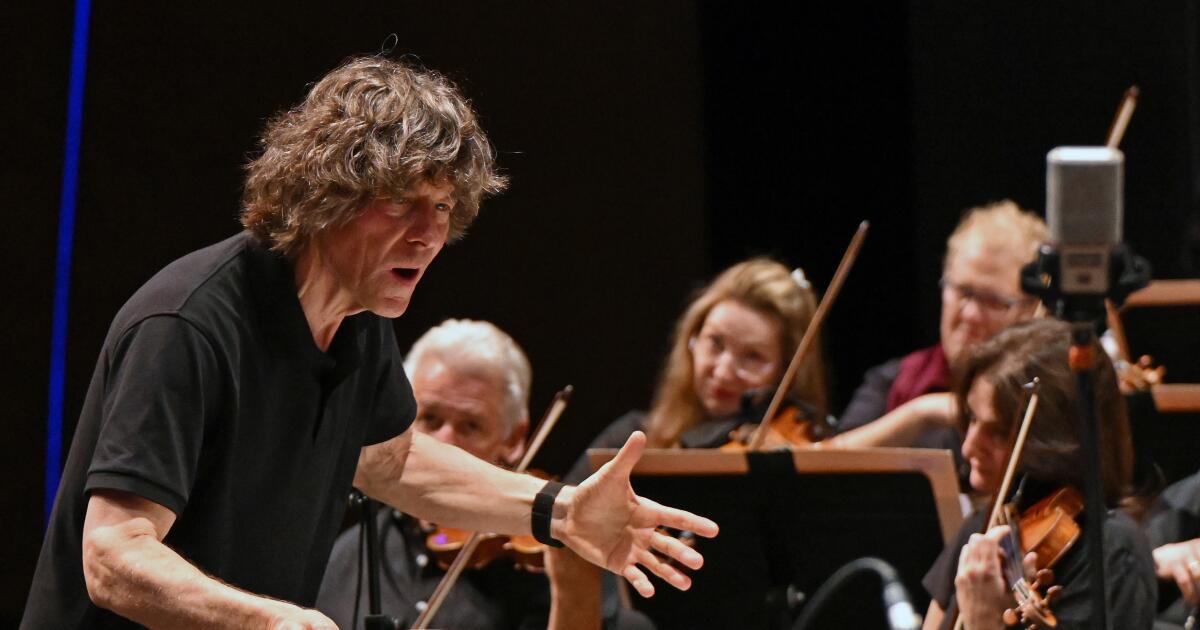
Film music is perhaps the most heard but least listened to music out there. And despite its ubiquity and invaluably additive contribution to cinema and frequent artistic glory, it has suffered from this lack of attention, of sufficient appreciation.
It had bastard status among classical culturati from the get-go, which kept it out of the concert halls where it arguably belonged as a rightful heir to other long-form orchestral music. But it has also gone unappreciated by the masses and even the film industry itself: look no further than the Golden Globes’ decision not to air the original score category on Sunday’s broadcast, ostensibly for time reasons. (Ludwig Göransson won for “Sinners,” and the show still ran longer than “Avatar: Fire and Ash.”)
On a mission against this devaluing and general ignorance about film music is conductor Scott Dunn, who has partnered with the Wallis in Beverly Hills to form a new orchestra — comprised of L.A.’s ace session players — dedicated to performing the best this art form has to offer.
“It’s fascinating to me that we had all these great geniuses in town, and kind of ignored them,” says Dunn.
The Scott Dunn Orchestra debuted last May with a whole concert devoted to Henry Mancini, followed in November by a showcase of Hollywood’s midcentury modernists. This Saturday they will host a tour of the 1970s, which means classic music by Jerry Goldsmith (“Chinatown”), Nino Rota (“The Godfather”), Marvin Hamlisch (“The Spy Who Loved Me”), David Shire (“The Conversation”) — and, of course, John Williams.
Dunn says this was probably the hardest concert he’s ever programmed: “I could, in 10 seconds, put together a second and maybe a third program from the ’70s, because the list is endless.”
(His next concert, in May, will focus on the European émigré composers who helped write the code of Hollywood film scoring in the 1930s.)
The ’70s was a fertile decade for film scoring. Some New Hollywood auteurs were eager for experimentation: “Chinatown,” composed as a replacement score in just 11 days, was written for four pianos, four harps, and solo trumpet; while “The Conversation” was just solo piano, as lonely as the film’s melancholy protagonist, Harry Caul. Other new directors wanted some old-time religion; thus, young Martin Scorsese teaming up with the legendary Bernard Herrmann on “Taxi Driver,” and young Steven Spielberg tapping John Williams — who dramatically resurrected the grand, symphonic storytelling score.
A fresh wind also blew in from across the Atlantic, with French and Italian composers importing both Old World (Rota) and New Wave (Michel Legrand) aesthetics to American cinema. Still another breeze blew in from Broadway, with composers like Hamlisch bringing extreme tunefulness and an arranger’s sensibility. Dunn’s program also includes music from the final score of Old Hollywood maestro Miklós Rózsa, for the 1979 film “Time After Time.” It was truly a decade of transition.
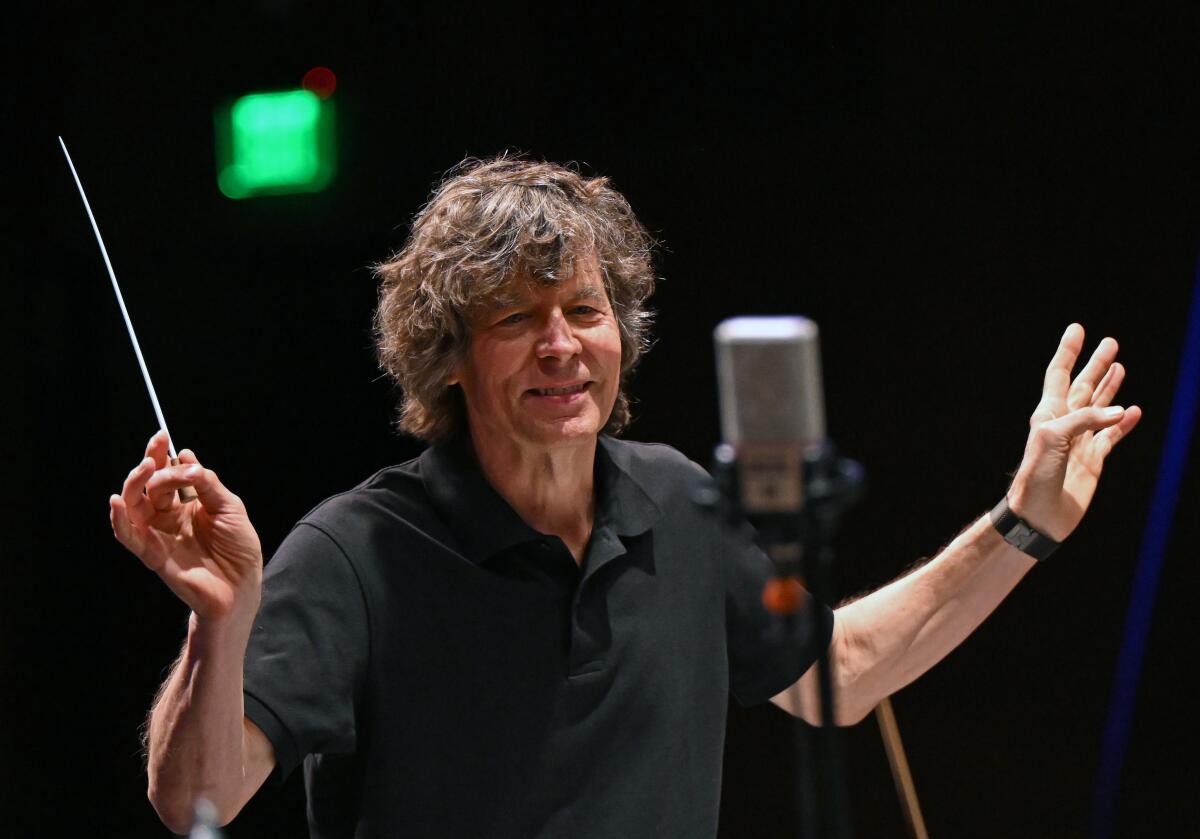
Conductor Scott Dunn
(Kevin Parry)
Some of these scores, or at least their main themes, have been heard in the concert hall. But even the best film music has often been relegated to “pops” and summertime concerts, with a tacit judgment among symphony orchestras that it should only ever be paired with children and picnic blankets.
It is true that film music is on every orchestra’s schedule these days — but as second fiddle to a giant projection of a popular movie. The LA Phil has joined an international trend of screening movies like “Jurassic Park” and “Home Alone” and playing their scores live to picture, a phenomenon that Dunn says he hoped “would bring interest in film music — but it hasn’t particularly garnered much focus on the music or the quality of the music. It’s mostly turned into a way to sell tickets for blockbuster films and fill your theater and make revenue.
“Which is a great thing,” he quickly adds. “It brings people in. But I find that if you actually take the film out of the equation, and are careful about the music selected, you can really make some amazing concerts of this music.”
His model was John Mauceri, who founded the Hollywood Bowl Orchestra in 1991 and conducted ambitious film music concerts here for 15 summers. Mauceri advocated a position that “the attention should be focused on the score,” says Dunn, who assisted Mauceri during those years — “that the film is actually kind of distracting, that the score works as concert music if it’s massaged correctly.”
The obstacles to presenting film music in concert have come from forces without — but also from inside the house. The snobbery and disdain from classical elites was internalized by the first generation or two of Hollywood composers, who in turn dismissed their own work and also often did not make an effort to preserve the music or rearrange it for concert performance. (Locating old score parts and making them playable, in addition to licensing from studios and rights holders, compounds the difficulty of these kinds of concerts.)
But ever since the dawn of Hollywood, there have been enthusiasts for these modern Wagners and Mozarts, moviegoers who developed a third ear to keenly listen to and appreciate this exciting new music playing under dialogue and sound effects, music that gets pejoratively labeled as “background” but which, for us, is the lifeblood and spiritual soul of cinema.
This little club included a lot of musicians, who went on to play “Indiana Jones” in their school ensembles and then joined professional orchestras and couldn’t wait to play “Star Wars” in Disney Hall or Carnegie Hall. The club also included conductors — like Gustavo Dudamel, an unabashed film music geek — as well as Mauceri and David Newman, son of legendary film composer Alfred Newman, who both became specialists and advocates in film music concerts.
Dunn came to this club in a roundabout way. Growing up in Iowa, he was drawn to the sheet music of Broadway songs on his family piano, and with the help of a great teacher he won a spot at Juilliard. But piano competitions freaked him out and he fled from music; he moved to L.A. and took pre-med courses at USC, earning board certification as an eye surgeon.
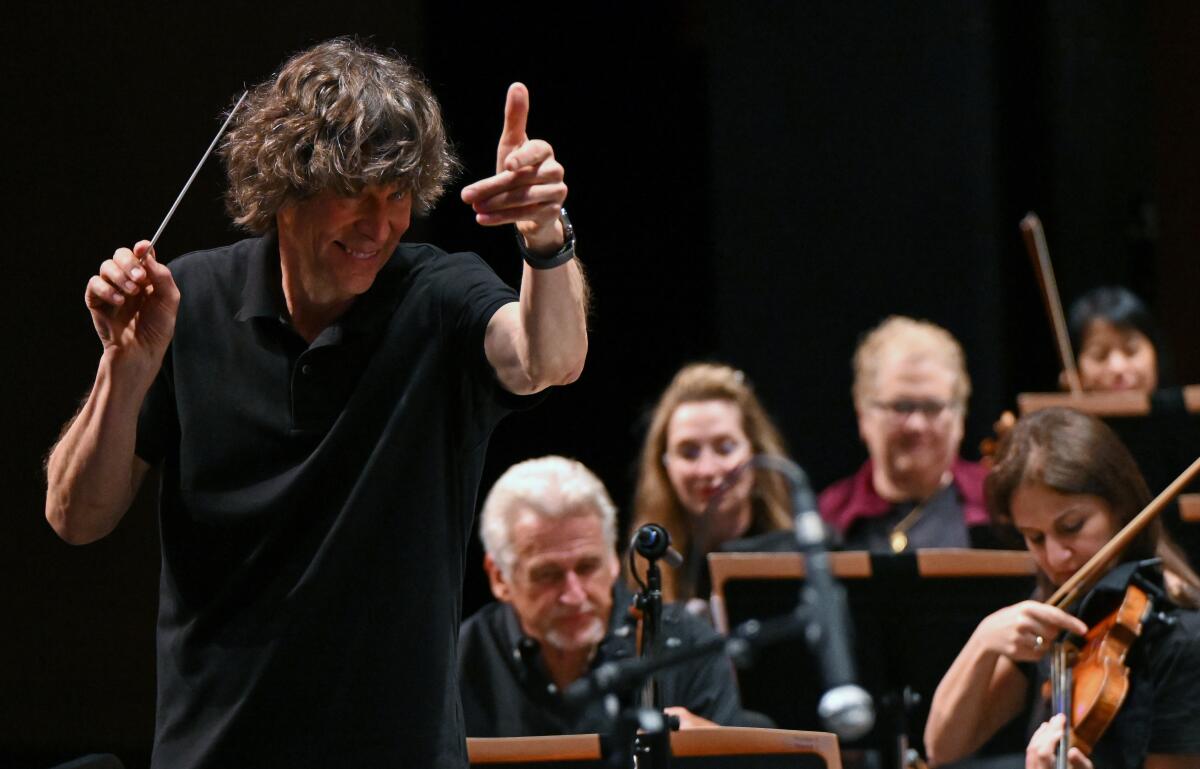
Scott Dunn Orchestra
(Kevin Parry)
Around this time in the early ’90s, Dunn sold his house; one of the interested buyers was Leonard Rosenman, the Oscar-winning composer famous for “Rebel Without a Cause,” who noticed the Steinway grand piano and competition-level scores and recognized that this “doctor” was in fact a musician. They met and became friends, and Rosenman convinced Dunn to return to music.
He initially went back to the piano, but found the life of a concert soloist rather lonely, so he gravitated toward conducting and making music with an entire orchestra.
“I wouldn’t recommend that path — trying to become a world-class conductor in your late 30s is a really painful row to hoe,” he says.
But it paid off. Dunn has conducted top orchestras from L.A. to Sydney, and accompanied many pop recording artists in addition to his championing of film music. (He also often does the arrangements, and occasionally sits at the keyboard.)
Is there an audience for this music? Dunn knocks on a wooden table and says they’ve sold out every concert so far. He has hopes for future concerts celebrating French composers, Randy Newman’s film music (“I just think he’s our modern day Schubert”) and, naturally, John Williams (“I’d love to explore some of his incredible lesser-known scores”).
This “background” music deserves L.A.’s full attention.