
Palo Alto plans to electrify more homes, buildings and cars, as well as expand communications to the community, as part of an effort to meet its ambitious environmental goals, according to a new plan.
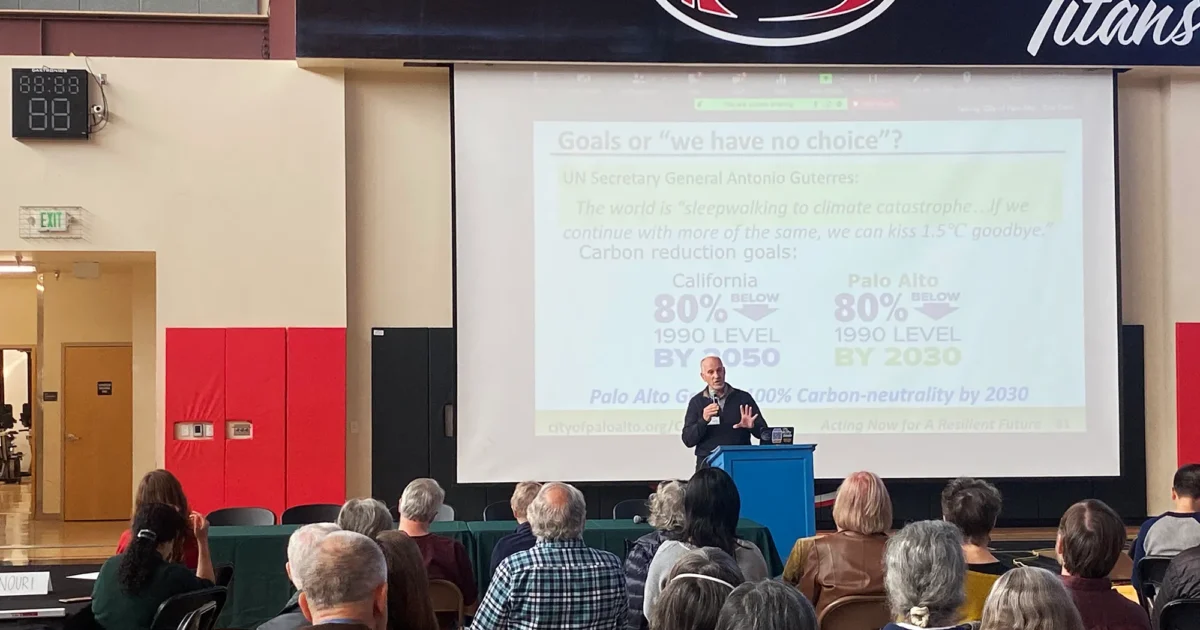
One of the primary goals of the plan, known as Sustainability/Climate Action Plan, is to achieve an 80% reduction in greenhouse gas emissions by 2030 compared to 1990 levels. While city staff will not have more recent numbers until February, emissions were down 47.4% by 2022, according to the staff report about the work plan.
Much of that reduction, however, came from the city’s adoption of a carbon-free electric portfolio more than a decade ago. Utilities Department staff emphasized that further progress would require far more participation from city residents.
“In terms of the pace that we would need to hit to achieve 80×30, it would require extraordinary levels of public participation,” Assistant Utilities Director Jonathan Abendschein told the Climate Action and Sustainability Committee on Jan. 9.
The committee — made up of Mayor Vicki Veenker and Council members George Lu and Pat Burt — has been discussing the plan for the past several months, and on Jan. 9 forwarded it to the full council for final approval.
The S/CAP splits its 47 strategies into three broader categories: 28 for climate action (primarily addressing the 80×30 goal), 16 for sustainability and three for communications.
The plan outlines several key actions that the city plans to take in the next two years toward the goal of electrification, such as an electric vehicle charging infrastructure for multifamily units, an advanced heat pump HVAC program and a pilot program for the electrification of centralized water heaters and boilers.
The Utilities Department has already made some progress in these areas. The city offers rebates for installation of heat pump water heaters, and it recently created a program that helps pay for installation of electric vehicle charging stations at residential buildings. Eligible participants can receive up to $80,000 for such installations, according to the Utilities Department. According to a progress report from city staff, the city’s initial program for multi-family properties has resulted in installation of chargers in buildings representing 9.2% of the city’s multi-family units. The updated electric vehicle charger program, which the council approved in November, aims to extend chargers to even more buildings throughout the city.
The committee acknowledged the ongoing uncertainty about the future of electric vehicles, with the federal government pulling back funding for charging infrastructure and taking a more aggressive approach toward oil production.
“There’s a huge debate right now about what the impact of our political environment is going to be on EV adoption rates. And it’s such a priority of ours because of the bang for the buck,” Veenker said.
But achieving 80×30 would take significantly more community uptake, according to city staff. For example, a 2021 report estimates that as many as 81% of gas water heaters in single-family homes would need to convert to heat pumps. In terms of transportation, 85% of new vehicle purchases by 2030 would need to be EVs to meet the city’s ambitious greenhouse gas reduction goals.
Between these various programs and initiatives, the S/CAP also directs the city to explore regulatory and financial barriers to mass electrification. Many of these are continued from the previous 2023-25 work plan.
As for sustainability, key actions for the next two years focus on water conservation and recycling, sea level rise adaptation, eliminating disposable food containers and increasing the city’s tree canopy, especially in south Palo Alto. Like the climate action strategies, many of these initiatives are continued from the prior S/CAP.
“The sustainability areas of Water, Climate Adaptation and Sea Level Rise, Natural Environment, and Zero Waste do not necessarily have a direct impact on greenhouse gas reductions, but have critically important sustainability, public health and safety, regional, resource conservation, and equity benefits that contribute to overall climate action,” the S/CAP states.
One of the biggest departures of this work plan compared to the 2023-25 version is the explicit strategizing for communication with the community. For the next two years, that includes more robust data and survey collection, as well as expanded outreach through targeted sustainability campaigns.
The 2025 Community Survey, which the council will discuss on Jan. 20, revealed that only one in seven Palo Alto residents feel extremely or very familiar with the city’s climate goals such as home electrification. And only one in 20 residents reported feeling extremely or very familiar with the 80×30 metric specifically.
The next step for the S/CAP is the approval by the full City Council during the Feb. 9 meeting. The council will also need to receive six consultant studies that break down the financing, funding and sector-by-sector analysis of electrification.
The committee generally lauded the workplan, even as they questioned the city’s ability to meet the lofty 80×30 goal. Burt conceded that Palo Alto is unlikely to meet that target but called the ongoing effort “exceptional” and well ahead of almost any other city.
“The leading cities are continuing to push the envelope like us,” he said. “There was no way of knowing what it would take to get to where we’re all hoping to go, and I think we are doing an effort that is exceptional, but is also likely to fall short of that goal.”
This story originally appeared in Palo Alto Weekly. Riley Cooke is a reporter at Palo Alto Weekly and Palo Alto Online focusing on city government.