
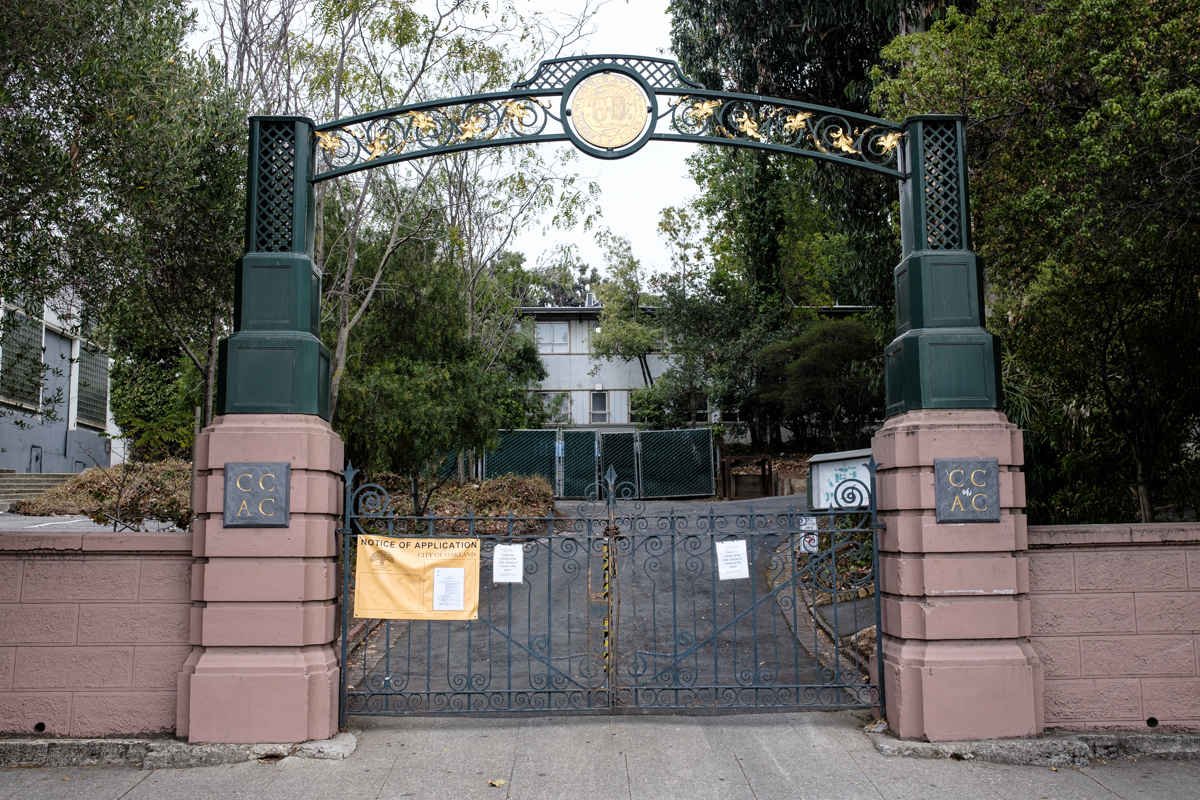
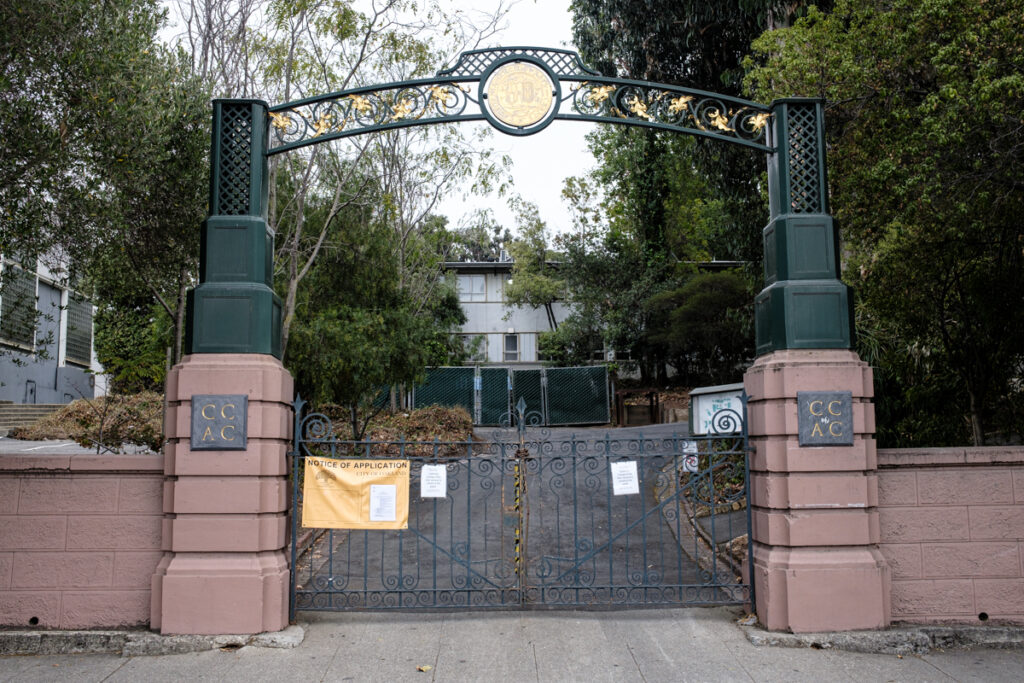
 California College of the Arts opened its Rockridge campus in 1922. This week, the school announced the sale of the property. Credit: Pete Rosos for The Oaklandside Credit: Pete Rosos
The four-acre woodsy Rockridge estate that housed California College of the Arts for over a century has changed hands, raising questions about the viability of a stalled housing project there.
Nashville’s Vanderbilt University announced this week its purchase of CCA’s San Francisco campus and plans to launch a new academic program there. The San Francisco Chronicle reported Wednesday that the real estate deal includes the college’s shuttered Oakland campus, too, located on Broadway.
“Vanderbilt has also agreed to take ownership of CCA’s former campus in Oakland,” says an FAQ page on the school’s website. “They have not determined specific plans for the Oakland campus.”
Vanderbilt did not respond to questions about the Oakland property and its future.
For nearly a decade, a proposed housing project at the Rockridge campus has been the poster child for fierce debates over development and preservation in the North Oakland neighborhood.
In 2017, CCA selected Equity Community Builders and the Emerald Fund to redevelop the campus after the arts college decided to consolidate its operations in San Francisco.
Initially, the developers proposed a 19-story housing tower with close to 600 homes, which faced vocal opposition from some neighbors, who formed a group called Upper Broadway Advocates. The group criticized many aspects of the proposal, including the scale and the lack of affordable units.
In response, the developers and architects redesigned the project, replacing the high-rise with smaller buildings, for a total of 448 apartments, either 5% or 10% affordable. The project would demolish 10 buildings on the campus and preserve two historic structures.
Meanwhile, the state of California told Oakland to plan for more housing in Rockridge, an affluent neighborhood with strong public transit, thriving business corridors, and a history of exclusionary zoning.
Over the years, the CCA project moved through the city approvals process, and was entitled at the end of 2024. By then, the economic landscape both locally and nationally had shifted, making it more difficult to finance development. Around that time, Emerald Fund’s president, Marc Babsin, told press that the project couldn’t break ground until the market changed.
Babsin repeated this to the San Francisco Chronicle this week, saying “the numbers just don’t work.” But he told the newspaper he’s “hopeful” that will change.
The developers had an option agreement with CCA to buy and build on the property once their plans were approved and they were ready to start construction. It is unclear whether that agreement will remain intact under Vanderbilt’s ownership. The Emerald Fund did not respond to interview requests Wednesday.
While this project’s future is unclear, another large housing development proposal in earlier stages is moving forward about a mile north on Claremont Avenue.
“*” indicates required fields