
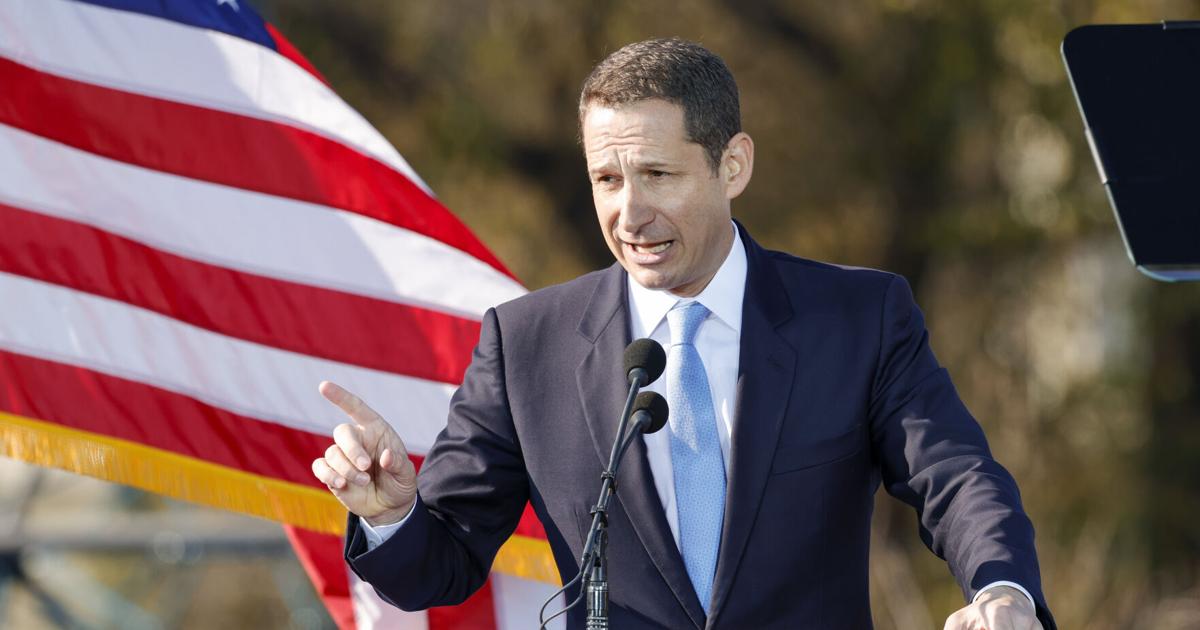
San Francisco Mayor Daniel Lurie gave an upbeat State of The City address Thursday, touting achievements from his first year in office along with positive crime statistics, economic developments and public-sentiment indicators while highlighting big challenges ahead, including deficits that will require cuts in municipal budgets.
“In 12 months’ time, we have become known around the world as a city on the rise,” Lurie said, reprising one of his stock lines about San Francisco’s improving fortunes.
Lurie spoke on a crisp, sunny morning before an invited crowd of about 600 people at Angelo J. Rossi Playground near Golden Gate Park in the northwest part of The City, a spot where he said he played soccer and baseball as a kid and his son has also played sports.
Reiterating that clean and safe streets are of paramount importance, Lurie celebrated that crime in San Francisco is down “nearly 30%,” homicides are at the lowest level since 1954, car break-ins are at a 22-year low and traffic deaths in 2025 were down by 42% from the prior year.
“Public safety is the foundation for San Francisco’s recovery, and it will always be my north star as mayor,” he said.
The improvement of San Francisco’s reputation, Lurie said, is reflected in increased conference bookings and this week’s announcement that Nashville-based Vanderbilt University will open a campus for about 1,000 students in the Showplace Square neighborhood near Mission Bay. Lurie courted Vanderbilt, which is buying the campus of the venerable California College of the Arts that will go out of business.
“A year ago, people questioned whether San Francisco would ever recover. Today, institutions like Vanderbilt, with plenty of choices, see our city as the place to be,” Lurie said.
Lurie recalled his creation of a “hospitality zone” police task force centered on a downtown area that includes the Moscone Center convention halls and the Union Square shopping and hotel hub. He said the strategic alignment has been bolstered by efforts to recruit more police officers and the opening of a new downtown “real-time investigations center,” a hub of surveillance technologies and practitioners that police say has assisted in at least 800 arrests since early 2024.
One of those in the audience Thursday was Ghazi Shami, founder and CEO of the San Francisco-based music company Empire, who was encouraged by developments in The City over the prior year.
Empire last year bought the historic and long-vacant One Montgomery building downtown and is working to turn into an innovative headquarters complex.
“I thought it was pragmatic,” Ghazi said of Lurie’s speech. “He has a real understanding of where The City is at and where we need to progress.”


Former Mayor Willie Brown and current District Attorney Brooke Jenkins greet Mayor Daniel Lurie after his State of the City Address at Rossi Park in San Francisco on Thursday, Jan. 15, 2026.
Craig Lee/The Examiner
The mayor, speaking amid an ongoing surge of federal law and immigration agents into Minneapolis, got a standing ovation Thursday when he recalled, without mentioning the president by name, how an influx of federal agents into San Francisco was called off in October. Lurie told President Donald Trump in a telephone call then that The City was making progress in lowering crime rates and stimulating its economic recovery. Some business leaders interceded with the president as well to say such a deployment was not needed.
“Under my administration, San Francisco will always be a city that takes care of its own,” said Lurie, referring to a $3.5 million appropriation he and the Board of Supervisors approved for additional legal defense funding “for our immigrant communities during an unprecedented time of fear and insecurity.”
Highlighting a less tolerant approach to public drug use, Lurie pointed to February’s passage by the Board of Supervisors of his Fentanyl State of Emergency Ordinance, which gave his administration more flexibility in contracting with mental-health services and addiction-treatment providers. Lurie subsequently ordered that city-funded programs not distribute fentanyl-smoking paraphernalia, a departure from harm-reduction policies, while also expanding shelter beds.
“We stopped freely handing out drug supplies and letting people kill themselves on our streets,” Lurie said. “It is not a basic right to use drugs openly in front of our kids.”
The fentanyl crisis raged on, nonetheless, with fatal drug overdoses on track to roughly match the level in 2024 at year’s end.
Lurie promised that this spring The City will open a stabilization center in SoMa for people arrested for public intoxication that will serve as an alternative to jail and hospitalization, and a connection to addiction treatment and other behavioral health programs. Those taken into custody will get access to help, while officers can get back on the beat faster, Lurie said.
“San Francisco is no longer a safe haven for those who want to sell drugs, do drugs and live on our streets,” Lurie said.
On the homelessness front, Lurie, who founded the antipoverty nonprofit Tipping Point before becoming mayor, said The City opened 600 new treatment-focused beds, and pushed for better coordination among health services, social services, law enforcement and other emergency responders, and the effort is showing results.
Shelter placements are up by 40%, and The City logged a record-low number of street encampments in December, the mayor said. Newly passed legislation is getting families living in recreational vehicles into housing and helping to “restore” public spaces, he said.

Department’s departures, elimination of unfilled positions is stretching patience at The City’s center

Like everyone else who has watched the Canadian television sports romance, Ali Wunderman’s life has since been turned upside down

It’s “an invitation to San Francisco to see Ukraine as it is today,” said The City’s Consul General of Ukraine, Dmytro Kushneruk
During the coming year, Lurie said that The City, which spends more than $1 billion a year on homelessness programs, will begin “redoing” every single homeless services contract “with a clear focus on accountability and results,” he said.
In a related vein, Lurie laid out a variety of other initiatives aimed at making The City more affordable — a theme increasingly prevalent in politics across the nation.

Cranes are shown at a construction site in front of the skyline in San Francisco, Wednesday, Aug. 20, 2025. (AP Photo/Jeff Chiu)
Jeff Chiu
The recent passage of his Family Zoning plan will help produce more housing that people can afford, Lurie said, though housing development is a slow-moving train. A coalition that includes a neighborhood alliance and a small business organization also filed a lawsuit filed this month challenging the plan, a move that apparently drew a swipe from the mayor. Lurie said Thursday that “some people are still putting their own interests ahead of what’s good for San Francisco families by trying to shut down this plan.”
The mayor promised to fund affordable housing projects and down-payment and loan-support programs “to assist educators and first responders striving to become homeowners and build generational wealth in the communities they serve.”
In addition, Lurie announced an expansion of free and subsidized early child care using money from a 2018 ballot measure voters approved for that purpose. Starting this month, he said, a family of four making less than $230,000 a year will qualify for free childcare at providers across San Francisco, and by the fall, those earning up to $310,000 a year will receive a 50% subsidy. Money will also go to raising early-childhood educator salaries and creating or expanding child-care facilities, among other purposes.
Lurie also unveiled a partnership with San Francisco Unified School District that will enable high school students to earn associate degrees and industry certifications at San Francisco City College, with guaranteed transfers to San Francisco State University. A student could thus get a Community Health Worker Certification at City College and then a Bachelor of Science in nursing at SF State.
Supervisor Bilal Mahmood said he welcomed Lurie’s emphasis on varied approaches to making life in The City less costly. Mahmood’s District 5 includes the Tenderloin, Hayes Valley, Lower Haight, Western Addition, Fillmore, Alamo Square, Japantown, NoPA, and Haight Ashbury.
“I appreciated the focus on affordability,” Mahmood said. “It’s a holistic issue that has to address housing, childcare and transit.”
Lurie vowed to keep leaning into public-private partnerships, like the Downtown Development Corporation, a privately funded nonprofit he called for on the campaign trail that has raised more than $60 million dollars for civic improvement projects that have included increased street cleaning and the fielding of welcoming ambassadors outside BART stations.
A top goal, meanwhile, will be winning voter approval in November for two anticipated ballot measures, one authorizing a city parcel taxi to fund the San Francisco Municipal Transportation Agency, the other a regional sales tax to fund SFMTA, BART and other local agencies facing deficits, Lurie said.
The proposed parcel tax would raise an estimated $183 million to $187 million, with annual levies starting at $129 for a single-family home up to 3,000 square feet and charges to tenants in rent-controlled apartments capped at $65 and single-room-occupancy units exempted. The five-county regional sales-tax measure, meanwhile, would allow for a 1% surcharge in The City.
San Francisco is facing an estimated $936.6 million budget shortfall in the upcoming two fiscal years. Lurie has directed municipal departments to identify $400 million in ongoing savings as The City prepares a budget, which must be finished by late July.
“I’ve instructed city departments that we are not going to spread ourselves thin by doing
everything a little less well. Instead, we are going to prioritize and deliver better services in essential core areas that keep our streets safe and clean and continue to drive a citywide economic recovery,” Lurie said Thursday.
Lurie said that a task force that includes Board of Supervisors President Rafael Mandelman will deliver a charter-reform ballot measure in November to streamline city government and make it work for everyday San Franciscans, not “insiders and special interests.”
“I will not accept or maintain an outdated system that drives up costs and breeds dysfunction and even worse — corruption,” he said.
The mayor said he would also continue working to simplify permitting processes with online tools and unification of systems such as those in the building and planning departments.
Lurie closed his speech by urging citizens “to roll up their sleeves and show their civic pride” by contributing personally, in particular this summer by participating in a first-ever citywide day of service. His wife, Becca Prowda, is pioneering the initiative.
“I’m calling on each and every one of you to join us — service, accountability, and change in big ways and small,” Lurie said. “By staying focused on the problems that need solving right here in San Francisco, we can reclaim our place as the greatest city in the world.”