
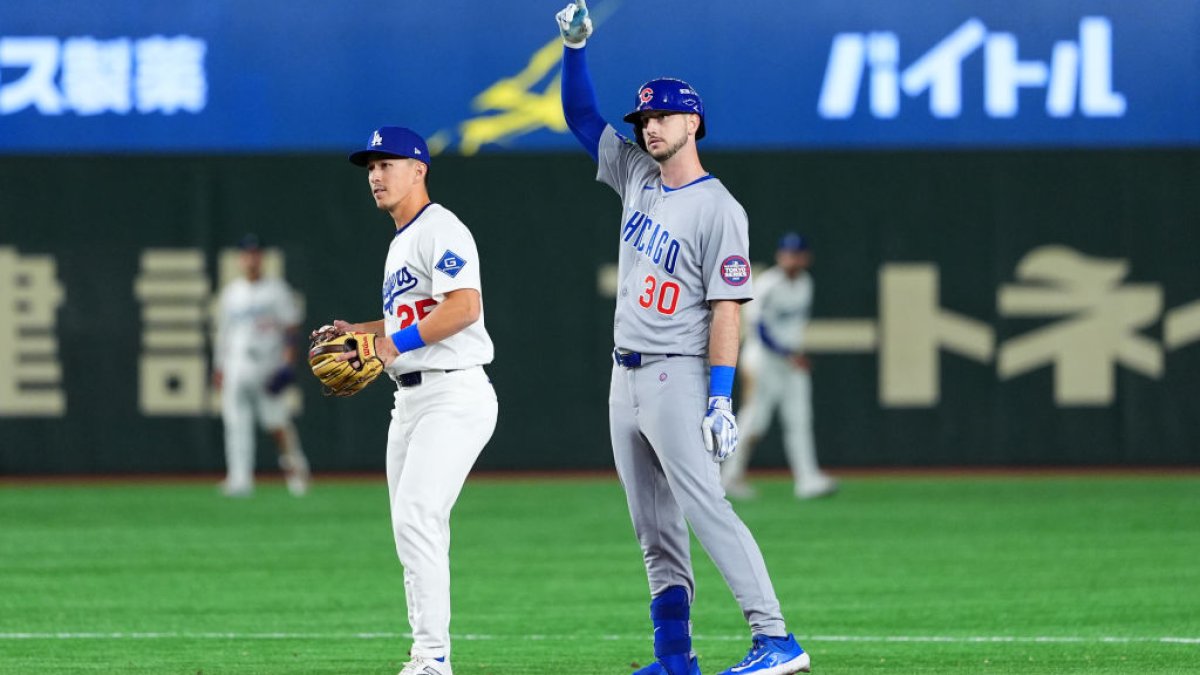
The wait ended the way so many modern baseball stories seem to in Los Angeles.
Kyle Tucker, the crown jewel of the 2026 MLB free agency class, is officially a Los Angeles Dodger.
Late Thursday night, the Los Angeles Dodgers finalized a deal with the four-time MLB All-Star and 2022 World Series Champion, agreeing to a four-year, $240 million contract that includes an opt-out after the second season. The pact carries one of the highest average annual values in baseball history and once again underscores the Dodgers’ willingness to operate at the very top of the sport’s financial ecosystem.
For months, Tucker’s free agency felt like a slow-burning standoff. Executives around the league believed his market would soar past $400 million on a long-term deal, especially given his age, durability, elite defense, and left-handed power bat. Tucker, coming off a season with the Chicago Cubs after being traded from the Houston Astros last offseason, was widely viewed as the rare free agent who checks every box: postseason pedigree, consistent production, and star presence without volatility.
But the market never quite erupted.
Instead, it pivoted.
As winter dragged on, the industry began buzzing about a different approach—shorter deals, massive annual value, and the chance for Tucker to re-enter free agency while still firmly in his prime. That’s where the Dodgers and New York Mets entered the picture in earnest. The Mets reportedly offered four years and $200 million, a strong bid that reflected their continued pursuit of top-tier talent. The Toronto Blue Jays, fresh off a 2025 World Series runner-up finish, went longest with their offer, hoping stability and years would sway the slugger north of the border.
In the end, Los Angeles wouldn’t be outdone.
The Dodgers pushed their offer to a level no one else could touch, combining financial dominance with flexibility. Four years. $260 million. An opt-out after year two. It was the perfect blend of security and leverage for Tucker—and a familiar aggressive strike from a franchise that has mastered the art of roster construction in the modern era.
Tucker batted .266 with 22 home runs, 73 RBI, and 25 stolen bases in 136 games with the Cubs last season. He was voted to his fourth All-Star Game in July.
Tucker is expected to start in right field for the Dodgers, moving Teoscar Hernandez to left field, where he played predominantly during the 2024 World Series season. The Dodgers needed another outfielder after left fielder Michael Conforto didn’t quite pan out as the team had thought in 2025.
Tucker slides into an already formidable Dodgers lineup as a middle-of-the-order force, capable of changing games with one swing while providing Gold Glove-caliber defense in the outfield. His postseason résumé only strengthens a team that measures success in October, not summer standings.
For the Dodgers, this signing isn’t just about winning the offseason. It’s about control—of the market, of the narrative, and of the championship window. While other teams blinked or hedged, Los Angeles leaned in.
Kyle Tucker bet on himself.
The Dodgers bet on now.
And once again, the rest of baseball is left reacting to a move that reshapes the balance of power—one expensive, deliberate swing at a time.