
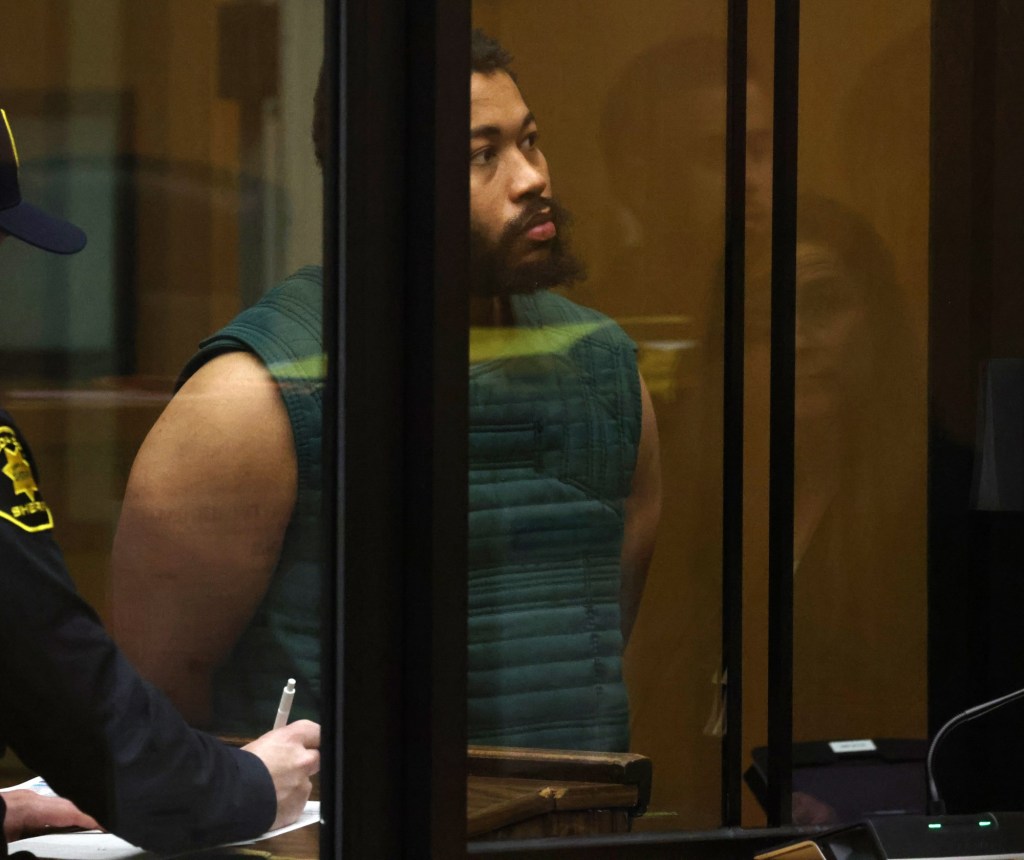
The attorney for the man accused of fatally shooting legendary Oakland football coach John Beam raised questions Wednesday about her client’s mental fitness to stand trial, casting fresh uncertainty on a prosecution that has garnered national attention.
The public defender’s concerns effectively pause the criminal case against Cedric Irving Jr., 27, while psychologists evaluate whether or not he is mentally competent to be prosecuted. If it is determined that he is not, then Irving could be sent to a state hospital for treatment, with the goal of restoring his ability to understand court proceedings.
The move casts a fresh spotlight on Irving’s mental wellbeing, after he initially told investigators that he targeted Beam on account of the longtime coach placing “witchcraft” on him and trying to “mess” with Irving’s body and mind. The statement later led Alameda County Chief Public Defender Brendon Woods to say the information “suggests serious mental health problems may play a significant role in this case.”
The matter of Irving’s mental competency pertains solely to whether or not he understands court proceedings and can aid in his own defense. It is a completely separate legal matter from his mental state at the time of the killing, meaning it has no bearing on whether or not his attorneys could seek an insanity defense at trial.
In a statement, Woods said that “we don’t think our client is able to stand trial right now because of his mental illness.” He also stressed that nothing can happen in the case until the matter of competency is resolved.
Beam was shot in the head on Nov. 13 at the Laney College Field House, where he worked as the college’s athletic director and had recently retired as a decades-long football coach for the Eagles. He died a day later, hours after authorities arrested Irving near the San Leandro BART station.
The killing made national headlines; Beam had starred in the Netflix show “Last Chance U” while helping more than 30 former high school and college players reach the NFL.
Authorities suspect Irving bought the gun used in the attack for the singular purpose of killing Beam, court records show. He bought the gun on Oct. 15 and picked it up from a Castro Valley gun shop on Nov. 4, after passing a background check, according to police and court records.
Police obtained records of the gun transaction with a search warrant, hoping the evidence can be used to offset an anticipated mental health defense from Irving. Under state law, a person can be deemed criminally sane at the time of a homicide — despite having a delusion as their motive — if there is evidence they knew the killing was wrong.
Steve Clark, a Bay Area attorney and legal analyst, stressed that Wednesday’s development had little to do with any such potential insanity defense at trial.
“Competency speaks to the state of the mind of the defendant now, when he’s trying to assist his counsel,” said Clark, stressing that it was completely separate from a defendant’s mindset at the time a crime was committed.
Irving’s public defender, Sydney Levin, said during a hearing Wednesday there was “substantial” evidence that her client was not competent. Though Irving was scheduled to enter a plea of guilty or not guilty during the hearing, he did not. In the meantime, Irving remains held without bail at the Santa Rita Jail.
Alameda County Assistant District Attorney Danielle London initially opposed the notion that Irving is not mentally fit to be prosecuted. Yet Alameda County Judge Thomas Reardon said the issue of Irving’s mental competency needed to be explored.
At London’s request, Reardon ordered that Irving undergo two psychological evaluations. Typically, only one is initially ordered, and a second can be requested if either side disagrees with the assessment.
Reardon ordered evaluations be completed by Irving’s next court date of Feb. 27. At that time, if both doctors report that Irving appears incompetent and neither Irving’s attorneys nor prosecutors disagree with those assessments, then Reardon could send Irving to a state hospital for treatment. Such treatments can take months or, in rare cases, even years, before competency is restored – if at all.
If either Irving’s attorneys or prosecutors disagree with the psychologists’ assessments, they can challenge those conclusions and request a full hearing on the matter, Clark said.
In any case, the prosecution is in for a “long journey,” Clark said.
“This sort of takes the case off the fast-track, unless both doctors in short order say, ‘We agree he’s competent,’” Clark said.
Jakob Rodgers is a senior breaking news reporter. Call, text or send him an encrypted message via Signal at 510-390-2351, or email him at jrodgers@bayareanewsgroup.com.