
Monthly San Diego Gas & Electric bills will increase by an average of $5 for the next three years after the California Public Utilities Commission on Thursday approved spending that SDG&E racked up between 2019 and 2022 to reduce the risk of wildfires.
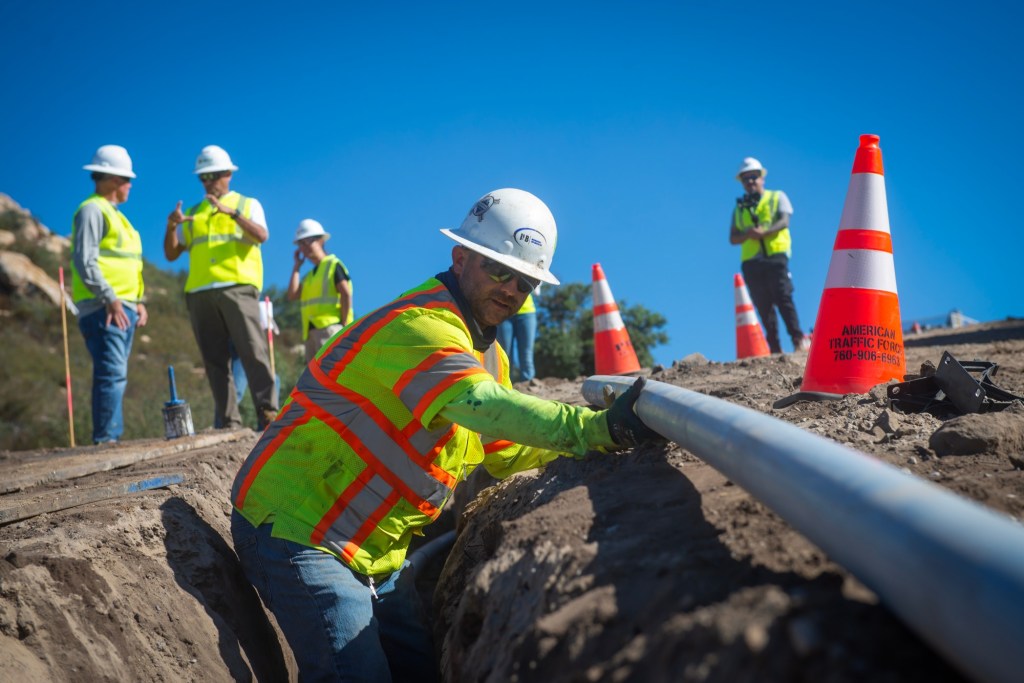
The decision signed off on efforts such as placing power lines underground and layering overhead lines with “covered conductors” to keep them from sparking fires, but the commission also slashed — or outright rejected — millions of dollars in other items that SDG&E requested.
The commission, or CPUC, OK’d the pared-down amounts in a densely worded 185-page revised decision on a 4-0 vote.
While SDG&E has already received some financial relief to recover its wildfire spending costs, there is still an under-collection of $177.46 million.
With Thursday’s decision, that amount will now be amortized over a three-year period, which pencils out to an increase of about $5 on the monthly bill of an average SDG&E customer. Those enrolled in the California Alternate Rates for Energy (CARE) bill assistance program will see an average increase of around $3 per month.
The increase will go into effect in SDG&E customers’ statements in April.
CPUC Commissioner Darcie Houck noted that SDG&E has not had a catastrophic wildfire in its service territory since 2007 but acknowledged that expenses associated with preventing ignitions weigh on customers.
“Wildfire safety is essential,” Houck said, “but it’s also very costly … ratepayers alone cannot continue to shoulder the burden and we need to be thinking about other solutions for funding these safety-related programs while maintaining high safety standards.”
SDG&E has spent roughly $6 billion in ratepayer funds on prevention efforts since the devastating Witch Creek, Guejito and Rice wildfires destroyed more than 1,300 homes, killed two people, injured 40 firefighters and forced more than 10,000 to seek shelter at Qualcomm Stadium in 2007. One of the fires was caused by a tree limb that fell onto an SDG&E line during high winds.
Wildfire prevention is a significant driver of rising power bills in California. According to a recent report from Stanford, the big investor-owned utilities in the state — SDG&E, Southern California Edison and Pacific Gas & Electric — planned to spend more than $9.2 billion in 2025, solely to lessen the risk of their infrastructure sparking a fire.
“Wildfire mitigation is essential to protecting communities, and the costs should be fully recoverable,” SDG&E spokesperson Anthony Wagner said after Thursday’s vote. “Proven safety measures — such as drone inspections, covered conductor, brush clearance, and emergency communication tools for public safety power shutoffs — have significantly reduced regional wildfire risk.”
Bill Powers, board member of the Protect Our Communities Foundation, a nonprofit based in San Diego, took part in the CPUC proceeding. He argues that SDG&E overspends on items such as undergrounding power lines, and says the commission should look at options such as expanding solar and battery storage to help reduce the financial burden on ratepayers.
“Lean into the 21st century instead of rebuilding a century-old grid that should be allowed to fade as new smart technology comes on board,” Powers said. “Instead, we’re rebuilding, in a different way, a century-old grid at a huge expense.”
SDG&E sought $218 million for its drone program, but the CPUC turned it down, saying the utility provided “insufficient” evidence that the costs were reasonable. However, the decision allows SDG&E to return to the commission and try to recoup the expenses, although some commissioners expressed irritation.
“The applicants, and any utility for that matter, should not expect a second bite at the apple to occur regularly,” said Commissioner John Reynolds.
The $5 increase comes on top of earlier bumps in SDG&E bills for the new year.
The utility last week announced revised figures that estimated an increase on the delivery rate of electricity from 21 cents per kilowatt-hour to 22.5 cents for residential customers not on bill-assistance programs, resulting in an increase of $4 compared to last year for those using 400 kWh per month.
Residential customers with natural gas hookups will pay just under $2 more for using 33 therms during the winter months, compared to 2025. A therm refers to one unit of natural gas.
The increases — including the $5-per-month escalation relating to Thursday’s wildfire spending decision — also apply to customers enrolled in San Diego Community Power and the Clean Energy Alliance, the two community choice aggregation, or CCA, programs in the region.
As per state rules, CCAs purchase electricity generation for customers in their respective municipalities. But legacy utilities such as SDG&E are still responsible for the costs associated with transmitting, distributing and delivering power across the region.
Persistent increases in utility rates have become a sore point for customers across California.
According to the California Legislative Analyst’s Office, average rates for SDG&E, Pacific Gas & Electric and Southern California Edison increased between 48% and 67% from 2019 through 2023.
There is some good news on the horizon. San Diego customers later this year can expect to see an estimated reduction of $3 on their monthly bills because of an earlier CPUC decision.
It’s a bit complicated, but the commission approved SDG&E’s general rate case in late 2024.
Essentially a budget outline, a general rate case estimates what the CPUC thinks it will cost to maintain and upgrade the power system for each investor-owned utility in California over a four-year period.
On a 4-0 vote in December 2024, the CPUC approved a rate increase of 2.6% for electricity and 1.8% for natural gas for 2024 through 2027.
But the commission did not approve the decision until 2024 was almost over. As a result, the rate increases had to be amortized into customer bills for 18 months starting in 2025 to make up for what was not collected.
That 18-month stretch will end in the middle of this year, which means a reduction in average residential SDG&E bills of about $3 per month starting around August.