
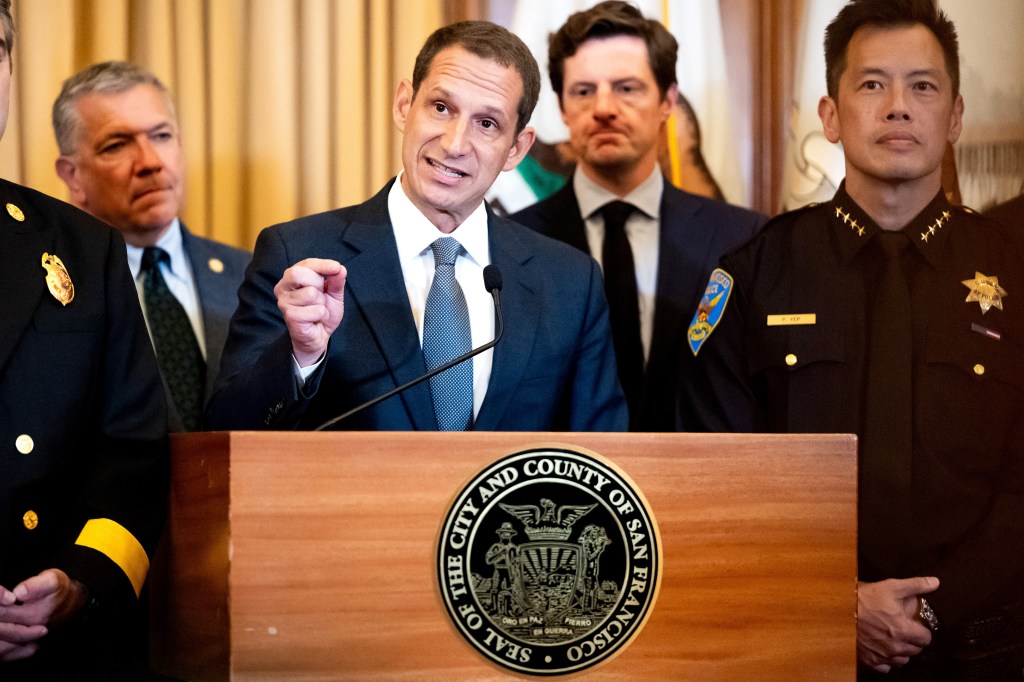
San Francisco’s mayor, Daniel Lurie, seemingly collects a pocketful of plaudits every day. By contrast, his counterpart in Los Angeles, Karen Bass, gets new grief almost daily.
The positives about Lurie, who ousted former Mayor London Breed in late 2024, were propelled by a coalition of voters unhappy with his city’s previous status quo. Though he was better known before running for his charitable leadership as founder of the poverty-fighting nonprofit Tipping Point, Lurie immediately after getting elected began focusing on crime, homelessness, housing bottlenecks and quality-of-life issues like cleaning the streets.
Lurie streamlined housing approvals, re-organized and sped up city safety responses, launched an anti-homelessness campaign and won a 73% approval rating at Thanksgiving among local voters. Bass faced some of the same issues when she took over but did little to clean up streets or fill potholes and did not reduce homelessness by much, with tent cities still proliferating almost four years after she was elected in 2022.
Most damaging of all, she absented herself during the start of January 2025’s Los Angeles County firestorms that killed 12 people and burned more than 7,000 structures in her city alone. Bass still is regularly blamed and castigated for the snail’s pace at which reconstruction has moved – even though most of the responsibility for that probably lies with insurance companies issuing many payouts far below what’s needed to rebuild — even to homeowners who had paid for sufficient coverage.
That’s not to say Lurie is credited with perfect performance. One example of a criticism: The slow response to a massive December Pacific Gas & Electric power outage that left fully a third of San Francisco without electricity, shutting down museums like the Legion of Honor art museum and leaving thousands of homes and shops without electricity for more than a day.
Still, the predominant image of Levi Strauss heir Lurie is that of an earnest problem solver blending private sector agility with an ability to experiment with public policy. Very few San Franciscans would bet against his chances for re-election, even if it is rather early in his term.
Meanwhile, very few Angelenos or others would bet on Bass’s re-election chances, even if she has only one formal opponent today: Austin Beutner, a billionaire former superintendent of the city’s school system who fostered creation of many charter schools.
Bass seems to encounter a crisis a day, not even getting a break during Christmas week, when her city’s largest newspaper blasted her for asking that the last few comments she made in one video interview about the local Fire Department’s failures of last January be edited out because she thought the interview had already ended.
Perhaps Bass — a former Congressmember and state Assembly speaker — believes she’ll get a pass on many of her clear failures because she carries a Democratic label into the 2026 nonpartisan re-election campaign.
Uh-uh. A prospective repeat opponent, developer Rick Caruso — the University of Southern California’s former chief of its board of trustees during that university’s long series of scandals — switched from Republican registration to Democratic because he knows the GOP label is locally poisonous. Beutner, a former investment banker and publisher of the Los Angeles Times, calls himself a “pragmatic Democrat,” a tag that might be appealing against Bass, who has been a party regular and is known as a staunch liberal.
Right now, Lurie clearly enjoys a stronger position at home than Bass. His high approval rating reflects a rebuke of past mayors and the appeal of his problem-solving approach.
Support for Bass is more mixed, with her current record containing many more failures than have afflicted either Lurie or any other recent Los Angeles mayor. But all Bass might need to redeem herself is a strong performance in the face of whatever the next crisis may be — if it comes before the November election.
Their public perceptions are in stark contrast, largely because of differences in how each has approached their city’s problems of the last few years, along with the very nature of those problems.
Email Thomas Elias at tdelias@aol.com, and read more of his columns online at californiafocus.net.