
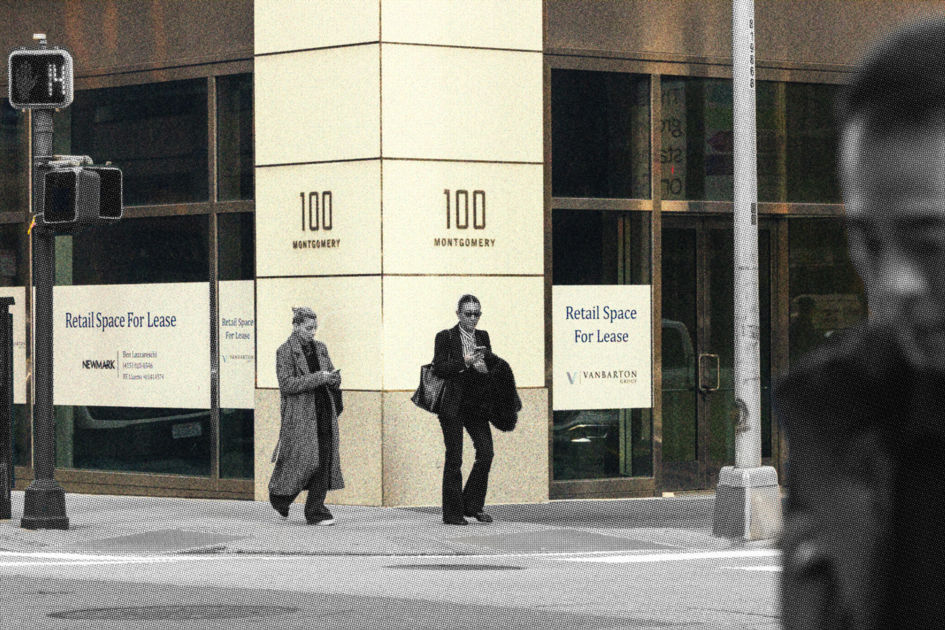
After the federal government took an axe to San Francisco Immigration Court in 2025, cutting its bench from 21 judges to four in a matter of months, it’s starting the new year by making that shrinkage permanent. Last week, the Department of Justice told court staff (opens in new tab) it will not renew its lease for offices and courtrooms at 100 Montgomery St. by the end of this year. The announcement was first reported by Mission Local.
The Montgomery Street facility housed 19 of the 21 judges at the start of 2025. Without it, San Francisco Immigration Court will run entirely out of its much smaller space at 630 Sansome St., where Immigration and Customs Enforcement also has offices. ICE officers routinely detain asylum seekers in the halls outside Sansome courtrooms, shuttle them a few feet down a hallway, and disappear them into a holding area. It’s a far quicker and more secretive process than the dozens of ICE detentions at the Montgomery building, which happened in public view on the street out front, leading to some of the past year’s most memorable confrontations between protesters and ICE.
 Source: Amanda Andrade-Rhoades/The Standard
In its internal announcement, the DOJ said all staff at Montgomery Street will be relocated to Concord Immigration Court this year. Several immigration law experts say that if cases are reassigned out of San Francisco, asylum seekers could be robbed of the unique bevy of services the city’s legal aid community provides.
“We‘ve been proud of ourselves as sort of like a model for the rest of the country for how to do large-scale, public-defender-style immigrant defense,” said Jordan Weiner, interim executive director at La Raza Centro Legal. “By shutting down SF immigration court, they’re doing a good job of making it harder for us.”
La Raza Centro Legal is part of the San Francisco Immigrant Legal Defense Collaborative, a group of 16 nonprofit organizations that provide legal support to people facing deportation. The collaborative ended 2025 with a flawless record in helping people detained by ICE at immigration court, winning 100% of habeas corpus cases filed in federal court to get those people released.
The city funds the coalition’s work and requires that nearly all of it take place in San Francisco. It’s unclear if San Francisco will pay for legal services at the Concord court, 25 miles away.
Concord’s court saw six of its 13 judges fired in 2025 and has a backlog of 6,000 cases.
“The judges in that court will now have to deal with a barrage of new cases on top of their already crushing caseloads,” said Shuting Chen, who was fired as anSF immigration judge in December.
What’s next
The culling of immigration judges has been one of the Trump administration’s most successful efforts to remake the federal judiciary to serve his policy objectives. In 2025, more than 125 immigration judges across the U.S. were terminated or accepted buyouts to retire early, shrinking the national judge corps by at least 15%. Courts in blue cities have fared far worse than average. In September, news leaked that the Trump administration planned to backfill the vacancies with 600 military judges. At least one of those military judges has already been fired (opens in new tab) for apparently granting asylum too frequently. In early December, the DOJ posted job openings for “deportation judges.”
The closure of Montgomery Street dashes hopes that any of the newly appointed or hired judges will restock the bench in San Francisco, which had one of the busiest immigration courts in the country.
“The court at Montgomery is an institution and, for many immigrants, the first real contact they have with the justice system in our country,” said Chen. “Its demise is an intangible loss … because the court is a symbol of the rule of law and judicial integrity and independence we’re supposed to have in this country.”
As of September, San Francisco Immigration Court had the nation’s 10th-largest backlog: 120,000 cases. For the thousands of asylum seekers whose judges have been fired, the most that they can do is refresh the DOJ website to see if their cases have been reassigned and when they might get a day in court. Many have received notice that their hearing dates have been pushed to 2029.
“There‘s a reason the Trump administration is trying to shut down the courts,” Weiner said. “Because that’s where you vindicate your rights.”
According to the DOJ’s memo, the Montgomery courts could be vacated as early as this summer, but it’s unclear when or where cases may be reassigned.
Weiner doesn’t think that will matter much in the end. “ I don’t think the administration has any plans for these cases ever to be heard,” Weiner said. “I think they’re going to keep finding ways to cut them off before they get to the final hearing.”