
“She tried to do exactly what I did,” he remembered. “But for some reason, I was allowed to do that and not her. That very clear sense of discrimination stuck with me.”
He went home unsettled — and then decided not to let the moment pass. Within days, he began figuring out how to help people like the single mother he’d seen on the roadside.
At first, the effort was modest. His costume was bare-bones — just a sweatshirt with a Batman logo — and the supplies he handed out came from money saved from summer jobs. He stashed pieces of the outfit in his backpack or under his clothes, slipping into his Batman persona after class to check on people downtown.
His choice of Batman was deliberate.
“I appreciate that the character is human,” he said. “[He] wants to do the right thing despite having no superpowers [and] turns personal struggle into something that helps others.”
He said his own struggles with a learning disability propelled him to become Batman. Now, helping others is a way to heal some of the pain he felt as a kid.
Then he grinned: “And the character looks cool. I won’t deny it.”
He embodied the character, not sharing his identity with even his parents. For Batman, anonymity is part of the work.
“It means I can keep myself out of this,” he said. “And it helps people recognize me from a distance.” He added that it also makes him more approachable, using levity to connect with the unhoused.
When Batman of San José walked beneath the Highway 87 underpass in 2020, the familiarity of the costume drew immediate attention — especially from a 3-year-old child living there with his mother.
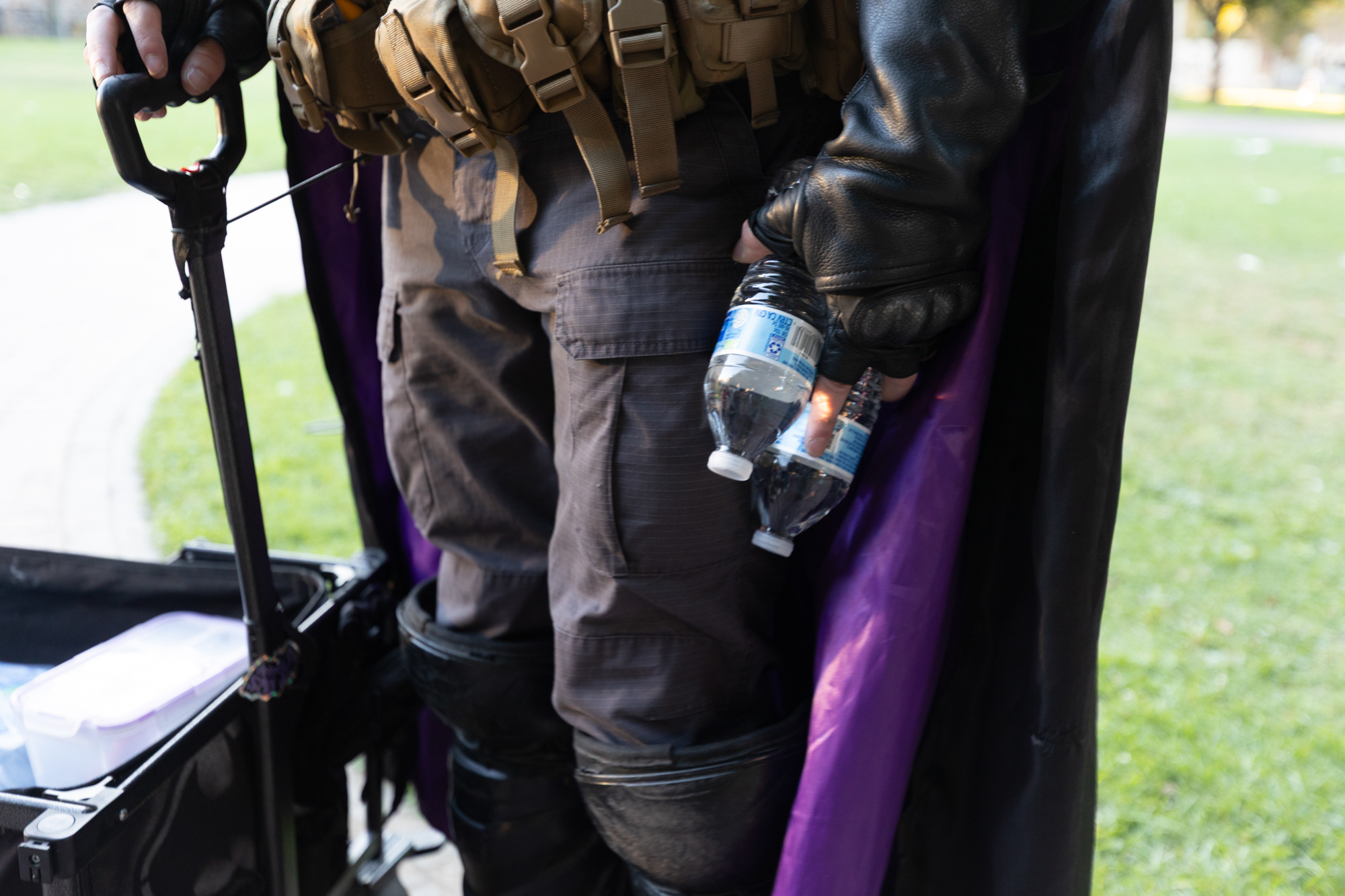 With bottles of water in hand, the Batman of San José prepares to distribute supplies in San José on Aug. 13, 2025. (Gustavo Hernandez/KQED)
“The kid was absolutely fascinated,” Batman recalled. “He was grabbing at the ears of the mask and the cape.”
The tender moment caught him off guard, and he found he was grateful to be wearing a mask.
“I lost it almost immediately,” he said, recalling the sadness of seeing a child so young without shelter. “The mask helped hide that.”
The family was trying to get the child into school, he explained, but life on the street made regular attendance nearly impossible. Over the next several years, Batman worked alongside case managers, providing groceries, financial assistance and a steady presence as the family navigated housing instability.
After about two years, when the family received more permanent housing, the child finally started attending school. Batman was there for his kindergarten graduation.
“It wasn’t high school or college,” he said. “But to that family, it meant everything, [and] that mom is my personal hero.”
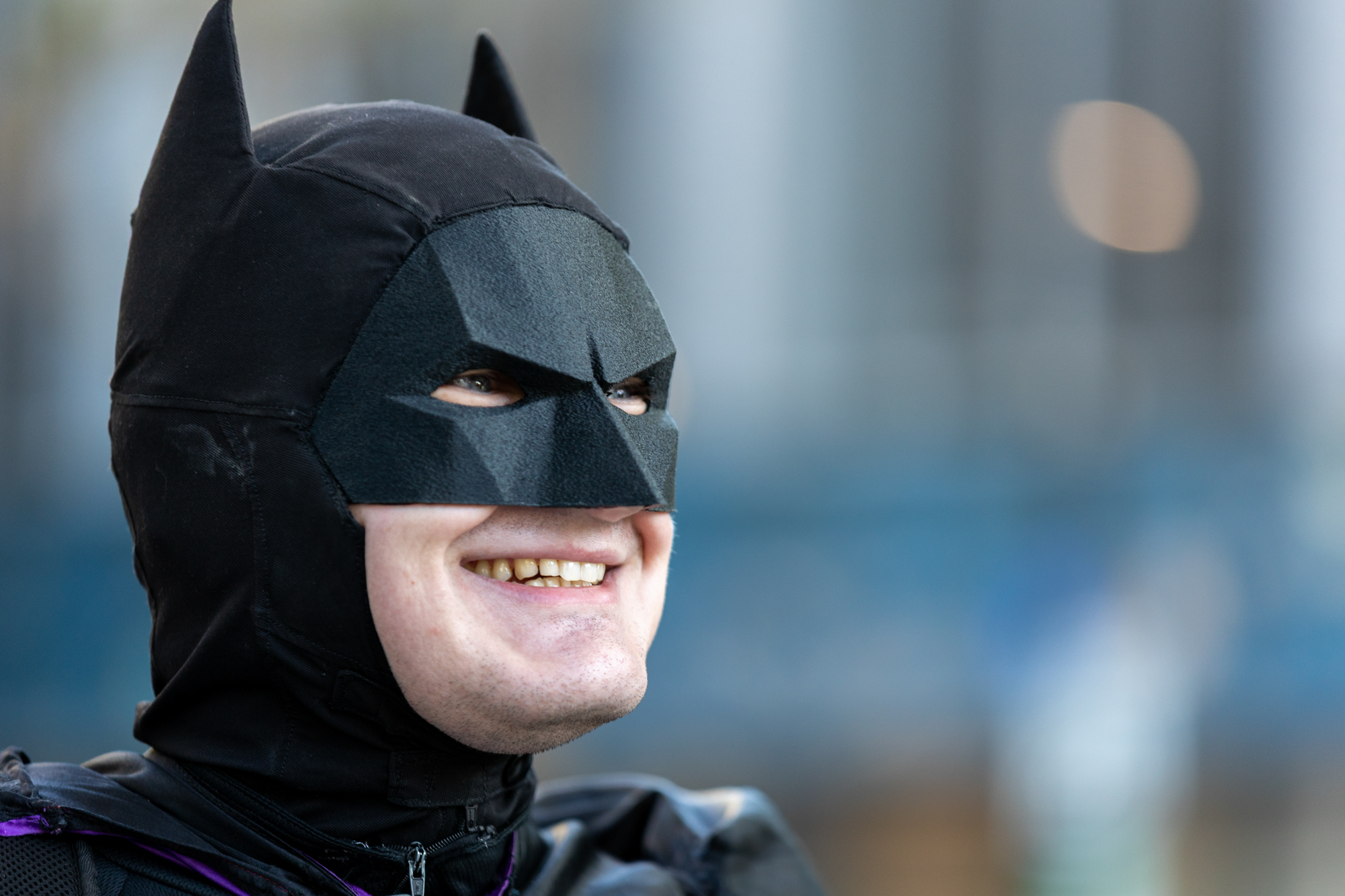 Surrounded by familiar faces, Batman laughs during a stop in San José on Aug. 13, 2025. (Gustavo Hernandez/KQED)
The mother told him her child now runs around clutching a piece of black fabric, pretending it’s Batman — something that keeps him safe.
“I never thought I’d have that kind of impact,” Batman said. “It taught me I don’t have to do everything — to that kid, that was everything.”
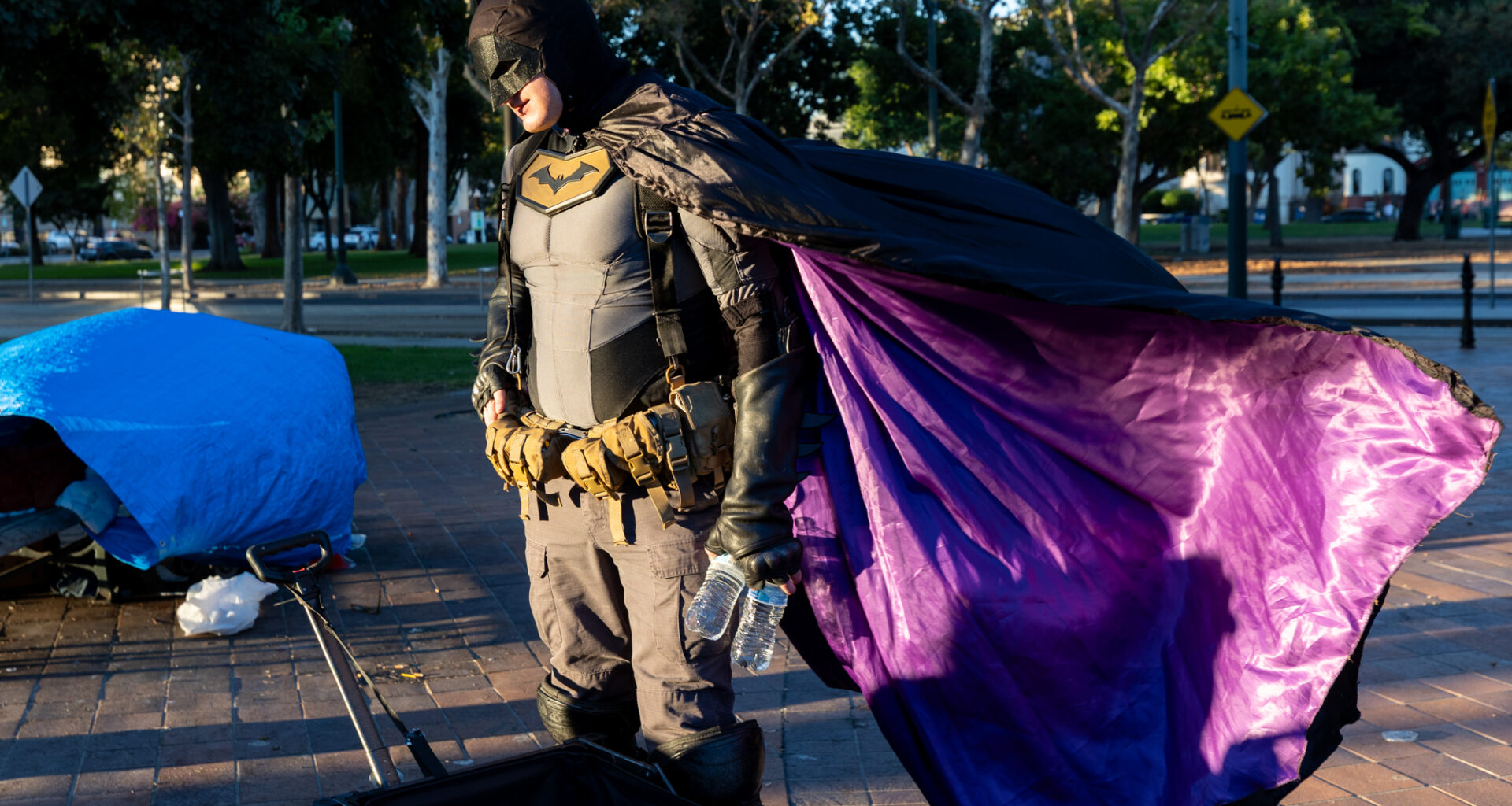
Since then, he has designed the costume with intention: gloves for scrambling up riverbanks, shin guards for kneeling beside tents, a belt filled with first-aid supplies, tools and tape. And the dramatic cape? It doubles as an emergency blanket.
“I can give it to someone if I run out of everything else,” he said.
The weight of friendship and loss
Batman has become a quiet keeper of stories and routes — able to trace who’s still around, who’s disappeared, and how lives on the margins shift over time. He has forged authentic relationships with the people he encounters, and each person leaves a mark.
“I consider a lot of the people I meet out here to be my friends,” he said.
He shared the story of Susie, an unhoused woman he checked on often, until police cleared the area where she was living.