
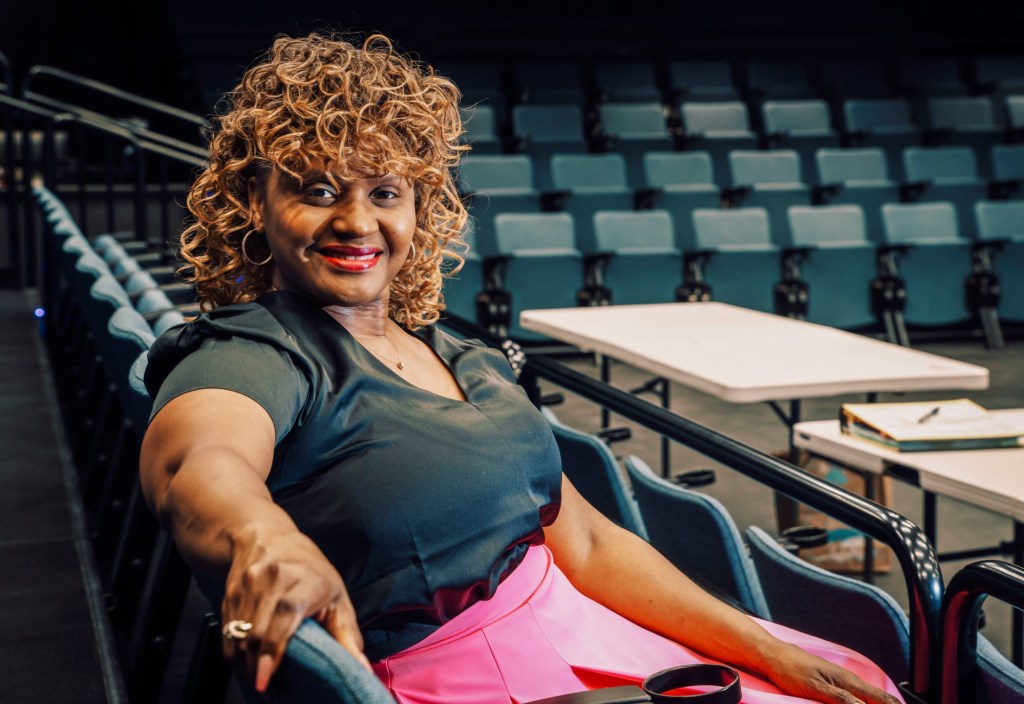
Monique Gaffney’s father always told her that “theater is in your blood,” and it makes sense. Her childhood home was filled with creative people and conversations, icons in the Black arts movement (like a visit from James Baldwin), and her own entry into performing through dance and, later, theater.
“My first introduction to theater was definitely my father. I remember that my father was often busy working, and I always sort of wondered, as a child, ‘What’s going on?’” she says of her dad, Floyd Gaffney, co-founder of the theater and dance department at UC San Diego and an artistic director at Common Ground Theatre, one of the oldest Black theater organizations in the country. “I didn’t really ask those questions until I was, probably, about 6 or 7, so my first sort of memory of theater was my own experience that my daddy was a professor.”
The theater bug sunk its teeth into her and she’s spent her career as a professional actor and teaching artist, including artist residencies, as a lecturer and adjunct professor, leading training programs, and as an associate artist with Write Out Loud, an organization providing education and programming to promote literacy and a love of literature by reading it aloud to audiences. Gaffney is one of the featured performers, alongside Linda Libby and Veronica Murphy, in the group’s next story concert, “Wonder Women: Hail To Our Heroines,” at 7 p.m. Monday at the Dottie Studio Theater at Liberty Station in Point Loma. These story concerts include a curated selection of short stories, poetry, or music performed by professional actors. This specific installment is focused on celebrating women and the power they possess to accomplish greatness, according to a released statement.
Gaffney, 56, lives in the Banker’s Hill/Hillcrest area and took some time to talk about her contribution to this upcoming performance, one of the “wonder women” in her own life, and the foundation her father’s work and love for the arts laid for her own career.
Q: Can you talk a bit about your childhood in relationship to the theater arts? What do you recall about your experience growing up and your introduction to theater?
A: My father was very active on campus at UCSD, as well as in the community. One of the things that he was very involved in was the Black arts movement, so he often invited very prominent African American leaders in the arts to the campus. At one point, I believe somewhere between ’80 and ’83, he invited James Baldwin to come to campus so they could discuss “The Amen Corner,” which he was directing with his students. And James Baldwin showed up at our house in Poway. That’s what I remember because I remember sitting down in front of him, and he was sitting on our couch in the living room, and he was just gingerly sipping on his whiskey, and I was just kind of staring at his big, bright eyes. I didn’t know who this was sitting in front of me until years later, but I was sort of introduced to theater/social activism at the same time here. He (Baldwin) was very kind. I don’t remember all the words that were exchanged, I just remember watching him and then my father was sort of like, “Your mother’s frying chicken, go upstairs” because they were going to discuss some other things. So, I think that obviously piqued my interest.
I would say my first entry into the arts was dance, for me, because I begged my parents, “Please, I want to dance.” They finally let me join one of the neighborhood organizations, and I became a dancer at 7. I used to be very, very shy and quiet — that has since changed — so dance was my world, I just loved it. And my parents came to all of my recitals and were very supportive. I want to say it was a musical that I first saw my dad direct, and I feel like it was “Ain’t Misbehavin’” because he did a lot of plays at the Educational Cultural Complex. I just remember being amazed by these Black actors who were larger than life, singing and dancing their hearts out. It just sounded so sweet and amazing, and I was like, ‘What’s this about?’ When I was a senior in high school, I auditioned for “South Pacific.” I’m not a singer, but I went for it anyway, and I did get cast as a chorus member and I had a ball.
What I love about Banker’s Hill/Hillcrest…
I’ve only been here for about two weeks because I just recently moved, but I love that it’s close to The Old Globe, which makes it easy for me to get to rehearsals right now, and I often walk in the (Balboa) park. I love being able to go walking whenever I want, which is very easy now that I live here. And this is a very vibrant part of San Diego, in terms of activity, so it’s a lovely area. I mean, I hate that we now have to pay for parking, but I’m within walking distance from it now.
Q: What appealed to you about pursuing acting and performing yourself?
A: Since I was so shy and relatively quiet, except at home with my brothers and sisters, I initially wasn’t interested at all. I think what really got me was my father had a Fulbright scholarship to go to Japan to study Eastern theater when I was around 16. He was going to write a big paper about Eastern versus Western theater, and all of the theories and methodology. At the time, I had a summer ballet scholarship to the Marin Ballet and I was thrilled. My dad was like, “No, you’re actually coming to Japan with the rest of the family to spend the next six to eight weeks here while I finish up my fellowship.” At first, I was angry I had to give up the scholarship, and I didn’t understand, so I was hurt and frustrated, but it turned out to be one of the best things for me. We were all over Japan for four to six weeks. In particular, I remember the Togamura International Arts Festival, which I think still occurs up in the mountains of Japan, so that’s primarily where we spent the majority of our time. My father was studying Tadashi Suzuki and watching Siti Company train every day. I think that’s where the transformation started because my father told me, “You sat for at least three to almost four hours in silence watching the Siti Company perform ‘Clytemnestra’ in Japanese, and you didn’t know what was going on, but you didn’t move an inch. You just watched and you were mesmerized.” He always said, “Theater is in your blood,” but he always gave me the opportunity to make the choice. He never forced me into it. That’s the biggest memory that always sticks out for me, that I sat there and watched the company train every day. I made sure I got up, got on the bus, came down the mountain, went to the campus with all these other theater companies. Everybody performing their piece and I was in the middle of all of it, and I just really soaked it in. I traveled with my father around Japan, we stayed at Buddhist monasteries, we were everywhere; I just followed where he went and really got the bug because by the time I got back to the states, I made the decision to audition for “South Pacific.”
Q: You’re one of the performers in Write Out Loud’s upcoming story concert, “Wonder Women: Hail to Our Heroines,” depicting the stories of powerful women. Why did you want to be a part of this production?
A: When Veronica (Murphy, artistic director and co-founder of Write Out Loud) approached me to do this, usually I say yes because I think what their organization does is just it’s such a necessary thing in terms of educating the community and having all of these programs. There are a lot of African American women that I do know about, but there’s a whole lot more that I obviously do not know about, and I feel like every time I work with them, I learn about somebody new, or learn about a new piece that I’ve never heard of. That always interests me as a storyteller. When she said, “Wonder Women,” the first thing that came to mind was that I grew up watching the TV show, “Wonder Woman.” That’s how it spoke to me, the memories of the TV show. Then, it led me to thinking about the “Wonder Women” in my life. I’ve been brought up that you honor those who came before you. You honor those who are here, as well, but especially those who came before you. That’s instilled in me from my parents, so wonderful women like my mother (Yvonne Gaffney), who has endured tremendous struggle, from when she was younger all the way up to now. She has late onset Alzheimer’s and I can’t imagine what my mother is going through right now. This has been going on for a little over 10 years, but the idea of losing your mind, I can’t imagine. As the disease slowly progresses, she’s aware of it and is like, ‘I’m going to do these crossword puzzles, I’m going to do the Wordle and solitaire and all these things.’ She’s just a fighter and I witness that and I go, ‘OK, there’s my Wonder Woman, my number one Wonder Woman who has my heart.’
Q: Can you tell us anything about your performance? Which woman/women you’ll portray?
A: One thing we’re doing, because it’s going to be Martin Luther King Day, we’re expanding on the women of color. So, I’m going to be doing, probably “Still I Rise,” and also some excerpts from Lorraine Hansberry, maybe some of her writings in terms of her collaboration with James Baldwin and the group of artists who met with Robert Kennedy to discuss the Civil Rights Movement. I may read an excerpt from “A Raisin in the Sun” and also some of her personal narrative.
Q: What was the process for selecting the women whose stories you’d share on stage?
A: For the most part, when Veronica is doing these programs, she gets in contact with me and tells me what she has and she usually has one of the pieces in mind for me, specifically. Then she always asks me my opinion about what I think, which I love. It’s very collaborative. In this case, with it being on Martin Luther King Jr. Day, I asked to expand on some of these things and gave her an idea of some of the women that I’m familiar with, but I she also has a niche for finding those that I don’t know about. I said I was very interested in anything that Lorraine Hansberry has to say, Coretta Scott King, anything by Maya Angelou, but there’s also a lot of women I don’t know about. Something Veronica shared with me is that one of the difficult things for putting this together was narrowing it down because there are so many amazing women. I think this is something my father instilled in me about whose shoulders you stand on and just honoring those who went before you, and what they endured.
Q: Can you walk us through your creative process in preparation for this performance? What kind of research was involved? The writing process? The rehearsal process? The costume/prop selection?
A: For me, I get really invested when I’m doing a production, whether it’s the production of a play or doing poetry or any kind of piece, I really go down a rabbit hole in terms of research because I get very fascinated by history. I always like to find that little nugget of truth that either somebody doesn’t know about or that I can pull out of the story about somebody. Producing these story concerts is a combination of me rehearsing on my own, which I think every actor does, and then rehearsing one-on-one, generally with Veronica. It’s a great process because then you really get very specific about the story and presenting it.
Q: Has the process of learning about and inhabiting these women illuminated anything for you about your own lived experiences?
A: Yeah, absolutely. It’s so interesting because I was thinking about this in terms of a lot of the acting roles that I usually get offered, which generally are, I would say, very strong women. I don’t necessarily see myself as that; I feel like I’m very resilient, so I think I’m a range of things. I can exist in all of that and still be the woman that I want to be. There’s a wealth of knowledge that I have learned from all the women I’ve encountered in my life—from my mother to my grandmother to my girlfriends—who have had to make certain choices in their lives based on whatever the circumstances may have been. I’m just drawn to it; I don’t feel like I choose it, I feel like it always chooses me, in terms of having these opportunities. And I’m like, “OK, let’s do it.”
Q: What is your hope for audiences when they leave Monday’s story concert?
A: I think that there are so many women. Even with that old adage that “behind every great man is a great woman,” or a strong woman, I want people to walk away with thinking, ‘Well, the woman’s not behind the man, she’s right beside him.’ Even if she has unseen sacrifices or unseen achievements, unseen strength, she’s right there beside you, and she’s strong, but she’s also human.
Q: What is the best advice you’ve ever received?
A: What’s coming to mind right now is “do it anway.”
Q: What is one thing people would be surprised to find out about you?
A: I would say that, even though I often play very strong women, that’s not necessarily my nature.
Q: Please describe your ideal San Diego weekend.
A: I love to dance. I’m an avid Afro-Cuban dancer, so in my world, if I can dance, I am elated. I’m a foodie, so I love a good meal. So, my ideal weekend would be to get up early enough for a very good brunch, then spending the day dancing in whatever form, a class or going out somewhere. Then, winding down later, who also likes to curl up with a good book and relax when it’s raining.