
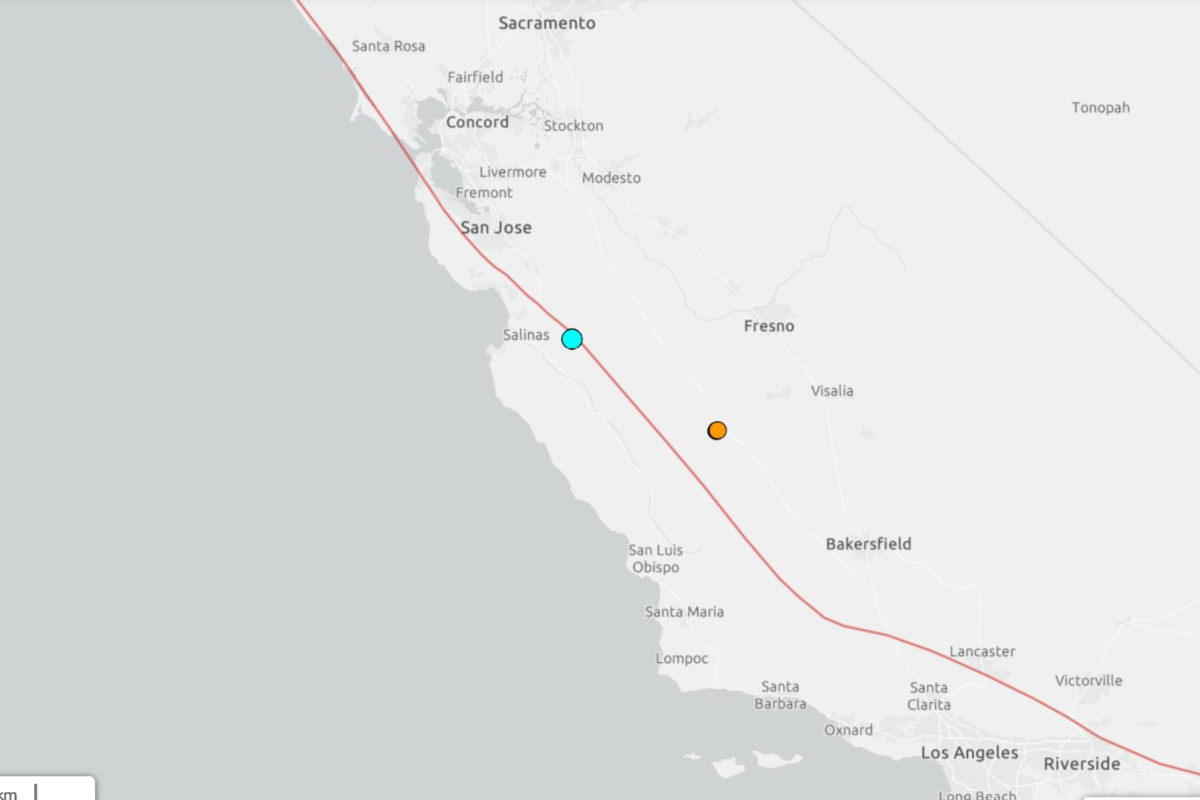
California experienced five earthquakes within a short period of time on Friday and Saturday, amid ongoing concerns about seismic safety in the region.
Four of the five struck near Avenal, California at strengths ranging from 2.6 to 2.8 magnitude at shallow depths. The fifth struck near Salinas at a strength of 3.3 magnitude at a depth of around 4.5 miles, according to data from the United States Geological Survey (USGS).
While none of the recent tremors led to significant damage, the events serve as a reminder of the state’s ongoing vulnerability to major earthquakes.
 The Context
More than 70 percent of Californians live within 30 miles of a major fault, according to the California Department of Conservation. increasing the risk that even moderate seismic activity could impact a large number of residents.
The earthquakes also highlighted the importance of emergency preparedness, especially as experts continue to warn that California is overdue for a significant seismic event.
What To Know
The USGS reported that, over the past several days, a sequence of at least five earthquakes shook California, with magnitudes ranging from 2.5 to 3.3. The most recent, a 3.3 magnitude quake, struck near Tres Pinos in San Benito County Saturday morning at a depth of 4 miles.
Earlier quakes were noted northwest of Pinnacles, near Avenal, and outside Santa Clarita, with magnitudes generally between 2.5 and 2.8. No injuries or property damage were reported, and no tsunami warnings have been issued.
This activity is part of a broader trend; earthquake swarms were also documented in regions like San Ramon and The Geysers, with dozens of minor earthquakes in recent weeks.
The Southern California Earthquake Data Center confirmed that seismic events have ranged up to at least a 4.0 magnitude in recent months.
What Is An Earthquake Swarm?
Scientists refer to a series of earthquakes in a confined area over a short period as an “earthquake swarm.”
Unlike aftershocks that typically follow a large mainquake, swarms consist of multiple smaller quakes that may not have a single dominant shock.
These swarms often occur along less prominent faults or in geologically complex areas with multiple intersecting faults. While swarms can be unsettling for residents, experts say they rarely indicate that a major quake is imminent.
Why Does California Have Earthquakes?
California’s seismic activity is primarily driven by its position atop several major fault systems, most notably the San Andreas Fault, which extends roughly 750 miles through the state.
Other critical faults include Rodgers Creek, Calaveras, and Hayward. The movement of tectonic plates along these faults causes most of California’s quakes.
The density of fault lines coupled with the size of the population means that seismic hazards can have serious implications for millions of residents.
What Causes An Earthquake?
Earthquakes occur when energy stored in the Earth’s crust is suddenly released, usually due to the shifting of tectonic plates along a fault line. This release causes seismic waves, which result in the shaking felt on the surface.
California’s faults are primarily “strike-slip,” meaning the plates move horizontally past each other. In certain regions, man-made activity—such as geothermal operations—can also trigger minor quakes, but the most significant risks remain tied to natural fault movements.
What People Are Saying
Annemarie Baltay, USGS seismologist, told the Los Angeles Times on December 22, 2025: “There’s gonna be a big earthquake in the Bay Area. We just can’t say exactly when and where. So, you should be prepared for that.”
Sarah Minson, research geophysicist with USGS, told SFGate in December 2025: “We think that this place [San Ramon] keeps having earthquake swarms due to a lot of fluid-filled cracks, thanks to very complex fault geometry—unlike, say, the San Andreas Fault, which is this nice clean edge.”
What Happens Next
Seismic activity will continue to be closely monitored by the USGS and California Institute of Technology.
According to the USGS, after a modest earthquake, there is about a 5 percent chance of a larger event in the following 72 hours.