
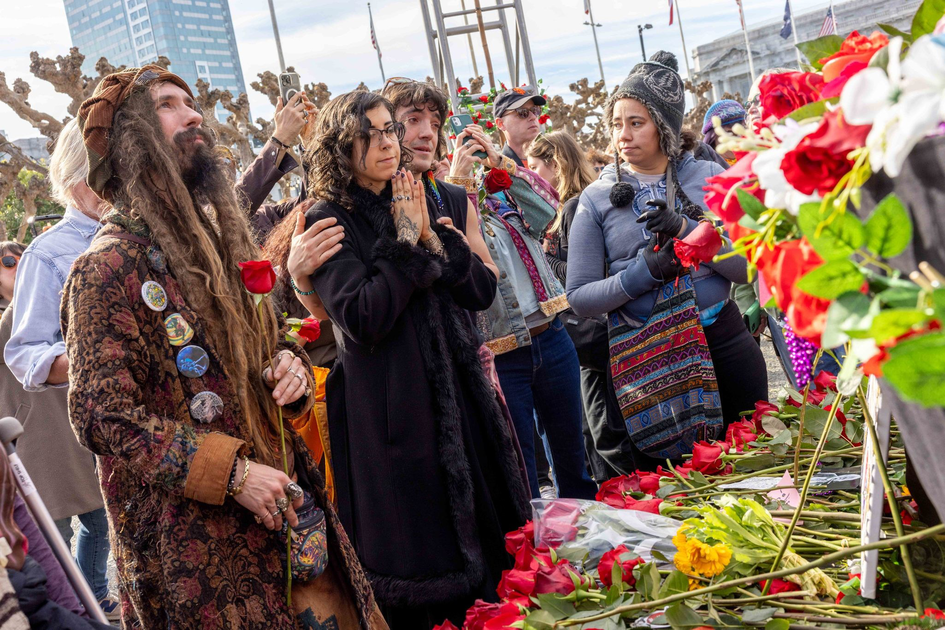
Since Bob Weir, a co-founder of the Grateful Dead, died at the age of 78 last week, Deadheads in San Francisco have been drawn closer, bonded by shared loss and gratitude.
They’ve gathered in the thousands on streets of the Haight, the meadows of Golden Gate Park, and Civic Center at Weir’s memorial on Saturday, not only to honor the San Francisco native who for so many years was a beacon of the city’s culture, but also to dance to the tunes that brought them all together in the first place.
For Michael deLeon, though, these gatherings haven’t relieved the grief — not only for Weir but for the band itself. He recalls that when Jerry Garcia passed away in 1995, it marked the end of the original band. But now, after the passing of Phil Lesh in 2024 and then Weir, deLeon is ready to admit this feels like something final: “the end of an era.”
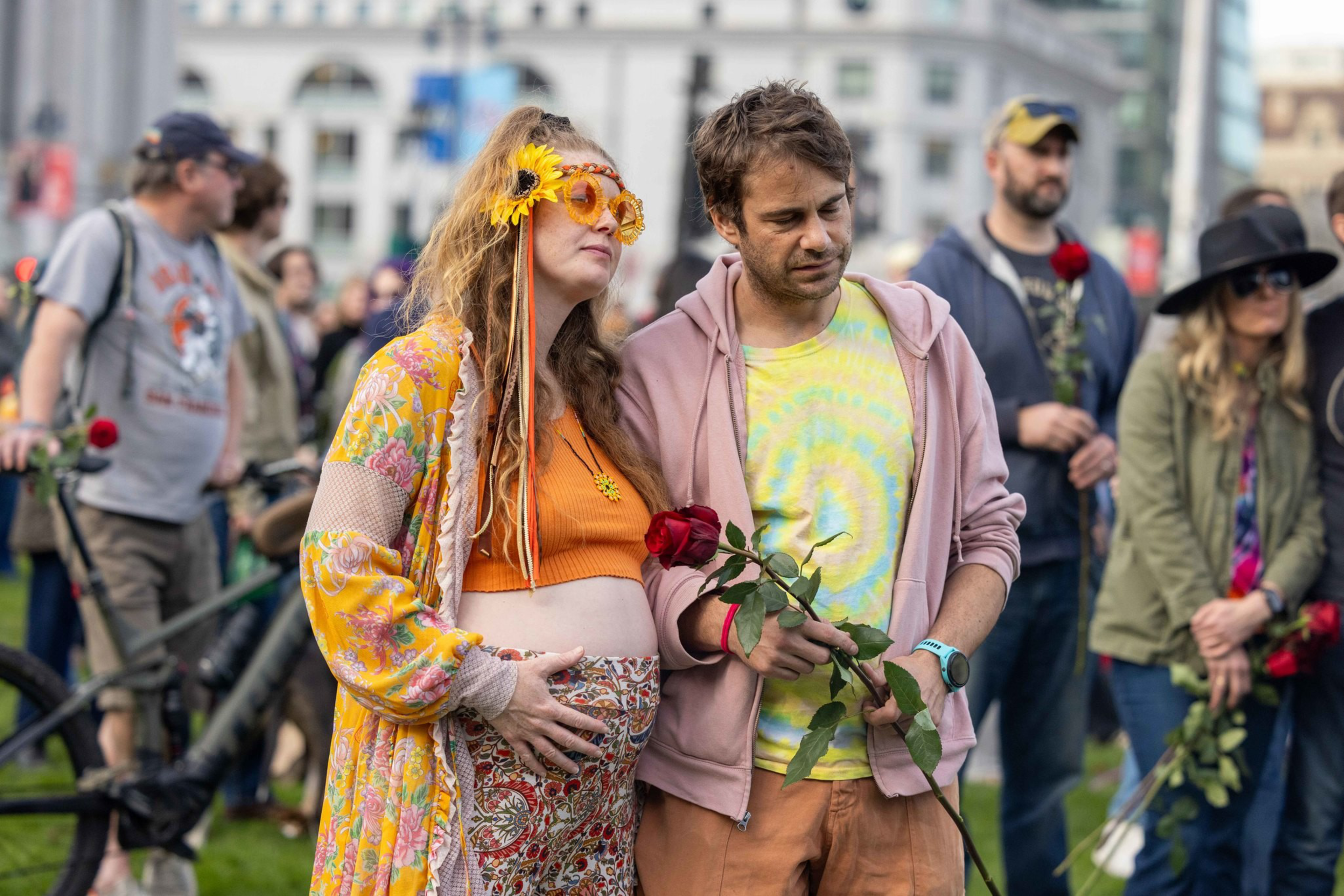 Maura Cotter and Seth Shapiro attend a tribute to the late Bob Weir at the Civic Center. | Source: Amanda Andrade-Rhoades/The Standard
Fighting back tears on Saturday afternoon at the Civic Center, moments before Weir’s memorial began, he said he’s spent the last week binging YouTube videos of the band’s concerts, searching for the spark that once carried him through decades of shows in muddy fields and festival grounds.
“It’s gone,” he said. “That’s what I feel more than anything.”
When Mickey Hart, a drummer for the band and its most well-known surviving member, took the stage at the memorial, it was clear he felt the same way, even if he clung to hope about how the music would live on long past its makers through the fans.
“Bob liked to talk about where the music would be in 300 years,” said Hart. “After watching it all build for 60 years, he could envision the depth of our impact hundreds of years down the line.”
“The songs of our lives are yours now,” he added. “If it was not for you, there would be no us. Be sure of that.”
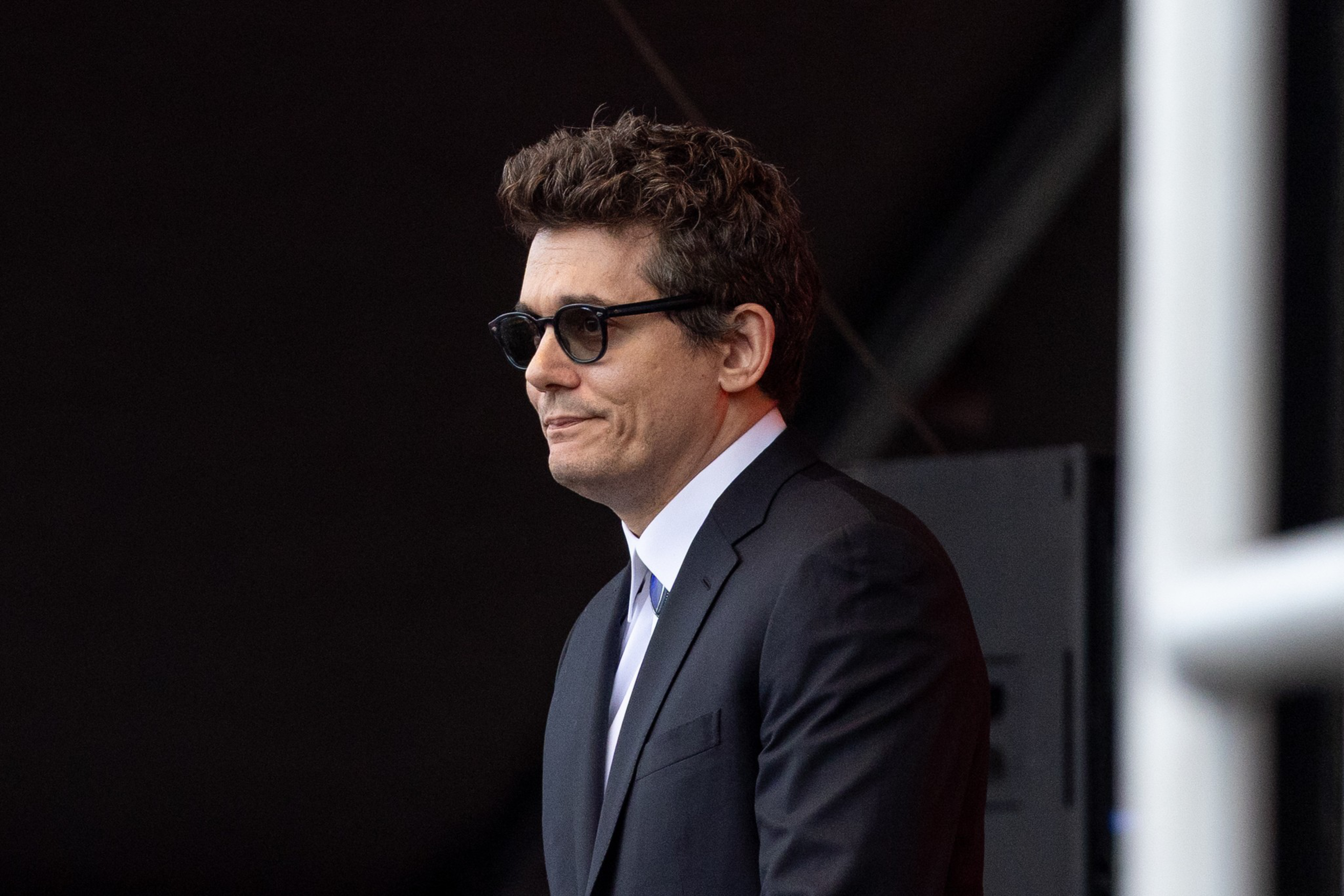 John Mayer, who co-founded Dead & Company with Weir, shared his memories of the late musician. | Source: Amanda Andrade-Rhoades/The Standard
 Thousands came out to mourn the recently passed Weir and dance to decades of his music. | Source: Amanda Andrade-Rhoades/The Standard
The most emotional speech of the afternoon came from John Mayer, a founding member when Dead & Company formed in 2015, who toured around the country with Weir before playing their final shows as part of a three-day festival at Golden Gate Park in August to ring in the original band’s 60th anniversary.
Mayer said that he and Weir were born on the same day, 30 years apart, and noted how the two learned to trust each other’s intuitions despite their generational gap. He said that the entire time he played with the band — now speaking entirely in the past tense — he was both a performer and a fan. Every time he wrapped up a show, he remarked, he too would need a long rest to reenergize, and he too would be counting down the days until the next one.
“Right now it’s easy to feel as if time is speeding up and taking so much from us all,” Mayer said. “But, I would remind you, as I have tried to remind myself this past week, just how many nights we all lived so fully in each second, hanging on every word of Bobby’s, following the music around twists and turns through forests and over majestic vistas.”
Some of the other tributes were virtual, like those sent in from 49ers players Nick Bosa and George Kittle. Others, like Mayor Daniel Lurie’s, were short and sweet. Weir’s youngest daughter led the crowd in 108 seconds of silence.
Joan Baez recalled that Weir was the only other person she knew who danced barefoot on stage. Nancy Pelosi did her best to tie Weir’s efforts to her own, claiming “that music, like democracy, is not fixed.”
“It is something we make together,” she said. “The world is a better place because of Bobby Weir.”
 Sa’rai Gutierrez, left, and her sister Sadie-Lou Gutierrez played during the tribute, which included fans of all ages. | Source: Amanda Andrade-Rhoades/The Standard
For DeLeon, like many others, the long, strange trip started as a teenager. He was a freshman at Washington High School when he skipped class to see the Grateful Dead — and trip acid — for the first time. Over the course of the next five decades, he would listen to the band high and drunk in his army barracks, and, once he got out of the military, see them in concert as many as 20 times a year.
“I keep hoping I’ll run into some friends I made back in the day,” deLeon said, looking out into the crowd of Deadheads. “It’s not so much about the band as it is about the family.”
The sentiment held true for Iddei Yasoda, a 70-year-old who discovered the band after moving to America from Japan, where he called himself a misfit for not committing to the traditional life path of working for a corporation after college. In the Grateful Dead, he found something he’d been missing, “a place where he could belong.”
“I found my community — a place I could fit into,” he recalled. “I wasn’t a misfit anymore.”
 Buddhist monks chant during a tribute to the late co-founder of the Grateful Dead. | Source: Amanda Andrade-Rhoades/The Standard
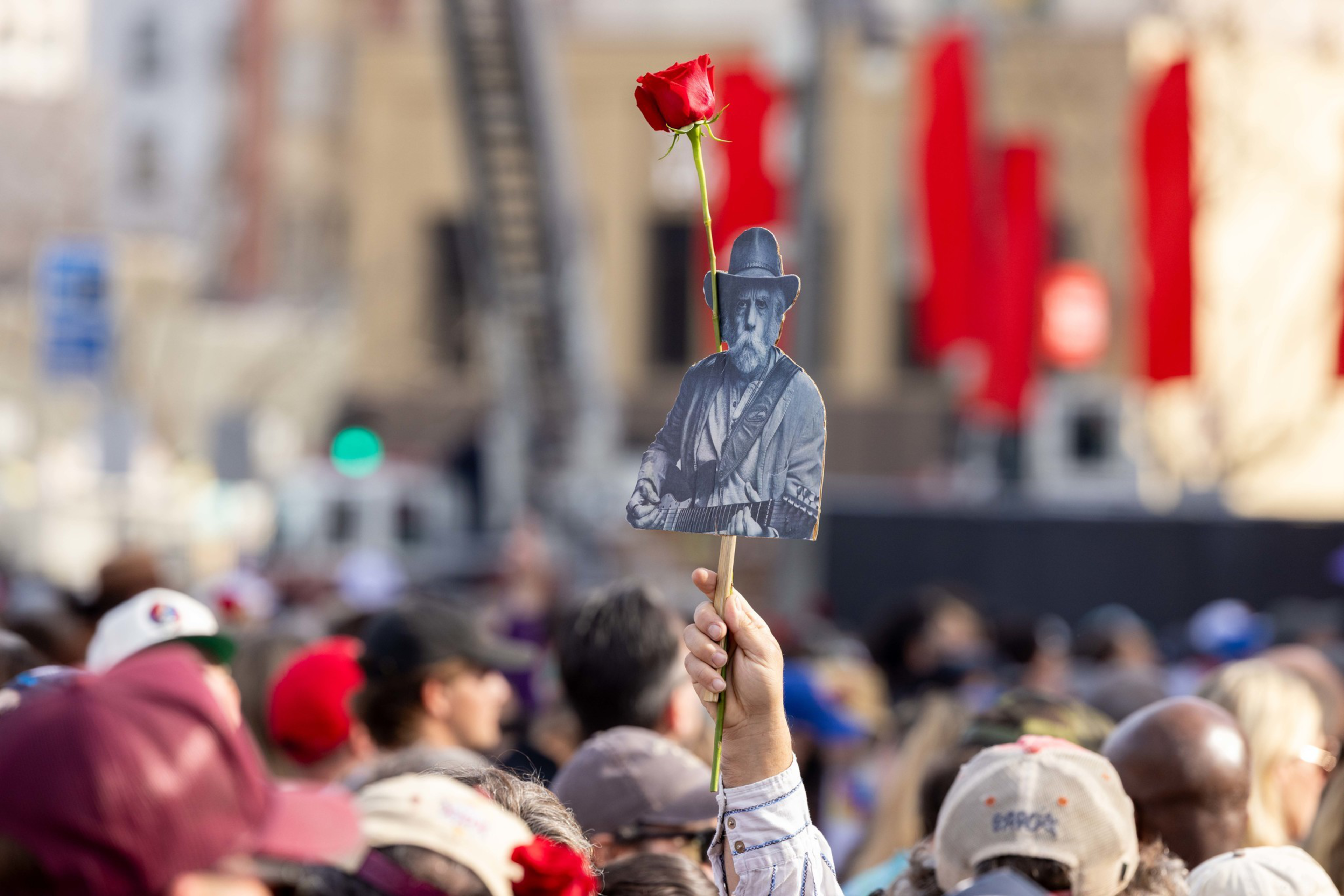 A person holds up an image of the late Bob Weir. | Source: Amanda Andrade-Rhoades/The Standard