
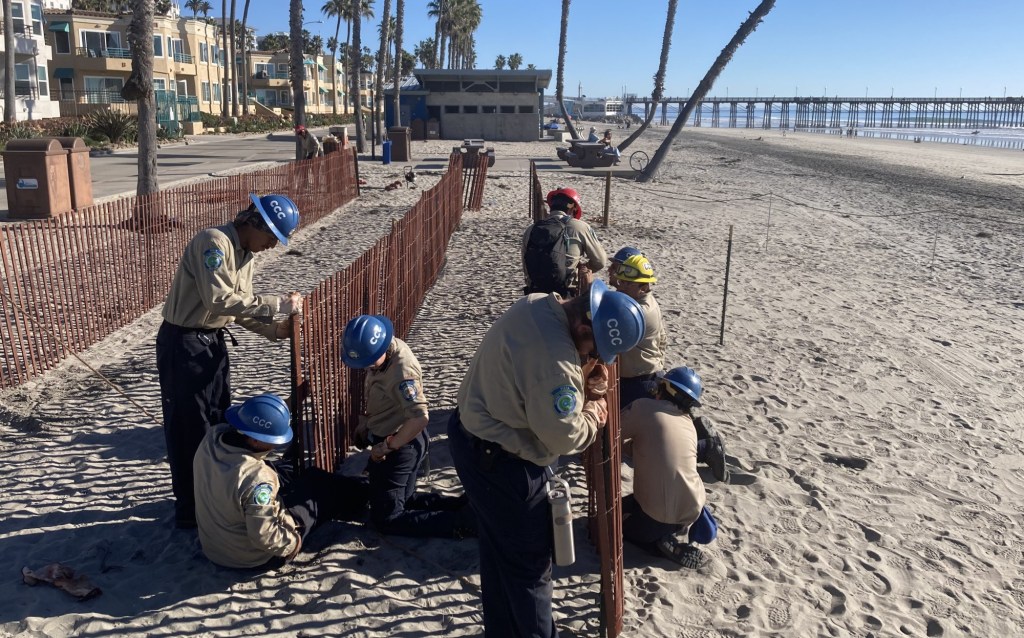
Fences made of wired wooden slats went up in spots along Oceanside’s northern beaches last week for a pilot project expected to restore sand dunes and native plants.
“Right now it’s just some fences and shims, or wooden stakes,” said Jayme Timberlake, Oceanside’s coastal zone administrator. “We will see a noticeable difference in about a year.”
The barriers are intended to stop sand that otherwise would blow off the beach and onto adjacent streets, sidewalks and parking lots at Harbor Beach and The North Strand, creating a maintenance problem. Instead, the windblown grains will be caught to create low dunes on the landward side of the beach.
Grasses, verbena and other low-growing plants in the dunes will help anchor the sand in a natural way and build a buffer to protect nearby structures from erosion, Timberlake said Tuesday.
“We did a seed collection on Camp Pendleton native dunes in the fall,” she said. Harvesting seed nearby is a way to get plants that are genetically adapted to the prevailing environmental conditions and are more likely to thrive.
Crews from the California Conservation Corps worked with the state Department of Fish and Wildlife and the city to place five of the dune plots at Harbor Beach. Protected by the harbor jetty, it is the widest beach in Oceanside.
Four plots were placed near the foot of Surfrider Way, north of the Oceanside Municipal Pier, and several more were to be installed at the mouth of the San Luis Rey River. The city plans to create 10 plots together covering a total of about 1 acre.
The project has the full support of the local advocacy organization Save Oceanside Sand, said Charles Bowen, the group’s communications director.
“This is another tool … that will assist the city in the sustainable restoration and effective management of its beaches,” Bowen said.
The city accepted a $56,876 grant from the U.S. Department of Fish and Wildlife in December 2023 to help pay for the project, which is seen as a relatively low-cost, low-impact way to reduce beach erosion. The project includes three years of monitoring and could be extended or expanded if successful.
Oceanside is working on several other ways to restore its badly eroded beaches south of the municipal pier.
The largest and most innovative of those is the Re:Beach project, a proposal to build landscaped rock headlands at the ends of Tyson Street and Wisconsin Avenue, along with an artificial reef in the water. The space between the headlands would be filled with nearly 1 million cubic yards of sand taken from ocean deposits.
The city also is partnering with other coastal cities in a regional plan led by the San Diego Association of Governments to mine ocean deposits for sand to be placed in multiple spots along the shoreline of San Diego County and southern Orange County.