
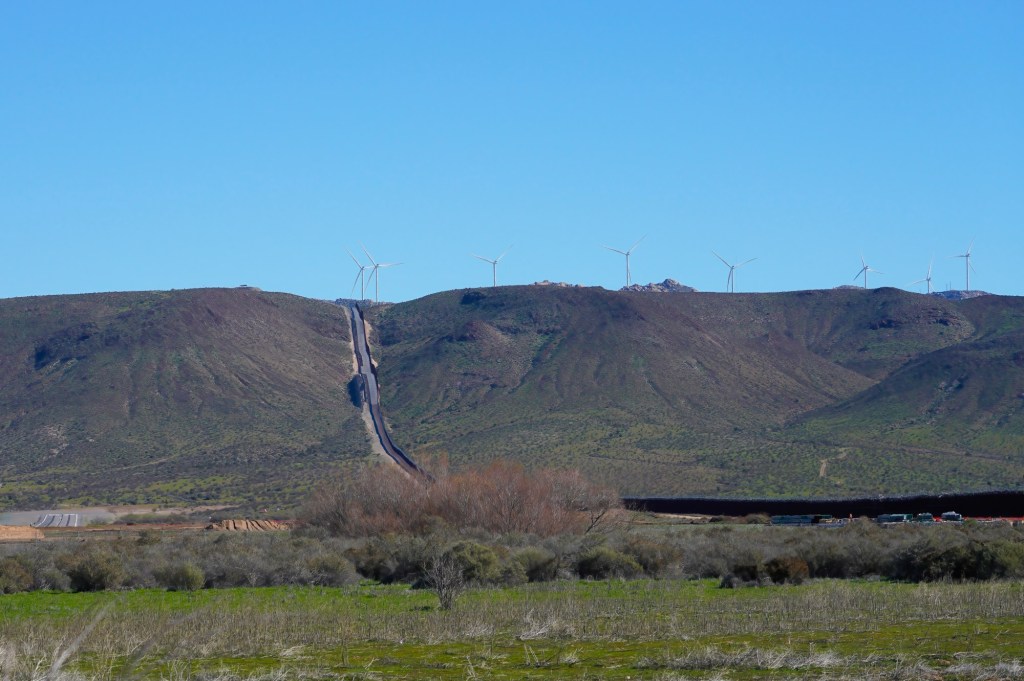
Tents are still set up inside the Juventud 2000 shelter in Tijuana, ready to provide migrants with a place to stay. But on a recent Wednesday, the once-busy refuge was quiet. Unlike this time last year, nearly all of the tents are empty.
“The difference is clear from the moment you get here,” noted José María García, the shelter’s director.
Migrant shelters in Tijuana have historically been an indicator of the state of affairs at the U.S.-Mexico border. One year ago, dozens of families, many of them asylum seekers, clung to their last shred of hope as they waited at the same shelter for confirmation to legally come in for vetting at a port of entry through the Biden-era CBP One app’s appointment system. As President Donald Trump’s inauguration date approached, time was running out for many migrants who had waited for months.
Trump had campaigned heavily on “closing the border.” And so he did.
The difference is staggering one year later.
Data from the latest monthly report by U.S. Customs and Border Protection shows a 92% decrease in migrant apprehensions by Border Patrol along San Diego County’s border with Mexico in December compared to the same period in 2024. Tijuana shelters have seen this significant drop firsthand.
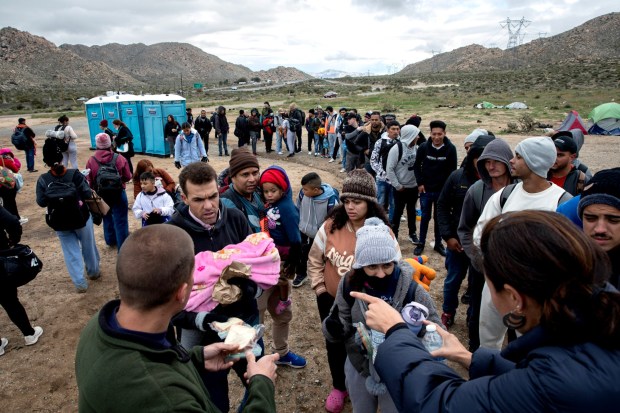 Volunteers hand out water and peanut butter and jelly sandwiches to more than 60 migrants who arrived to a camp just off Interstate 8, where they waited to be processed by U.S. Border Patrol on March 15, 2024, outside Jacumba Hot Springs. People came from Pakistan, Brazil, the Dominican Republic, Bolivia, Honduras, Egypt, Somalia and other countries. (Ana Ramirez / U-T file)
Recently, the Juventud 2000 shelter was housing 10 migrants who had fled violence in their hometowns in Mexico. According to García, none of them intended to cross into the U.S.; instead, they were planning to settle in Tijuana. Around this time last year, the shelter had about 80 people “still waiting to see what might happen.”
It didn’t take long to confirm the incoming administration’s plans.
On his first day in office, Trump ended the CBP One system, under which nearly 1 million migrants were allowed to enter the country with parole. He also signed a series of executive orders, including plans to build additional barriers and deploy troops along the southern border.
“I think the message sent by the United States was well understood,” García said.
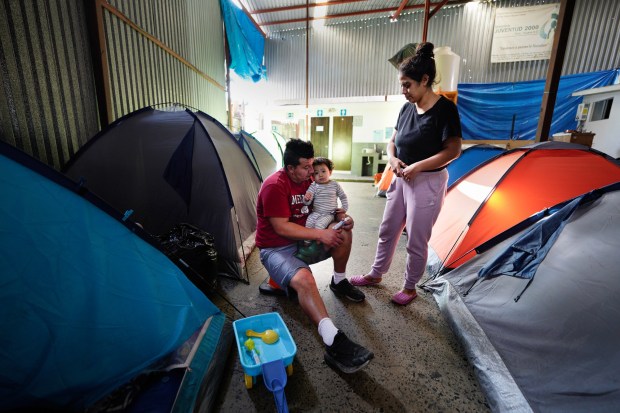 Edgar Villanueva and his wife, Karen Garcia, along with their baby boy, Nain Villanueva Garcia, have been living at the Juventud 2000 shelter in Tijuana since late 2025. They were among 10 people from Mexico staying there. The other tents, which a year ago were full, now sit mostly empty. (Nelvin C. Cepeda / The San Diego Union-Tribune)
Some families initially stayed at the shelter a little longer, hoping that another legal way to apply for asylum would be announced. Not only did that not happen, but quite the opposite — efforts to crack down on immigration escalated, both along the U.S.-Mexico border and throughout the interior.
With videos all over social media showing immigration detentions in the U.S., many migrants changed their plans.
Tijuana grew quiet. The action was now unfolding north of the border.
‘A game changer’
Throughout most of 2024, the 60-mile stretch of the U.S.-Mexico border in the San Diego sector was the busiest for migrant apprehensions. In December 2024, there were 10,111 migrant encounters by Border Patrol. Compare that to 855 apprehensions last month. Officials noted that such low levels of activity have not been seen in the sector since the 1960s.
“In just one year, President Donald J. Trump’s ironclad commitment to securing our border and enforcing our nation’s laws is liberating Americans from the crushing burden of unchecked illegal immigration,” the White House said in a news release last week.
Border Patrol’s San Diego Sector Chief Justin De La Torre attributed the steep decline in part to the end of a “catch-and-release” border policy. Previously, migrants, many of them asylum seekers, were processed by Border Patrol and later released to await their immigration court hearings. Nowadays, a Border Patrol spokesperson explained, Mexican nationals who aren’t expelled immediately through Tijuana are held in custody pending their hearings. Depending on flight availability, people could also be flown to southern Mexican towns.
De La Torre, who was tapped as the new sector chief in November, called it “a game changer.”
“By no longer releasing people into the U.S., we have removed the incentive for those considering illegal entry via smuggling routes,” he said in a statement. “We no longer have people illegally entering and surrendering to agents, expecting to be released, which allows Border Patrol agents to return to patrol and interdiction efforts rather than processing and releasing hundreds of illegal aliens a day.”
Reinforced border wall infrastructure and collaborations with other agencies, including the military, have also helped, he said. Under the Trump administration, troops, including Marines from Camp Pendleton, were deployed to provide engineering support to the Border Patrol. Miles of concertina wire were installed along the primary and secondary fences of the U.S.-Mexico border wall.
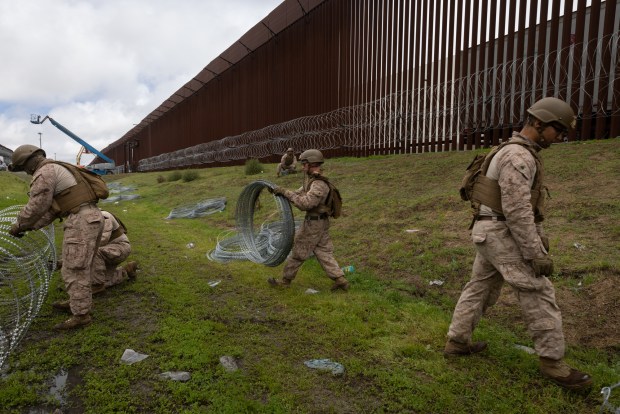 U.S. Marine Corps Task Force Sapper adds concertina wire to the U.S.-Mexico border walls on March 12 in Otay Mesa. (Ana Ramirez / U-T file)
De La Torre also acknowledged the increased likelihood of individuals being prosecuted for illegal entry.
In fiscal 2025, the U.S. Attorney’s Office for the Southern District of California prosecuted 2,021 unlawful-entry cases, up from 256 the previous year, according to data from the U.S. Attorney’s Office. Federal prosecutors in the office, which covers San Diego and Imperial counties, also prosecuted 1,098 cases for reentry after deportation, up from 525 the prior year. The data showed that prosecutions for both unlawful entry and reentry were continuing at roughly the same pace through the first three months of fiscal 2026.
García, who runs the Juventud 2000 shelter, noted that while the number of migrant encounters remains low, some migrants are still trying to cross the border by taking more dangerous routes. Garcia pointed to cases in which people have been injured or killed in maritime smuggling incidents off the coast of San Diego and from falling from the U.S.-Mexico border fence.
De La Torre said in an interview last month that smugglers are turning to social media to recruit people and are lying to them, telling them that the agency is “allowing people in again” or that they can “claim asylum,” to convince migrants to use their services.
‘Enforce immigration law without apology’
Immigration enforcement, for years typically concentrated at the border fence and out of the eye of the general public, quickly became a spectacle on city streets. San Diegans were soon witnessing immigration detentions by masked agents in their neighborhoods — during school drop-off, at parks, in the parking lots of Home Depot, outside workplaces such as hotels and construction sites.
Watching Trump’s mass deportation campaign play out in the open stunned many onlookers. Some fought back, including a crowd that gathered in protest during an immigration raid at South Park’s Buona Forchetta restaurant just before Friday dinner service in May.
From January to mid-October last year, Immigration and Customs Enforcement’s San Diego field office, which covers San Diego and Imperial counties, made 4,934 arrests, dwarfing the 764 arrests made in all of 2024, according to data from the agency obtained via public information request by the Deportation Data Project and analyzed by the Union-Tribune. In September alone, the San Diego division made more than 1,400 arrests.
The data documents administrative immigration arrests made by ICE’s Enforcement and Removal Operations, which is the agency’s main arm responsible for enforcing immigration policy.
Arrests made in the community, such as street or workplace arrests, have become far more common under Trump. From January to mid-October last year, the San Diego ICE division made about 4,000 such arrests, compared to fewer than 400 the previous year, according to the data. Community arrests accounted for about 80% of all local ICE arrests in 2025, up from 51% the previous year.
Community patrols and bystanders also documented an increase in the number of Border Patrol agents working alongside ICE during immigration enforcement operations.
“There was an increase in activity beyond the border,” said Benjamin Prado, who has been part of community patrols dedicated to monitoring the activity of federal agents in San Diego neighborhoods with the nonprofit organization Unión del Barrio for many years. “We saw the role the Border Patrol is taking inside the United States. It’s not just ICE anymore.”
Federal officials in San Diego confirmed this late last year. As once-busy border crossings slowed down, Border Patrol agents were able to increase their presence in interior operations.
Most people arrested by San Diego’s ICE division had no criminal charges pending and no criminal convictions, according to ICE’s data. That was 59% of arrests from January to mid-October last year, compared to 40% the previous year.
 White House “border czar” Tom Homan and U.S. Customs and Border Protection Commissioner Rodney Scott speak during a press conference along the U.S.-Mexico border wall in San Ysidro on Dec. 13. (Sandy Huffaker / For The San Diego Union-Tribune)
Immigration advocates have said that they believe the data indicate that the increase in arrests is a response to the agency trying to fill an arrest quota, rather than targeting “the worst of the worst,” as the Trump administration has repeatedly claimed.
Tom Homan, the White House’s “border czar,” addressed the matter during a recent visit to San Diego. He insisted that those arrested were in the country illegally, which violates federal law, and that the agencies involved are enforcing that law. “We’re going to enforce immigration law without apology,” he said at a Dec. 13 news conference at the San Diego border.
‘You’re no longer free’
Fear has gripped immigrant communities in San Diego, even those with legal status. Many with green cards or U.S. citizenship started to carry documents with them, just in case.
Rhythms of life changed more dramatically for others.
One longtime Escondido resident, who has resided in the U.S. without authorization for decades, says she rarely leaves the house anymore.
“If I go to the store, I’m looking around everywhere,” she said in Spanish. She asked not to be named for fear of repercussions.
She made a living as a nanny for years, but she stopped doing that nearly a year ago. She said she no longer felt safe taking the children she cared for to the park or school. She said she doesn’t want to expose them to the possibility of seeing her get detained.
“It’s sad because you’re no longer free,” she said. “You’re not free to go out, walk in the park, or go out for ice cream.”
The mother of two grown U.S. citizens first came to the U.S. from Mexico more than 30 years ago in search of a better life. She was deported years later and settled in Tijuana for a while. But when her niece died, she returned to support her sister, she said.
The woman, who has also been a community volunteer, said she understands that she must “respect the laws,” but she added that “sometimes necessity forces us to be here.” She said she has considered going back to Mexico, but the thought of being away from her daughters makes her hesitate.
‘Up-the-mountain battle’
Federal agents were not just targeting people in hiding. A new front line emerged in the hallways outside immigration courtrooms or during check-ins with ICE at the Edward J. Schwartz building in downtown San Diego. Several people showed up to what they thought would be their final green card interviews at the U.S. Citizenship and Immigration Services building and ended up being detained by waiting agents.
“This is in line with their policy priorities to achieve some sort of mass deportation,” said San Diego-based immigration attorney Ginger Jacobs. “And what easier way to detain people or try to deport people than to have them come to you?”
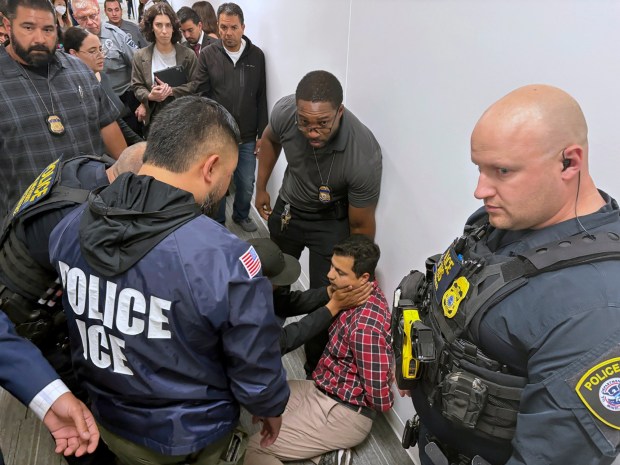 U.S. Immigration and Customs Enforcement officers conduct arrests outside the immigration courtrooms in San Diego on May 23. (Michael Ho Wai Lee / Sipa via AP Images)
In response, community volunteers, including faith leaders, teamed up with other local organizations to document and accompany immigrants to their scheduled appointments at these locations. The number of trained volunteers went from approximately 80 in August to 465 by the end of December, said the Rev. Scott Santarosa of Our Lady of Guadalupe parish in Logan Heights.
Immigration attorneys were faced with heavier workloads and curveballs as the Trump administration redefined battle lines.
“Every single week, we are faced with a new policy, a new rule that either erodes due process or puts more hardship on our clients,” said Ian Seruelo, an immigration attorney for more than 10 years and chair of the San Diego Immigrant Rights Consortium.
Some, like Seruelo, have filed more habeas petitions than ever before, challenging the legality of their clients’ detentions, given Trump administration guidance to put those who entered the country without inspection into mandatory detention and not allow bond hearings.
However, late last year, a federal judge in California ruled against such a policy after a federal class-action lawsuit. Another lawsuit filed by Al Otro Lado claims that the Trump administration has shut down access to asylum at ports of entry along the U.S.-Mexico border.
While wider efforts are being made through lawsuits to stop certain policies, immigration attorneys continue to fight on a micro level inside the immigration courts, Seruelo said.
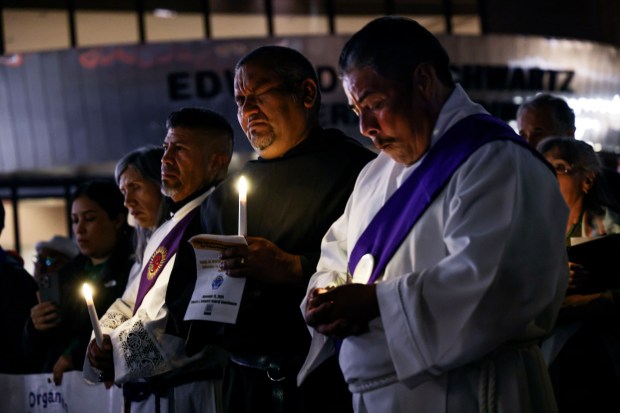 Clergy members and worshipers hold a candlelight vigil for immigrants on Nov. 13 outside the federal building in downtown San Diego. (Sandy Huffaker / For The San Diego Union-Tribune)
Jacobs, who has been an immigration attorney for 24 years, compared the past year to an “up-the-mountain battle.” Still, she believes there is hope within the courtrooms.
“The Trump administration wants people to think everyone’s losing, everyone’s being detained, everyone’s being deported, so that they’ll give up,” she said.
“People are still becoming naturalized U.S. citizens, people are still getting their green cards, people are still winning their cases in court,” she said. “It’s harder than it used to be, but it’s not impossible, and I don’t want the community to lose hope.”
Staff writers Kristen Taketa and Alex Riggins contributed to this report.