

San Diego felt both familiar and like a city on the cusp of major transformation in 1983.
“America’s Finest City” was coming of age in the midst of a transition from quiet Navy town to major metropolitan center.
For most of the year, J. David Dominelli continued his ascent, supposedly earning millions of dollars a day through the foreign-currency trades of his investment bank, J. David & Co.
Along the way, Dominelli acquired multiple expensive homes, a fleet of exotic foreign cars and three private jets, while becoming a patron saint to the city’s arts and politicians. All while enriching more than a thousand of his neighbors — or so it seemed.
As the calendar approached September, sportswriter Jerry Magee — a legend even in those days — was returning to The San Diego Union’s offices in Mission Valley after spending the day at Chargers headquarters.
Magee had been inspired by a letter to the editor he had recently read in Pro Football Weekly. The writer of the letter opined that he’d be a better general manager than those working in the NFL, and gave an example of the “fantasy team” he’d build if he had the opportunity.
Magee thought that sounded like fun, and decided to enlist Bill Center, then in his first year as Padres beat writer, and sports columnist Wayne Lockwood to help him flesh out the details of what would become the J. David Football League. It was named for Dominelli, because in Magee’s estimation, no one was living a bigger fantasy than he was at the time.
Now in its fifth decade of existence, the JDFL (renamed the Magee Memorial Football League after Magee died in 2019) proves fantasy football isn’t just about the points; it’s about the people who keep the game alive.
Past and present members of the JDFL talked about football, friendship, and fantasy football’s shift to a cultural phenomenon:
‘We had more interest than we had spots’
Three men — Oakland businessman Bill Winkenbach, Raiders P.R. director Bill Tunnell and Oakland Tribune sportswriter Scotty Stirling — are credited with creating fantasy football.
The idea emerged during a Raiders road trip in 1962 and led to the formation of the Greater Oakland Professional Pigskin Prognosticators League shortly thereafter. Jerry Magee and colleagues Bill Center and Wayne Lockwood conjured up the JDFL on the Tuesday before the 1983 NFL season kicked off.
Bill Center: Jerry Magee wrote for Pro Football Weekly. He was a regular contributor. In fact, a lot of his best stuff appeared in Pro Football Weekly. He saw a letter from somebody who wrote to Pro Football Weekly with the idea of, “Boy, if I had a fantasy team, these would be my players.” That’s where Magee picked up the idea of forming a fantasy league. It was a letter to the editor about who were the best players in the game at the time. Magee brought the Pro Football Weekly into the office, and we went upstairs to the cafeteria on the fifth floor. It was a full-service dining room and everything. We sat down and Wayne Lockwood joined us. That’s how we sort of hammered out some of the details of what we wanted to do. We went back downstairs to the Union sports department and did a little survey of how many guys might be interested in joining us. It was mostly guys on the desk, including Steve Oakey, who ended up winning the first season. We had eight teams in the first year. The next year it expanded to outside of the office. Also, the next year I think Nick was in.
Nick Canepa: I was the beat guy for the Chargers in ’82 and ’83. It was right around then I think the JDFL began. They were a couple of years in when I joined. In 1984, Clark Judge came to cover the Chargers when I got the column. He got in, did it by himself a few years, and then we did it together for many.
Clark Judge: Nick had told me they had this league, and I came out there in ’84. Nick said we should go into this because he and I traveled together all the time. I was doing the Chargers and he’d be the columnist. He’s the guy that got me out there in the first place. He said, “You should talk to Clark Judge” after the Colts had moved. We quickly figured this is actually a pretty fun deal.
Canepa: We had guys from all the papers around here, and some of those guys are still in the league. Gary Hyvonen was the sports editor at the North County Times. Bob Nightengale, I think, started when he was on the local L.A. paper, when the L.A. Times was still down here.
Gary Hyvonen: I think I might have started, I was thinking ’83, it could be ’84. I started at the North County Times in ’82. I think in ’83 and ’84 I started doing more stuff, but I was covering a lot of baseball, including the World Series in ’84. Once I started getting the Charger beat, I was down there. We’re in the press room covering the team, and they’re all talking about it. Clark was on the beat. Obviously, Magee was on the beat. That’s how I found out about it, because it was all the beat writers mainly, and the columnists. Tom Cushman was in it. Wayne Lockwood was in it. It was almost all print people. I don’t remember any radio guys or TV guys being in it.
Hank Wesch: Part of the draw to me was Jerry Magee. Like everybody else, I had great respect and admiration for him. Bill asked me, and I sort of hesitated because a lot of the guys were experts on the NFL. Magee was a legendary NFL writer. I was kind of a utility man for the Union at that point before the merger. I was covering various sports. I would occasionally do a sidebar on a Chargers game, but I wasn’t into it as much as I figured the other guys were. I thought I’d be swimming with some sharks.
Jay Paris: Our little gathering of knuckleheads trying to outsmart each other is classic. It’s special for me as in 1992, two guys showed up in town to track the Chargers and they didn’t know a soul — coach Bobby Ross and me! With my mom being from Mississippi, I was the only scribe that could understand what the heck Bobby was talking about! I didn’t alienate too many people in camp that summer, so I was invited to join the JDFL — whatever it was once called — and joined in my rookie year on the Chargers beat. That was high cotton as there were like seven beat writers back then for all the papers and not everyone was invited in.
‘We figured out everything in like an hour over hamburgers’
There was no widespread consensus on how to score a fantasy football league or draft a fantasy football team. Magee believed that points were paramount in real football, so they should be equally important in the made-up version. In the beginning, the JDFL only counted touchdowns, field goals and extra points. The points for passing TDs were divided up between the quarterback and the receiver, each getting three, while a rushing TD was six. Any scoring play over 50 yards counted double. Rosters consisted of two QBs, four running backs, four wide receivers, two tight ends and two kickers. A starting lineup needed a QB, two RBs, two WRs, a TE and kicker each week. The trio believed the only fair way to choose players was to utilize a snake draft format.
Center: We figured out everything in like an hour over hamburgers upstairs. We had the draft at Magee’s house the next night. It was right before the season, and I think the draft was on a Wednesday night. There were no Thursday night games then, and the season was going to start that weekend. We had to draft right away.
Hyvonen: Me and Bob, we always used to think 30 points was our goal every week. Let’s just get 30 every week and we’ll win the league.
Wesch: In the beginning, it was TD-only and no points for catches and yardage. The JDFL was more meat and potatoes than every other league we were in, even then. The other leagues were more complicated. So when we gathered to do our preseason stuff, we made up two different lists. We still do.
Hyvonen: Bill would always have us call our lineups in. I’ll never forget that number because we called it for 30 years. It’s like my childhood phone number. Some guy scored four touchdowns, and you wonder if Nick played him or not. You wouldn’t know until maybe Wednesday when Bill would send out the release.
Center: I actually had the first pick the first year and I really made a mistake. I didn’t know exactly what to do, and I drafted a kicker with the first pick. I took Giants kicker Ali Haji-Sheikh, but remember, at that time, we didn’t give points for yards or anything else. Anything over 50 counted double, but nobody was kicking 50-yard field goals back then.
Canepa: Kickers score the most points. Rick Smith, who is one of my partners now, thinks we should draft one in the first round.
Judge: Moves were first-come, first-serve. Nick and I are at the opening game at the Coliseum, Raiders and the Chargers. We’re watching the games back east, so we’re watching the 10 o’clock starts. The Rams had a running back who was like, “Whoa, who’s this guy?” It was Greg Bell. We picked him up at halftime of that first game, and Bell became a monster.
Center: Defenses didn’t come in until about six or seven years into the league, and then only lasted for a while. We didn’t do yards or anything. One of the problems was that most of the defensive touchdowns were over 50 yards. So it was skewing stuff, and everybody voted to remove the defenses after that.
Canepa: I liked having a defense. I don’t know why we ever stopped it.
Center: Nick always wishes that whatever is not there, is there.

‘Al Saunders just popped his head in there’
The JDFL held its draft at either Jack Murphy/Qualcomm Stadium or the Chargers headquarters for nearly 30 years until the Chargers moved away.
Judge: We drafted in the media room at Jack Murphy Stadium. The media room is right off of the PR director’s offices. You go in through a door, there’s Pat Rogers on the left and then there are two assistants, Bill Johnston, and it might have been LaVonne Chambers. Then you take a left and you’re going down the hall to the media room. Before you get there, on the left-hand side is Rick Smith’s office. It’s a big office. Then we get to the media room, and that’s a much bigger space for all the writers to sit in. That’s where we held our drafts.
Hyvonen: (Former Chargers head coach) Al Saunders is a friend of mine. I still stay in touch with him to this day. He had taken over for Don Coryell in ’86, so it must have been either ’87 or ’88. We were in the media room, doing our draft, and all of a sudden, Al Saunders just popped his head in there. He sees a bunch of people huddled around doing something, and he goes, “Hey, what’s going on?”
Judge: Al would always go, “Hey, what’s up, guys?” or “Hey, guys!” It was so disingenuous. He didn’t give a (expletive) about anyone. That was usually a sign that there’s trouble. “What’s up, guys? You got a second?” You’d go, “Uh oh,” because he was about to destroy you.
Hyvonen: Somebody said we’re having our fantasy draft. He goes, “Oh, great!”
Judge: He wanted to know how it worked, so we explained it to him.
Hyvonen: He says, big smile on his face, “Any Chargers taken?” And Magee, in his typical style, just leaned back in his chair, took the cigar out of his mouth, blew a little smoke, and said, “Al, we’re only in the seventh round.”
Canepa: They were horrible.
Hyvonen: The team was really bad. That was just the perfect line. Al had this little look on his face.
Judge: The place burst out laughing, and Al just shut the door.
Center: I remember that door closing quietly as Saunders didn’t have a retort to Magee’s comment.
Al Saunders: I vaguely recall the scene, but in all honesty, I don’t remember the dialogue. If I ever write a book, though, that’s going to be in it. That’s classic Jerry Magee.
‘How’s that (expletive) point, Tommy?’
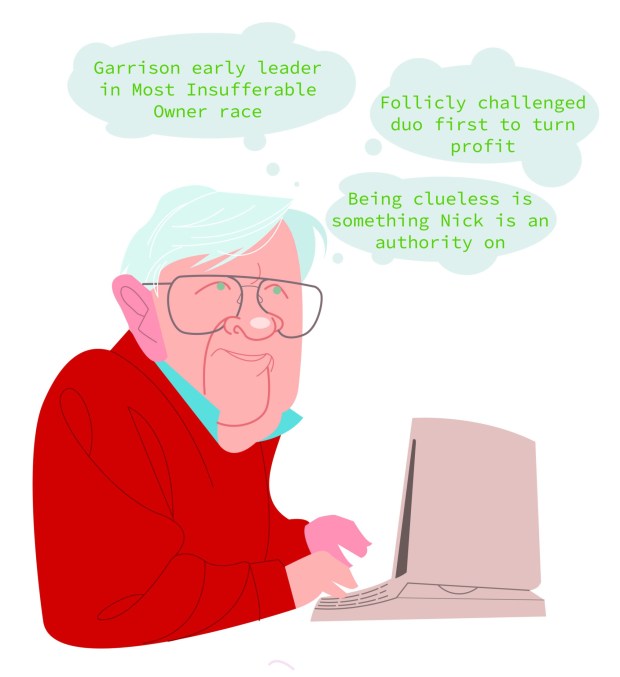
In the early years of fantasy football, the most enterprising commissioners would produce write-ups, type them up and mail them out. They would detail the previous week’s scoring as a way to keep the league informed. They might even engage in some lighthearted trash talk.
Canepa: Center used to poke fun at everybody, you know. I tell you the truth, he never was worth a (expletive) as an owner anyway, but he used to take shots at us every week in his release.
Center: My best writing was the releases. They were especially good early on.
Hyvonen: Bill, and now Boyce, get to poke fun at you. There’s motivation in trying to avoid the wrath of these guys.
Boyce Garrison: We used to have to wait for the releases back before email. We’d get them couriered up to the North County Times by Geoff Ooley or Jay Paris, whoever was covering the Chargers. Center would give the releases to them, and then they’d bring them to the office and put them in people’s boxes.
Paris: The trash talk is keen and the second-guessing on picks is off the charts.
Center: It was fun because I’d just rip on people who screwed up. Not only would I do the points, but I’d do the points not played and just ridicule whoever left winning points on the bench. I would go into great detail and point out how stupid they were, even if it was me.
Wesch: The newsletters were worth the price of admission. Some of the things Bill would write … I think it was tongue-in-cheek when he ripped you, but that’s probably questionable.
Center: There was Tom Shanahan, who (complained) about me counting his points wrong when I missed a point. He sent me a note saying that point may determine whether or not he would win the championship that year. He went into the tank right after that. So I started every release with, “How’s that (expletive) point, Tommy?” He quit right after that.
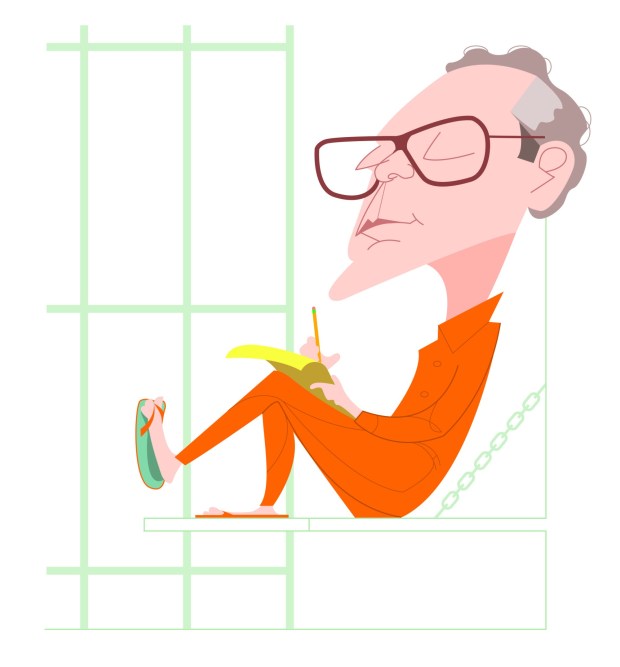 “He was in prison. Magee decided, “Hey, you know, the league’s named after him. We should at least offer him a chance to be in it.” He came up with the address. … we sent him a letter inviting him to join. We never heard back, but we got a receipt that he received the letter.” (Chris Morris, For The San Diego Union-Tribune)
‘We should at least offer him a chance to be in it’
The lifeblood of any fantasy football league that lasts this long, beyond the camaraderie, are the stories that accumulate over the years. Like the time when Magee asked the league’s namesake if he’d like to join.
Center: Magee came up with the name J. David Football League. The slogan for the league was “No one ever lived a greater fantasy than Jerry Dominelli.” He was in prison. Magee decided, “Hey, you know, the league’s named after him. We should at least offer him a chance to be in it.” He came up with the address. I don’t know how he did it. He had resources. He might have contacted Dominelli’s lawyers or something, but we sent him a letter inviting him to join. He could even come in the first year and not pay dues. We never heard back, but we got a receipt that he received the letter.
Canepa: I bet that went over like a fart in church.
Center: I won my first title in 1989 on the last drive of the last game of the regular season. I got to within five points of Nick and Clark late in the game. The second Cincinnati crossed the 50 and I couldn’t get six from Boomer Esiason, Clark thought he was safe. So he calls and he’s just singing, “We are the Champions.” He’s just being brutal. Then Esiason threw a touchdown pass to Rodney Holman. I guess Clark forgot I had him. So I got the six points I needed to win by a point. Clark just hung up the phone and disappeared.
Judge: Well, I don’t specifically remember that, but I do remember calling him at different times and singing “We Are the Champions” to him. I’d always do that, and it drove him nuts. I probably sang that to him. That sounds like me. I don’t remember that specifically, but that certainly sounds plausible.
Canepa: That’s typical Clark.
Dr. Barry Graff: We made the greatest trade in the history of, not only the JDFL, but maybe any fantasy football league ever. We trade Plaxico Burress, when he was very good, to Center. I don’t even remember who we got because it doesn’t matter. It was a running back or something. The day after we traded him to Bill, Plaxico shot himself in the leg. Bill wasn’t happy, but he chuckled because it was just so ridiculous.
Dan Hayes: I joined the league, I believe, four years ago, and it was a combination of my old boss Gary Hyvonen, who previously was the sports editor at the North County Times, and Boyce inviting me. (Former U-T reporter) Dennis Lin told me to join it because the draft experience was entertaining. A few years ago, maybe it was Canepa and his partner, they thought they were muted. But they weren’t and instead their entire conversation via a speakerphone surrounding draft strategy was broadcast for anyone to hear.
Paris: Best part since we’ve gone remote on the draft is Nick trying to log on.

‘You go to Peter King to find stuff out?’
USA Today began publishing weekly fantasy statistics in 1988. Magazines like Fantasy Football Index, Street & Smith’s and Athlon were invaluable resources for draft preparation. But if you happen to be an NFL insider — or know one — it doesn’t make much sense to buy a magazine.
Paris: (Former Chargers general manager) Bobby Beathard helped me and Colonel (Geoff Ooley) one year — I carpooled with him every day from North County. He would always try to convince us to take guys that didn’t play on TV on Saturdays, think Aaron Hayden and Mikhael Ricks — complete busts! We quit asking for his input at some point.
Judge: When Nick and I decided to take it seriously, we had some great years. We had L.T. (LaDainian Tomlinson) when he scored a gazillion touchdowns, I believe it was 31, and I don’t think he was even the first pick of the draft.
Canepa: Even after Clark left for the San Jose Mercury News, he’d fly down for draft day. I remember one year he got held up. They were circling or something and I had to make our first pick. I was scared to death.
Judge: We had some sort of mechanical issue during the flight. We crossed paths with the contrail of another plane and we got rocked. We had to land at LAX, so now I’ve got to find a phone. I’m calling Nick because Nick would get really nervous if I wasn’t there. I tell him, “You need to get this guy and this guy.”
Canepa: I can’t remember what pick I made, but I’m certain it wasn’t great because I did no research. He was in charge. He was the general manager, period. I wasn’t even a scout.
Judge: I finally get to San Diego. I didn’t run for baggage or anything. I run for a phone. “OK, Nick, how did we do in the first round?” He says he took Ricky Watters. I said that’s good. He was in Philadelphia. “Where are we now?” “Second round.” “Have we drafted?” “Yeah.” “Who’d you take?” “J.J. Stokes.” I went, “Are you (expletive) me?” Stokes was a San Diego guy and a rookie. I said they got John Taylor and Jerry Rice. Where do you think he’s going to score a touchdown?
Canepa: Who was the running back for Miami? His last name was Humphrey or Humphries.
Judge: The Broncos had traded Bobby Humphrey in 1992. He had twice rushed for over a thousand yards in Denver and scored seven touchdowns each year. So he was a guy you wanted to have in our league.
Canepa: Anyway, Clark would talk to Peter King and Peter King said he was going to have a big year.
Judge: I was stringing for Sports Illustrated, and I told Peter King, who I was very close to, we were in this fantasy football league. It still wasn’t a big deal nationwide, but there were pockets where people knew what was going on. Not like it is today, though. Peter said the guy we should get is Bobby Humphrey. I said, “Bobby Humphrey?” He said, “Yeah, he’s in Miami now. He’s going to have a monster season.” I said, “Really?” He said, “Yeah.” I said, “First round?” Peter said, “First round. Monster season.”
Canepa: I tried to talk Clark out of taking him with our first pick, but I didn’t.
Judge: OK, so we take him with our first pick, I think we might have had the seventh pick. The guys were like, “Whoa. Where’d that come from?” I said it came from Peter King. “All right. Oh, wow.”
Canepa: Humphrey stunk.
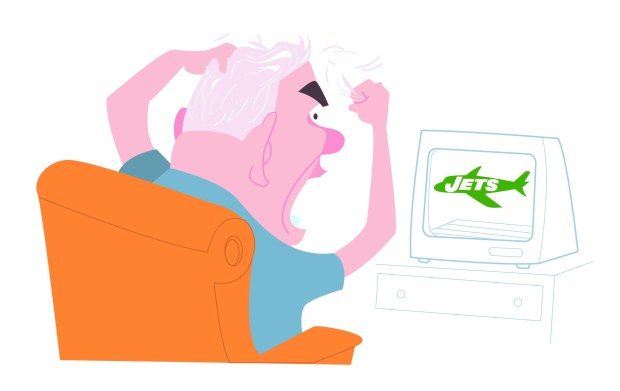 “I think of all the things I’ve done in over 50 years in this business, fantasy football is absolutely the most frustrating thing of all. Watching the Jets, they get down to the 2-yard line, and bring in somebody else. I mean, you just sit there pulling your hair out.” — Nick Canepa (Chris Morris, For The San Diego Union-Tribune)
‘While we’re still young!’
Jerry Magee died on Jan. 2, 2019 at the age of 90. Bill Center wrote in his friend’s obituary that day: “Over dinner many years ago, Magee was asked about his Army duty in Korea. “It was cold,” he said. “But war is cold even in summer.” Having eloquently made his point, Jerry Magee moved on, leaving the rest at the table to contemplate his thought. That was Jerry Magee. With words, he made you think.” Three weeks later, Center notified the league he was stepping away after 35 years as commissioner.
Center: The only reason I stayed on for as long as I did was Jerry asked me to stick around. He wanted me to stay. I had told him I was going to get out. I had lost my enthusiasm for it, and he asked me to stay as commissioner. It made sense to leave after he passed.
Judge: Bill was the heart and soul of the league. He did a great job. Once he said he was stepping away, and Jerry had passed on, I thought there was no reason to continue. Those were two people I really cared about.
Canepa: Jerry Magee had some of the great stories, at least four or five of the best sportswriter stories of all-time, on his own.
Garrison: By the time I was around, he was not a good drafter, and he took too many Raiders. But he would say some funny (expletive). Magee was just a funny human being. He would just say the most deadpan stuff that would crack you up.
Canepa: I think of all the things I’ve done in over 50 years in this business, fantasy football is absolutely the most frustrating thing of all. There is nothing more frustrating than fantasy football. We have Breece Hall, right? Watching the Jets, they get down to the 2-yard line, and bring in somebody else. I mean, you just sit there pulling your hair out.
Hyvonen: When Jerry passed, some people started backing out. That’s when I called Boyce, and said, “Why don’t we just name the league after Jerry?” Some people thought it’s just not the same without him. Jerry started this, but we’ve been doing this for so long. We got Nick back, but Clark Judge left, and Bill never came back. At least we kept it together, named after Jerry because he was the greatest.
Wesch: It was great to meet at the Chargers headquarters and go through the draft, having these guys wisecrack. Nick, you know, sitting there when somebody took too long to make a pick, saying, “While we’re still young!”
Garrison: Me, Hyvonen and Nightengale have seven titles. Nick and Clark had five. (Scott) Yoffe has won it twice. (John) Schlegel’s won it twice. Center won twice, in 1989 and 2017. So he went 28 years between titles.
Wesch: I don’t know that we’ve ever won. We’ve come close a couple of times. We used to have playoffs afterwards, where you redraft. Those were fun. I think we might have won one of those.
Graff: We’ve never won in over 30 years, but that doesn’t dissuade us.
Hyvonen: This was my introduction to fantasy sports. I had no idea what it was, but Magee asked me to join. He was a freaking Hall of Famer back then, and I was just a little two-bit punk starting out. He was always good to me. Me and him sat at Don Coryell’s funeral together at Viejas Arena. We were way up in the rafters, sitting together. We talked about tennis as much as football. Some of the Charger training camps were at UCSD. Jerry was a big tennis player, covered the U.S. Open all the time. A couple of times, we just ran out to our car, grabbed our rackets, and played tennis in the afternoon during two-a-days. I miss him a lot. I’m glad we named the league after him.
Judge: You talk about the best of times. That was the best of times. You don’t know until it’s gone. Magee was hysterical and Center ran the thing perfectly.
BOX: Where are they now?
Bill Center is still a Union-Tribune contributor.
Nick Canepa is in his sixth decade with the Union-Tribune, having started on the evening Tribune in 1971.
Clark Judge is a freelance writer who hosts “Talk of Fame Two.”
Gary Hyvonen, who lives in Alpine, worked for the North County Times from 1982-2006 and currently manages his rental properties while enjoying 2-3 weekly rounds of golf.
Boyce Garrison retired as section editor for sports at the Union-Tribune in 2024, and recently won his record eighth JDFL/MMFL championship.
U-T turf writer emeritus Hank Wesch is fully retired, fighting the aging process and enjoying being a grandfather of four.
Dr. Barry Graff continues to love the league, despite never winning.
Jay Paris has authored books on Shohei Ohtani, the San Diego Chargers and Los Angeles Rams.
Dan Hayes is in his ninth season covering the Minnesota Twins for The Athletic.
After 2 1/2 seasons as head coach of the Chargers, Al Saunders finished his distinguished career as an assistant with seven other NFL teams, retiring in 2018.