
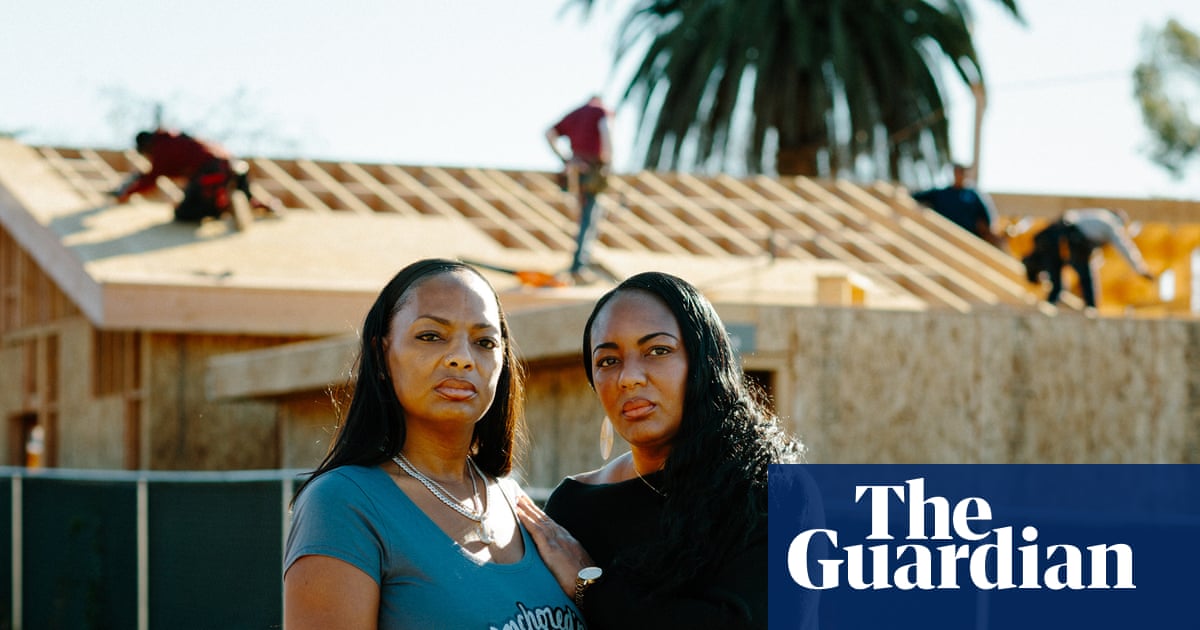
Ellen Williams’ left hand played with her long dark hair as her right hand guided the steering wheel, her phone resting face-down in her lap. Born and raised in Altadena, an unincorporated area in Los Angeles county, she didn’t need to look at a map as she drove to where her home of 22 years burned down.
We passed empty lots with gaping holes where foundations once stood. The banging of hammers rang through the neighborhood and wood frames rose from the dirt, the smell of fresh lumber in the air. Perched on street corners were signs declaring: “Altadena is not for sale.”
The signs speak to an intrusion that has tormented Williams and other wildfire survivors over the last year: real estate investors aggressively pursuing their land.
Williams’ family lost four homes in the Eaton fire, which killed 19 people and destroyed about 9,500 buildings. She received the first call from a real estate investor just two days after her home burned down. The call was from a representative of an investment group who knew her full name and asked if she wanted to sell her lot.
The calls haven’t stopped. “I got one of those calls yesterday,” she said as she drove. “Immediately people saw dollar signs.”
Altadena is known for its thriving Black community that moved there when redlining kept them from buying homes elsewhere. Now, the community is experiencing what academics call “climate gentrification” as residents fight displacement.
Longtime residents who lost their homes are drowning financially due to insurance issues and the high cost of rebuilding, realizing they can’t afford to start over, and selling their land for less than it was worth when their homes were still standing.
At the same time, real estate investors see Altadena as an opportunity. With ample land cleared by flames and bulldozers, they can buy discounted property in an urban area where it’s hard to find land to build. One recent survey found that real estate investors have bought up nearly half the empty lots in Altadena that sold after the fire.
Ellen on her sister Eshele’s lot in Altadena, California. Her home was lost to the Eaton fire.
Williams and her family plan to return to Altadena, but she knows that other longtime residents can’t withstand the financial pressure that threatens to reshape her hometown.
“It was a good opportunity for investors to come in, so that’s exactly what they did,” Williams said. “How dare you? Within days of people losing their homes you want to give them an offer. We’re still processing, yet you want to put a value on land.”
The night of the fire, Williams awoke to her son shaking her. Her family members had arrived in a caravan to warn them that fire was coming down the mountain. Before she went to sleep, Williams had seen the orange glow in the mountains overlooking Altadena and had put some items in the car, just in case.
Now police were driving down the street with megaphones blaring. “There were embers flying everywhere. It looked like a war zone,” Williams said. She sat at a restaurant near her house and watched as embers propelled by hurricane-force winds lit the palm trees like matchsticks. That’s when she realized no one was coming to save her home.
Within a day of the fire’s outbreak, at least 2,800 Black households were forced to evacuate, a UCLA report found. The report also found that Black households were more likely to sustain fire damage, and to be located in the fire’s perimeter; 61% of Black households in Altadena were located in the Eaton fire perimeter compared to 50% of non-Black households, and 48% of Black homes were destroyed or severely damaged compared to 37% for non-Black homes.
The disparity can be partially attributed to the historical policy of redlining, a discriminatory housing practice that saw federal agencies create color-coded maps indicating which areas had large Black populations. Those communities were marked red and deemed high- risk for mortgages. The practice was outlawed in 1968.
In the 1960s, Williams’ grandmother moved from Kentucky to California, settling in Pasadena, next to Altadena. But freeway construction displaced Black residents including the Williams family. Due to redlining, Black families couldn’t buy homes east of Lake Avenue, a major road that cuts through Altadena, so the Williams family bought homes on the west side.
Together, the freeway construction and redlining pushed the Williams family closer to the fire-prone San Gabriel mountains. Decades passed and climate change increased the fire risk, so when the Eaton fire broke out, it was Black households who were more likely to live inside the evacuation zone.
Ellen William’s lot. She and her family plan to return to Altadena, but she knows that other longtime residents can’t withstand the financial pressure.
As we spoke on the phone, UCLA professor and urban cultural historian, Eric Avila, peered at historic, color-coded maps of Altadena on his screen. Avila noted that the area west of Lake Avenue in Altadena was marked in yellow, or “definitely declining”, in the redlining parlance of the time, meaning it carried significant risk to lenders. The area east of Lake Avenue was green and blue, meaning it was desirable, and Black families would likely have been blocked from buying homes there.
“There’s an inherent risk living in this wildland-urban interface zone on the edge of mountains,” he said. “The tragedy is that Altadena reflected an opportunity for a group of people that have experienced high rates of discrimination.”
As survivors seek to rebuild, signs of deep racial disparities are appearing. Nearly six in 10 Black-owned homes in Altadena sustained severe fire damage – the highest rate of any racial group, a UCLA analysis found. Most residents want to return, but nearly seven in 10 severely fire-damaged properties show no progress toward rebuilding. “Black homeowners in particular stood out as facing the greatest barriers,” Gabriella Carmona, the report’s lead author, said.
A real estate development company bought Troy Laster’s property after he lost his home of nearly 40 years in the fire. “They bought multiple [lots] on the block. I know for sure they got three, if not more,” he said. At first, he made a pact with his neighbors to rebuild, but later changed his mind. His wife struggled with trauma from the fire, toxic chemicals lingered in the soil, the rebuilding process felt daunting, and they would have had to pay rent and a mortgage for the duration of rebuilding. So they sold their property and moved to Las Vegas.
“I know, in my heart, the city will never be the same,” he said of Altadena.
Survivors must apply for permits to rebuild, but applications remain stalled. Data suggests this is due to financial burdens. Previous wildfires, like the 2023 Maui fire, have shown that disaster recovery exacerbates existing inequities, with spikes in housing prices, underinsurance and bureaucratic delays pushing survivors out of their communities. “It bubbles into exactly what we see in lots of other disasters, and hence the climate gentrification connection,” Carmona said.
A rose and a black homes matter sign on a lawnLeft: A blooming rose surrounded by burned vegetation on a burned lot in West Altadena Right: Black Homes Matter sign in West Altadena.
After the Eaton fire, the county and state passed policies to reduce costs and expedite rebuilding, and Federal assistance is available, but survivors and advocates say these measures don’t go far enough. “People are in financial trouble, and disaster rips that bandaid off, and then we see more of [the economic precarity that] was already there,” said Lori Gay, chief executive officer of Neighborhood Housing Services of Los Angeles County (NHS), a non-profit that is providing financial support to hundreds of residents who lost homes.
Insurance is a key reason the community is struggling to rebuild. Insurers control how and when to release rebuilding funds, and 70% of insured survivors have experienced delayed, denied or underpaid claims, according to one survey of nearly 2,000 people. Only one in four survivors who suffered severe damage or total loss have had their claims fully approved.
The home of Williams’ mother, which she has owned for more than 50 years, burned to the ground. State Farm cancelled her insurance months before the fire, but didn’t notify her, because her insurance payment was combined with her mortgage payment into a single monthly figure. As a result of State Farm’s actions, she was forced into a less robust policy with another company, meaning she was underinsured and received a lower payout than she would have obtained from State Farm. She has not received a payout from State Farm, but believes she is owed one. “We’re still fighting back and forth with State Farm about her property,” said Eshele Williams, Ellen’s sister.
People who were underinsured or uninsured face a much larger gap to cover the cost of rebuilding. “I have seen back of the napkin calculations assessing what that gap might look like,” Carmona said. “We haven’t run that analysis ourselves, but it’s probably in the $300,000 or $400,000 range.”
Federal funding is not easily accessible to fill the gap. Small Business Administration loans cover some of the rebuilding cost for survivors who meet specific financial criteria, but many don’t qualify.
Ellen and Eshele on Ellen’s lot.
For those facing the largest gap, a controversial compensation scheme may determine if they can return. As evidence grew that Southern California Edison’s power lines probably sparked the Eaton fire, the company launched a payment program for survivors who agree not to sue. The company has acknowledged the fire was probably caused by its equipment but has stopped short of accepting full legal responsibility.
Survivors who lack insurance may feel more pressure to accept the offer, noted Jasmin Shupper, founder and president of Greenline Housing Foundation, a non-profit that is focused on closing the racial wealth gap, and is supporting Eaton fire survivors. People with adequate insurance are looking to litigate so they can maximize what they can recover from the company. “They can wait, because their insurance will get them back to rebuilding. It really depends on people’s individual circumstances,” said Shupper, who lives in Pasadena and was displaced for six months due to the fire.
Gay has had tough conversations with survivors. Many see the offer as inequitable or “race-driven”, yet they find themselves living in unstable housing and are short the half a million dollars needed to rebuild. “Can you afford to live another two to five years waiting on a settlement that’s bigger?” Gay asked. For those who can’t afford to wait, the offer may be their only hope of returning.
Rebuilding isn’t only about financially supporting survivors – it’s about preserving Altadena’s identity as a sanctuary for Black families that grew into a “Black Mecca”.
Flowers bloom behind a plastic fence around the lot where the Williams sisters’ mother’s home once stood, now lost to the Eaton fire.
“It’s more than just homes, you’re talking about legacies,” Shupper said. “You’re talking about people who, in the face of overwhelming opposition, were able to obtain home ownership and have thriving communities. That’s what’s at stake here.” If resources are not allocated to help the community return, “then it will be completely changed,” she added.
Ellen Williams parked next to her property and stepped out to greet her sister, Eshele, who had pulled up in her car. A walkway led to where her front door once stood but only bare ground remained, surrounded by an orange plastic fence marking the property line.
The family received financial help and advice from Neighborhood Housing Services. Ellen submitted the plans for her dream home. Up the street, a prefabricated home will be placed on their mother’s land at a lower cost than it would take to rebuild from the ground up. Within sight of their mom’s lot, Eshele is rebuilding her home, too. She was a renter and lacked rental insurance but was able to buy the land thanks to NHS.
Seeing palm trees still prompts anxiety, but Ellen Williams is focused on the future. “The neighbors are coming back. The only transfer of property was one of my neighbors over here,” she said, gesturing across the street. “They were older, so they transferred it to their kids, who are adults, so it will still be in their family.”
“Other than that, everyone’s coming home, so that’s very exciting. I didn’t want new neighbors,” she joked.