
By Glenn Sacks, Special for CalMatters

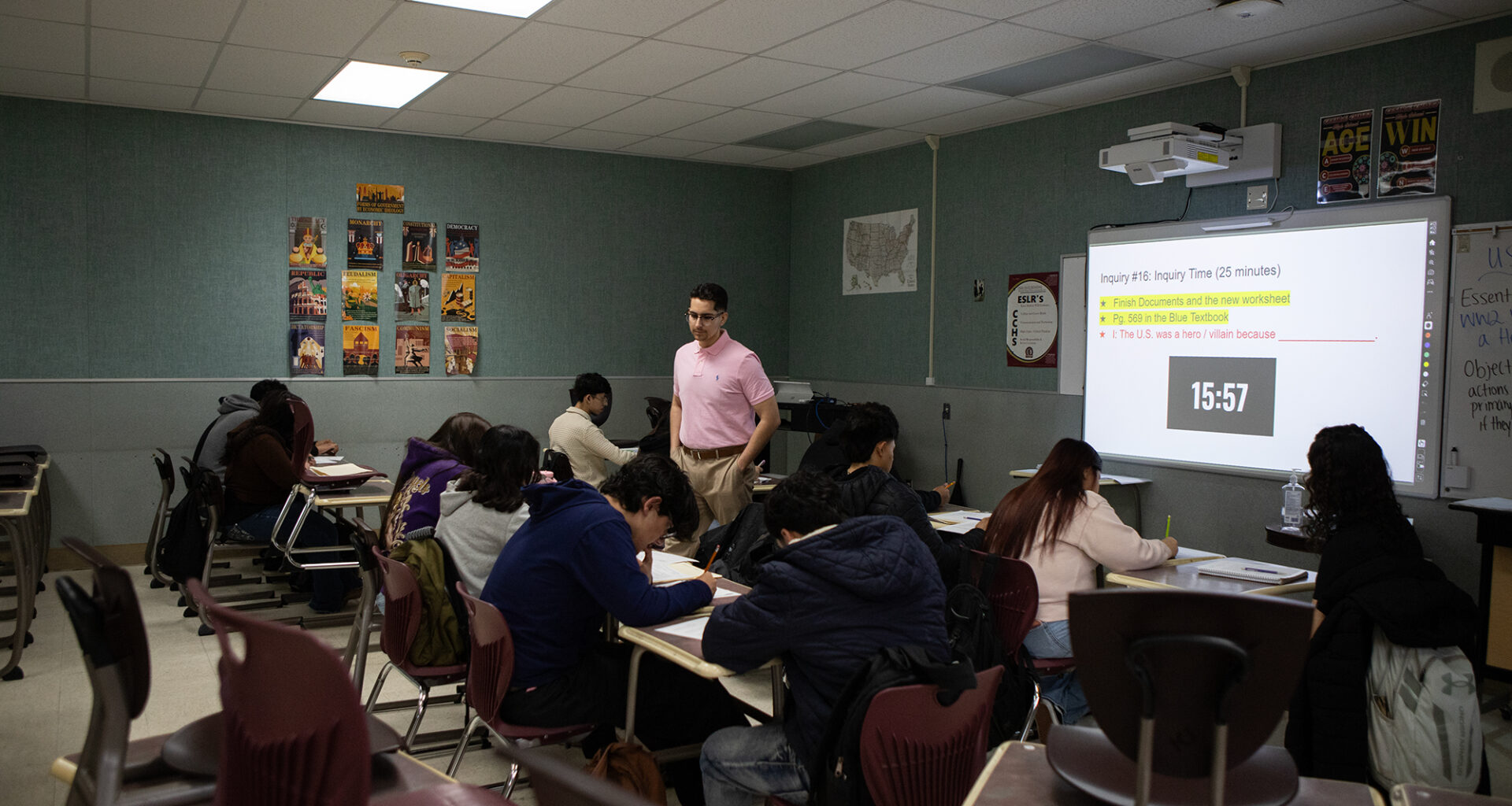
A teacher goes over a lesson in a high school classroom in Delano on March 5, 2025. Photo by Larry Valenzuela, CalMatters/CatchLight Local
This commentary was originally published by CalMatters. Sign up for their newsletters.
Guest Commentary written by
After a recent University of California at San Diego report documented a decline in incoming freshmen’s math skills — despite K-12 school grades edging ever upwards — conservative critics have been blaming teachers and their unions for grade inflation.
Grade inflation is assigning artificially higher grades for a level of school work that in the past merited lower grades. Put another way, it’s the increase in average grades awarded to students over time, absent higher academic achievement.
Columnist Karol Markowicz condemns teachers for letting “students’ grades balloon,” saying educators are falling down on the job. The editorial board of the Southern California Newspaper Group blames the crisis on teachers unions which, they claim, have been “let off the hook,” but whose “power will have to be curbed.”
But teachers are usually the ones resisting grade inflation. They’re usually demanding rigor and accountability. Also, our unions don’t tell us how we should grade; instead they defend our discretion in grading.
So where does this grade inflation come from? School districts and school administrators.
In the Los Angeles Unified School District, as in many others, teachers have been under pressure to eliminate most failing grades and to reduce the number of D’s they award.
In one “low-performing” high school, for example, after every five-week grading period, each teacher receives a grade summary with a chart showing how many of their students are getting D’s or F’s compared to the school as a whole. Each low grade is highlighted in bright red.
Included is a lecture from the district that “a disproportionate number of Fails or D’s for any reporting period or for a single assignment immediately signals the need for revising the instructional program.”
At some schools, giving low grades has become a laborious process. It is not enough that report cards relay the message that the student is “in danger of failing.” To give a low grade, teachers must also repeatedly contact parents and then log each contact.
Teachers are already overloaded with paperwork. And in the face of having to deal with 30 to 40 sets of parents, teachers have a large incentive to say, “This is too much work; I’ll just give them all C’s” — which is, of course, part of these requirements’ purpose.
Yet people with a stake in education have numerous legitimate incentives to inflate grades.
Many districts, including Los Angeles, suffered significant enrollment drops during and after COVID. School officials perceive, not unreasonably, that making it easier for students to pass and graduate leads to better attendance and higher enrollment.
In California, schools are funded by attendance. Administrators are right to protect their budgets and avoid the pain and rancor of layoffs. For them, grade inflation is a useful tool.
Another problem with strict grading: students who have no hope of passing a class are much more likely to become discipline problems.
Late in a semester, there’s a tendency to have “travelers” — students who don’t attend classes because they know they can’t pass. They rove the campus, dodging school authorities. In these cases, administrators, deans and teachers all have an incentive to give everybody a chance to pass.
In large public school systems, many students come from disadvantaged backgrounds. Some critics blame measures designed to help these students for the problems UCSD reports.
Education author Lance Izumi alleges “many schools emphasize equity over merit,” while education reformer Robert Pondiscio condemns “K–12 education’s love affair with ‘equity’,” calling it “intellectually bankrupt.”
Teachers are continually whipsawed between demanding good attendance, hard work and accountability and making accommodations for students whose home lives are difficult.
A few weeks ago Immigration & Customs Enforcement nabbed and deported the fathers of two of my seniors. Both students are now working full time to support their families, while also trying to stay on track to graduate.
Other students have been homeless, forced by circumstances to move far away, fear coming to school because of ICE or are just hungry. Rigor and accountability are great in the abstract, but in practice, teachers cannot ignore their students’ struggles.
This article was originally published on CalMatters and was republished under the Creative Commons Attribution-NonCommercial-NoDerivatives license.