
As the need for affordable housing continues to define L.A.’s housing landscape, developers must navigate the complexities of building these communities.
The execution of these projects is currently being shaped by creative financing packages as well as growing private-sector interest.
Between 2018 and 2024, just 10% of new rental housing units built and certified for occupancy in Los Angeles County were affordable to low-income households, according to August data from USC’s Neighborhood Data for Social Change. Even so, the number of affordable units being delivered per year is increasing, with 4,397 units completed in 2024, compared to 1,597 in 2021 and 491 in 2018.
Despite this uptick, the need is still tremendous. Based on the Regional Housing Needs Assessment, NDSC estimates a shortfall of more than 578,000 rental units in Los Angeles County for households making less than 50% of the county’s area median income.
While nonprofit developers and public sector funding have long dominated the affordable housing creation space – and make no mistake, they still do – for-profit firms and private capital are increasingly shaking up the market. And despite shared goals, developers’ financing strategies significantly affect projects’ costs and timelines.
In interviews with nonprofit and for-profit developers alike, there seems to be a consensus that Los Angeles projects built using low-income housing tax credits (LIHTC) typically range from around $700,000 to $900,000 per unit. This is the result of many factors, including lengthier timelines for securing this funding, the need for additional funding sources, prevailing wage requirements and much more.
Additionally, with LIHTC, the lower the income level a development seeks to serve – like residents earning less than 50% AMI versus up to 80% AMI – the more complicated the project can become, said Lisa Gutierrez, director of affordable housing at U.S. Bank.
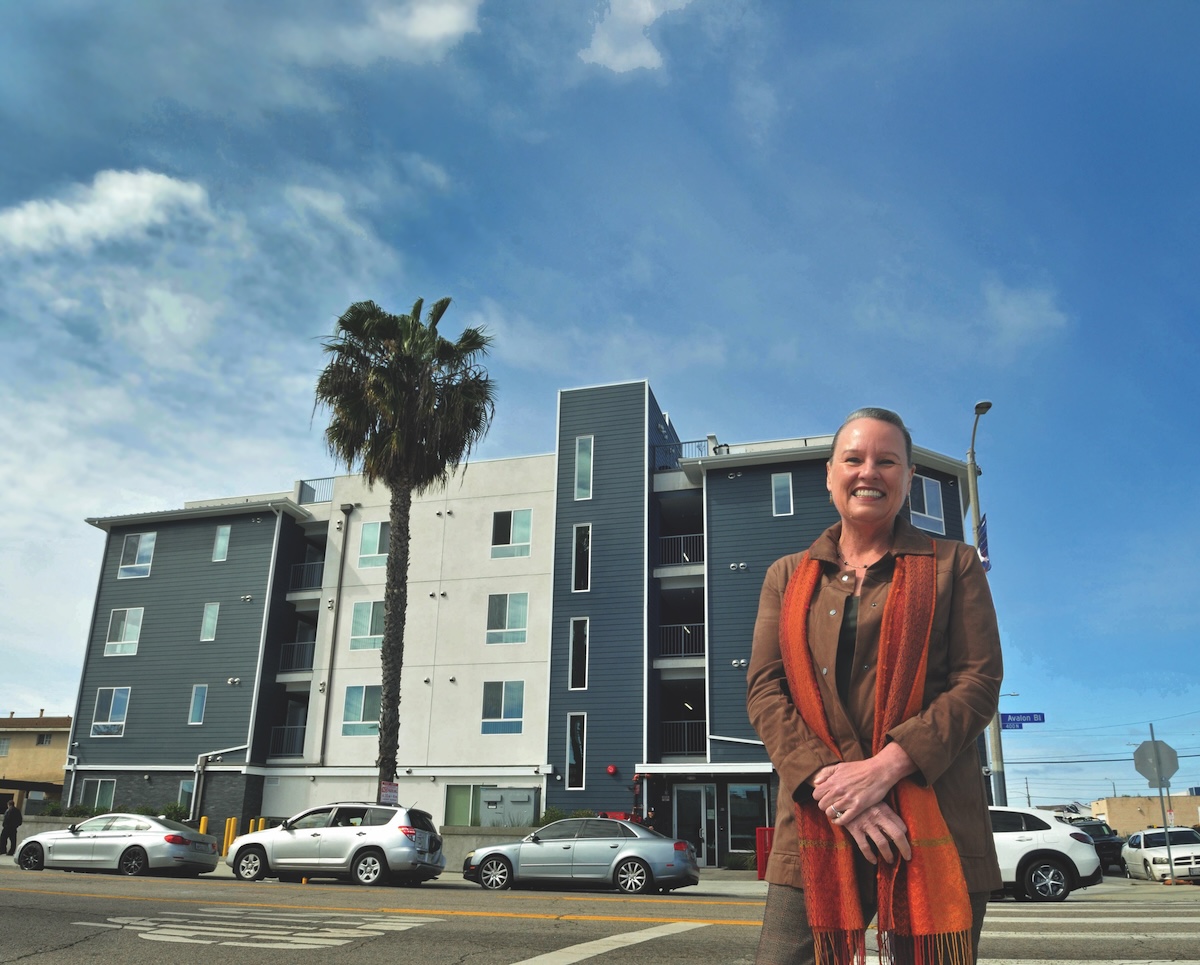
 Lisa Gutierrez
“Deeply affordable developments … will have multiple layers of financing sources that are coming from state, local and regional levels,” Gutierrez said. “Those capital stacks look much different than a workforce housing development.”
With every additional financing source comes specific requirements and conditions that developers must incorporate into their project, she added.
In the L.A. market alone, U.S. Bank has done about $4.3 billion in affordable housing finance – $1.7 billion through LIHTC and $2.6 billion through affordable housing debt. This translates to about 270 deals and more than 22,000 units financed, working with both nonprofit and for-profit builders.
Within the last decade, Gutierrez said the need for private capital to get involved in affordable housing finance has become “much more crucial.”
“Public sources are finite,” she said. “We can’t solely rely on that (if we want) to be able to produce as many units as possible.”
Westwood-based SDS Capital is one prominent firm supplying private capital to affordable developments. Founded by Deborah La Franchi in 2001, SDS has a $1.6 billion portfolio across various funds and has financed more than 3,600 affordable, workforce and permanent supportive housing units in its tenure.
Key to SDS’s strategy is maintaining a low number of financing sources for a project.
SDS is currently focused on financing permanent supportive housing projects in California, all of which are dedicated to the homeless population. For these projects, the firm uses two main funding sources: the SDS Supportive Housing Fund, which provides 97% of the capital, and the project’s developer, which provides the rest.
“It’s very streamlined and we do not have any third-party debt (which keeps) our legal costs to close a transaction at less than $10,000,” La Franchi said.
In today’s interest rate and inflation environment, SDS is funding projects at between $325,000 and $375,000 per unit. Prior to the Covid-19 pandemic, this number was around $225,000 per unit, La Franchi said. Typically, the firm’s supportive housing projects consist of 500-square-foot, one-bedroom apartments. La Franchi acknowledged that affordable housing projects may come with more square footage, which affects price. Still, SDS’s cost-per-unit ratio is impressive.
Aside from limiting the number of funding sources for a project, she said developers can keep costs down by replicating previous projects.
This means using the same vendors across projects to secure better rates and working with the same architect, who will tweak existing plans to fit various projects, rather than coming up with a new design every time.
“It’s more about manufacturing something that’s the same versus creating a whole new concept for each project,” La Franchi said. “That’s been our model, and that is how we’ve been able to keep the cost low.”
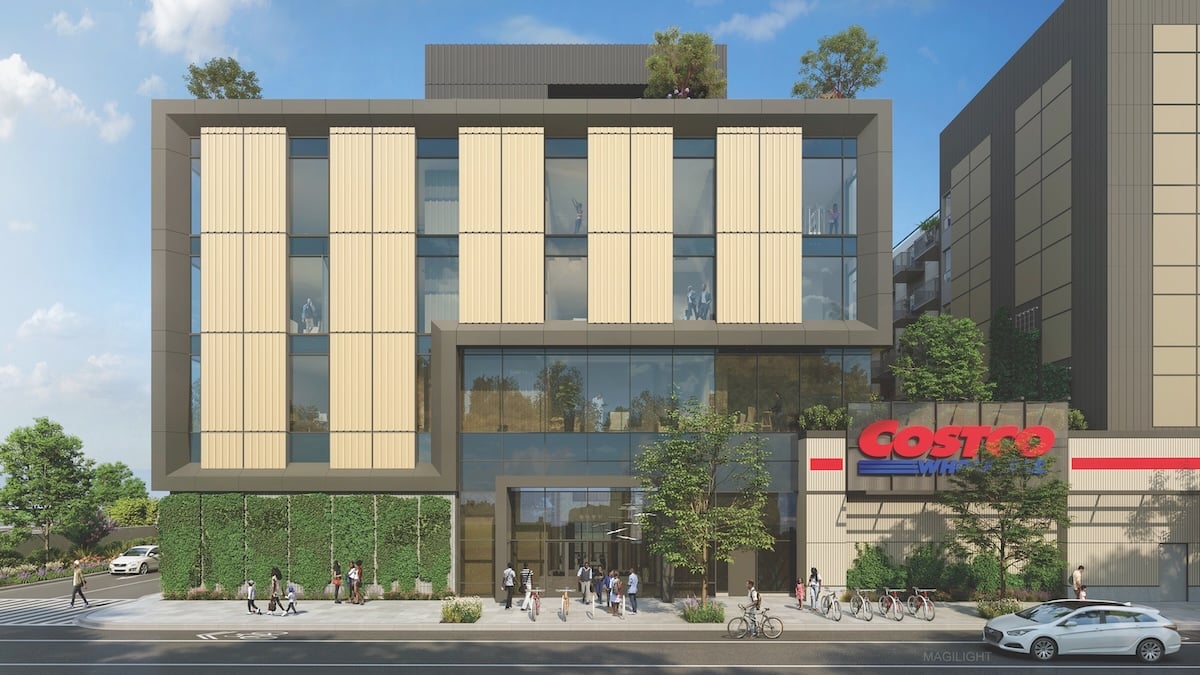 Thrive Living is combining housing with an anchor Costco store. (Rendering c/o Thrive Living)
Another proponent of private financing for affordable projects is Thrive Living, a real estate development and investment firm based in Brentwood. Thrive develops both mixed-income and fully affordable housing. The firm is making a splash in the Los Angeles market with its mixed-income, mixed-use 800-unit apartment building in Baldwin Hills, which will be anchored by a Costco once completed.
By not using public subsidies, Ben Shaoul, founder of Thrive Living, said he’s saving time and money.
“The only way to solve the affordable housing crisis is to build a lot more housing,” Shaoul said. “Our company is focused on innovatively changing the way things are done to build as fast as possible and at scale.”
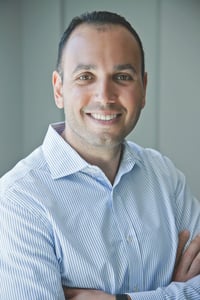 Ben Shaoul
The cost-per-unit for Thrive’s affordable projects in L.A. ranges from $300,000 to $500,000, including parking structures. As a for-profit, Thrive uses recycled bond volume caps from LIHTC developments for its non-LIHTC projects and also transfers profits from completed projects to new ventures.
“Thrive has developed a different way to build affordable housing, an efficient model that excites investors because it delivers tangible social and community impact, while also generating profits – capital that can be used to fund the next project,” Shaoul said. “We’re demonstrating to investors that it’s possible to build affordable and workforce housing using privately financed market-driven strategies.”
While we’re seeing significant innovation from for-profit firms, that doesn’t mean there isn’t any from the nonprofit space. For Bridge Housing – a nonprofit developer based in San Francisco but quite active in the L.A. market – the ability to pull off projects requires creative thinking, said Ken Lombard, president and chief executive of Bridge.
“To really make progress towards solving the affordable housing crisis… you have to be unwilling to accept the status quo,” he said.
Lombard noted that LIHTC has been and will likely continue to be the predominant finance source for affordable projects. Yet given the costs and timelines associated with LIHTC and its availability, many in the space – including Bridge – are exploring alternatives.
 Ken Lombard
This included launching the firm’s first private equity fund in September. Backed by KeyBank and BMO, the fund aims to raise $350 million in equity and is expected to close this quarter, Lombard said. Scouting other investment opportunities and using general obligation bonds are additional strategies.
Among Bridge’s local projects are several housing components of the $1 billion redevelopment of Jordan Downs in Watts.
When evaluating opportunities, Lombard closely considers the time required to assemble a project’s financing package. “If we can’t get it done within 24 months, then that’s either a project we walk away from, or we look for different alternatives,” he said.
In the city of L.A., it typically takes nearly three years from the time permits are approved to project completion for an affordable multifamily building with five or more units, according to NDSC. This does not include the time it takes to go through the permitting process, apply for LIHTC, wait for the results and get the remainder of a project’s financing package in order which can take several years.
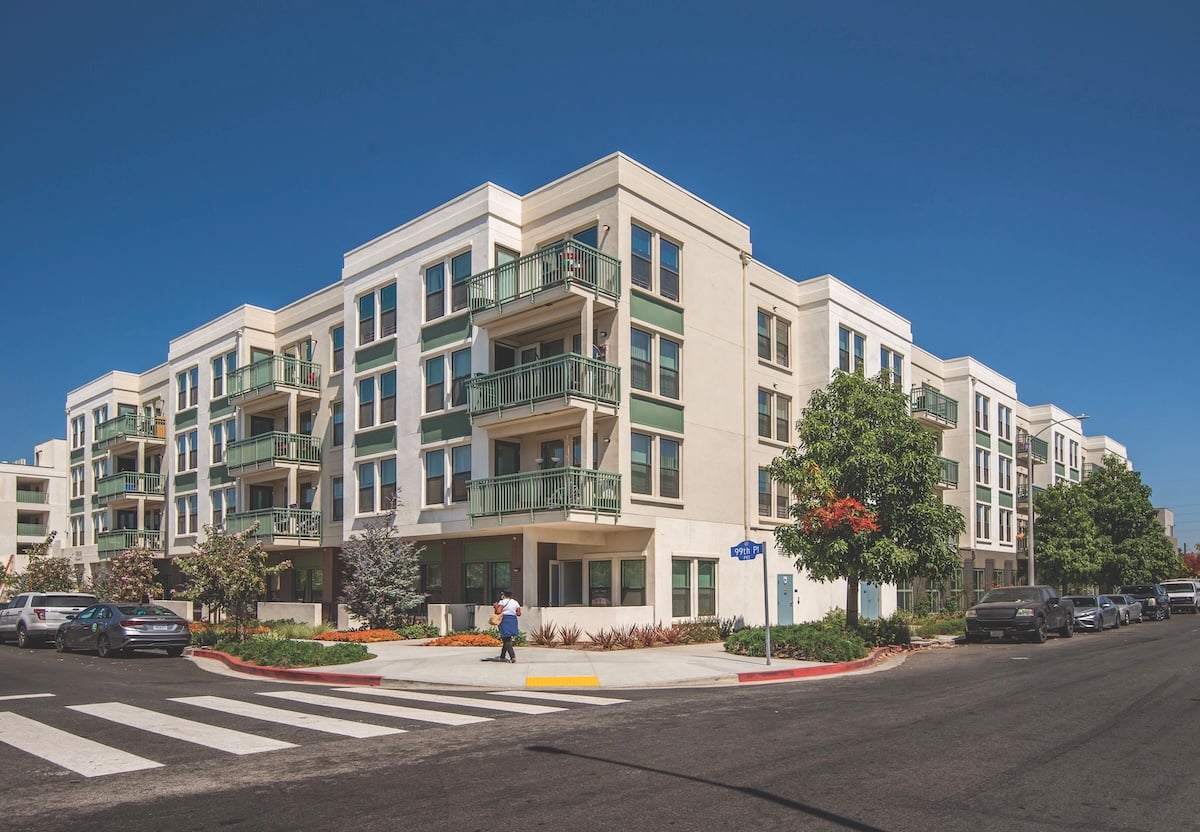 The Kalmia Rose development at Jordan Downs. (Photo c/o Bridge Housing)
“Time is critical for us especially in an environment where it’s not just nonprofit companies competing for the opportunities, but there are also for-profit firms that have alternative means to finance projects,” Lombard said.
Bridge is also strict about cost-per-unit. Projects must come out to around $500,000 to $600,000 per unit; otherwise, Bridge will not do the project, Lombard said. This is generally lower than most nonprofits can achieve when developing in Los Angeles.
One reason nonprofits may be more comfortable with pricier projects than for-profits is the structure of their revenue production. Nonprofits get paid by charging developers a fee based on a percentage of the project’s total cost, whereas for-profits don’t see any returns until they’ve paid back their lenders.
“The traditional way (nonprofits operate) is no matter how high the per-door cost is, if there is available money, whether it be through agencies, tax credits – no matter how it underwrites – they’re going to do the deal because as a company, they are dependent on generating developers’ fees as their revenue stream,” Lombard said.
Instead of this model, he said nonprofits need to underwrite affordable projects the way a developer would for any other project, ensuring the deal pencils out in a way that generates “a reasonable return which in today’s market should be between 7% and 12%,” he said. This not only makes projects more competitive but also more sustainable, given the rent caps on affordable housing.
Even with these strategies to lower the cost of building affordable housing in L.A., the market is much slower and more costly than in other geographies.
With increased regulation, high land costs and extended permitting timelines, investment interest in L.A. can be spotty, said Patrick Chopson, co-founder and chief product officer at Cove Architecture, an AI architecture firm based in Atlanta that analyzes building activity nationwide.
 Patrick Chopson
“It’s kind of like if you went to a restaurant and you ordered food, but there was a less than 80% chance that you would get your meal,” he said. “You might consider going to another restaurant, and that’s kind of how capital thinks about the L.A. market.”
Part of the problem with L.A.’s lengthy approval timelines is that “each part of the process is linked instead of parallel,” Chopson said.
In comparing 10 major metro areas’ timelines for approving large-scale multifamily developments, Cove found that L.A., New York City and Philadelphia had the longest processing times, at 16 to 25 months, 12 to 36 months and 12 to 24 months, respectively. On the other hand, Houston had an approval timeline of one to two months; Miami was three to six months; and Dallas was six months.
One action the city of L.A. took to mitigate this, specifically for affordable housing projects, is Executive Directive-1, which provides expedited review. Even still, La Franchi said in the discourse she’s had with developers using ED-1, most say the program’s 90-day timeline isn’t quite accurate. Instead, approvals seem to take nine to 10 months.
Additionally, projects using ED-1 must be 100% affordable, meaning mixed-income developments cannot secure the expedited timeline.
Overseeing U.S. Bank’s affordable housing finance on a national scale, Gutierrez has noticed that other metros tend to favor mixed-income projects while L.A. focuses on deeply affordable developments.
“Spreading that affordability out drives the cost-per-unit down because you don’t need to layer as many sources of funding to fill the capital stack,” Gutierrez said.
Still, she thinks, given the state of homelessness in California and Los Angeles, “the state and the city are meeting the need of the moment in the market right now,” by focusing on 100% affordable housing. However, projects could be less costly through mixed-income structures.
In addition to SDS Capital’s work in California, the firm also operates on a national scale and currently manages a 10-state fund in the South, which includes Texas, Florida and North Carolina. In comparing how these states and their local municipalities run their entitlement and permitting processes versus Los Angeles, La Franchi said, “it’s night and day.” She also pointed to “great” incentive programs from these states, such as a variety of property tax abatements for affordable housing.
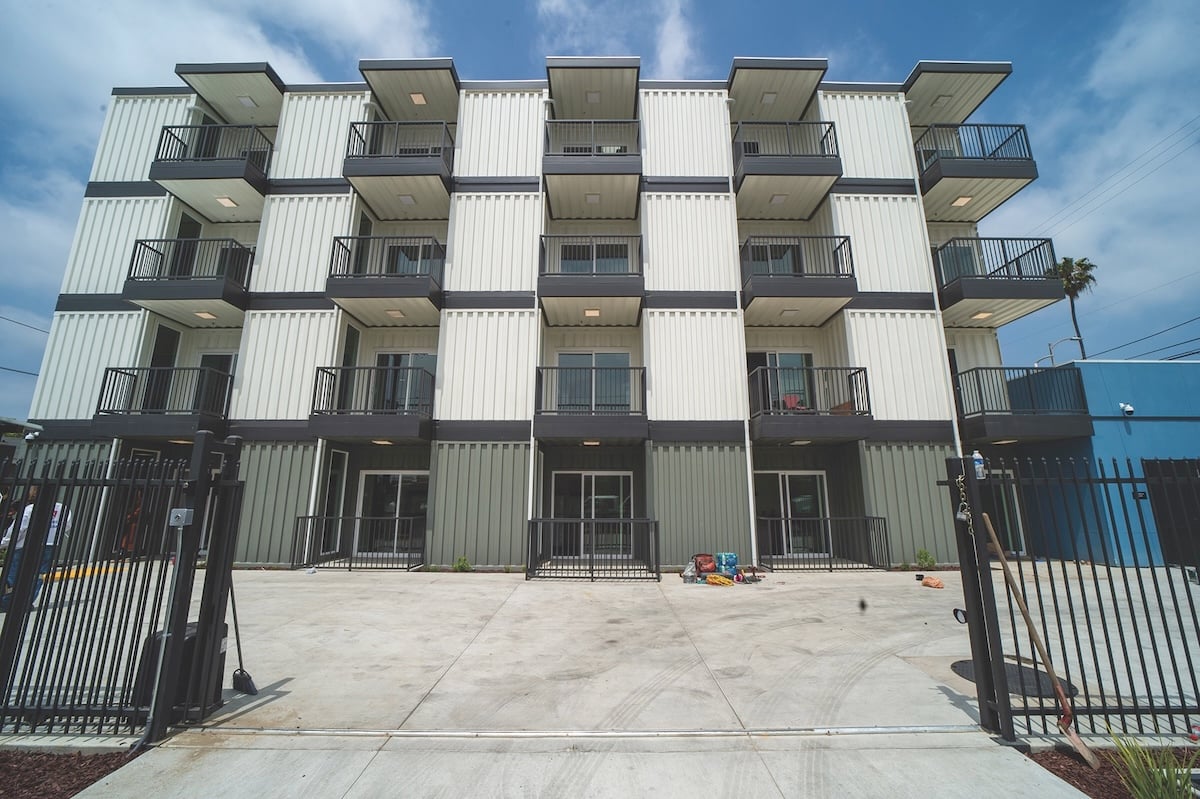 Asset: An SDS Capital Group project, known as Dolores Huerta in Vermont Square. (Photo by Thomas Wasper)
“These incentives are metastasizing because the different cities and states are looking over their shoulder and seeing what’s working in one market and adopting it,” La Franchi said, adding that she’d love for L.A. to adopt more incentive policies.
On the developer side, Gutierrez thinks looking for ways to streamline the construction process would help speed up the completion of affordable projects. This could mean looking at modular or panelized building techniques, she said.
Embracing technology is another strategy, such as using AI to analyze a project site’s zoning code, dig into prior approvals, public hearings and comments surrounding a development.
“Many firms are starting to wake up to the fact that they can use AI to help them be more responsible,” Chopson said. “You can deploy technology to help lower the cost of the project, because the real cost in L.A. is regulation, so (developers and architects) need to think about optimizing against that.”