
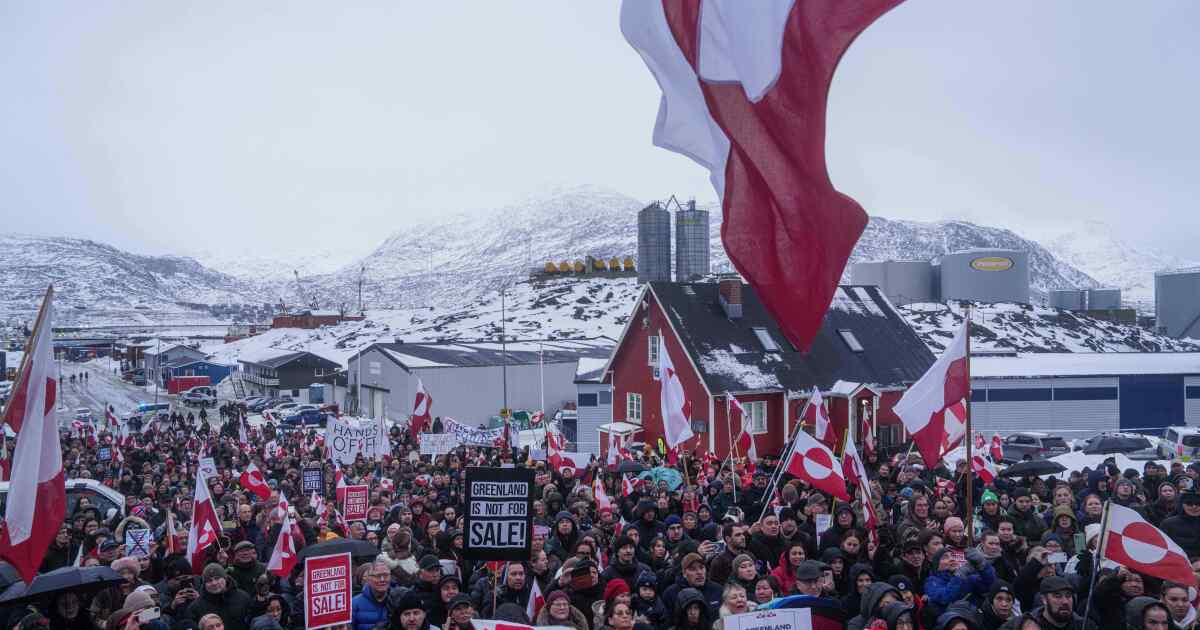
BERLIN — The eight European countries targeted by President Trump for a 10% tariff for opposing American control of Greenland denounced the move Sunday, warning that his threats “undermine transatlantic relations and risk a dangerous downward spiral.”
The joint statement by some of America’s closest allies signaled a possible turning point in the recent tensions over sovereignty and security nearly 24 hours after Trump’s threat.
It was also the most forceful rebuke of Trump from the European allies since he returned to the White House almost a year ago. In recent months, Europeans have mostly opted for diplomacy and flattery around him, even when seeking an end to the war in Ukraine. Sunday’s statement, coming after some European countries recently sent troops to Greenland for a Danish military training exercise, appeared to be a step back from that strategy.
The unusually strong joint statement from Denmark, Norway, Sweden, France, Germany, the United Kingdom, the Netherlands and Finland said troops sent to Greenland for an operation dubbed Arctic Endurance pose “no threat to anyone.”
Danish Foreign Minister Lars Lokke Rasmussen told reporters in Oslo that a dialogue was opened with the U.S. last week and “we will not give up on that. … So we will stay on track — unless the U.S. decides differently.”
Added Norwegian Foreign Minister Espen Barth Eide at the same news conference: “We will not allow ourselves to be put under pressure, and those types of threats [of U.S. tariffs] are unacceptable between close allies.”
Six of the countries targeted are part of the 27-member European Union, which operates as a single economic zone in terms of trade.
Following emergency talks among the EU’s national envoys Sunday, EU Council President Antonio Costa said the bloc’s leaders agree “that tariffs would undermine transatlantic relations and are incompatible with the EU-U.S. trade agreement.”
They expressed “readiness to defend ourselves against any form of coercion,” Costa said in a statement. He is expected to convene a summit of the bloc’s leaders later this week.
The impasse comes on the eve of this week’s World Economic Forum in Davos, Switzerland, with Trump and European leaders scheduled to attend.
In solidarity with Denmark, Greenland
Trump’s Saturday announcement sets up a potentially dangerous test of U.S. partnerships in Europe. He appeared to indicate that he was using the tariffs as leverage to force talks over the status of Greenland, a semiautonomous territory of NATO ally Denmark that he says is crucial to U.S. national security. Trump says he would like the U.S. to buy the Arctic island, but has not ruled out taking it by military force.
“We stand in full solidarity with the Kingdom of Denmark and the people of Greenland,” the group’s statement said. “Building on the process begun last week, we stand ready to engage in a dialogue based on the principles of sovereignty and territorial integrity that we stand firmly behind. Tariff threats undermine transatlantic relations and risk a dangerous downward spiral.”
There are immediate questions about how the White House could try to implement the tariffs because of the EU’s status as a single economic zone. It was unclear, too, how Trump could act under U.S. law, though he could cite emergency economic powers that are currently subject to a U.S. Supreme Court challenge.
EU foreign policy chief Kaja Kallas said China and Russia will benefit from divisions between the U.S. and Europe. She added in a post on social media: “If Greenland’s security is at risk, we can address this inside NATO. Tariffs risk making Europe and the United States poorer and undermine our shared prosperity.”
Europe has been trying to keep Trump on its side to ensure American support for Ukraine, including Washington sharing intelligence with Kyiv and its involvement in security guarantees if a peace agreement is reached with Russia.
Rasmus Sondergaard, a senior researcher at the Danish Institute for International Studies, called Trump’s announcement “unprecedented” because tariff threats normally stem from trade disagreements, not territorial disputes between allies.
“That’s of course why we’re seeing the response from European countries saying ’enough is enough,’ ” he told the Associated Press. “I think there’s in part probably a strategic calculation, of course, from the governments in these countries that if you give in to Trump on this, what will be the next thing? And at some point you have to sort of push back.”
Sondergaard also said Trump leveled the playing field for Europe with the tariff threat. Europeans cannot compete militarily, but the EU can wield an economic weapon through reciprocal tariffs.
NATO Secretary General Mark Rutte wrote on social media Sunday that he’d spoken with Trump. Rutte has been criticized in recent days for largely sidestepping questions about Trump and Greenland and any NATO tensions over the island.
“We will continue working on this, and I look forward to seeing him in Davos later this week,” Rutte said.
British Prime Minister Keir Starmer also spoke to Trump and told him that “applying tariffs on allies for pursuing the collective security of NATO allies is wrong,” a Downing Street spokeswoman said. That call followed conversations with Rutte, Danish Prime Minister Mette Frederiksen and European Commission President Ursula von der Leyen.
Trump’s move was also panned domestically.
U.S. Sen. Mark Kelly, an Arizona Democrat and former astronaut and Navy pilot, said Trump’s threatened tariffs on U.S. allies would make Americans “pay more to try to get territory we don’t need.”
“Troops from European countries are arriving in Greenland to defend the territory from us. Let that sink in,” Kelly wrote on social media. “The damage this President is doing to our reputation and our relationships is growing, making us less safe. If something doesn’t change we will be on our own with adversaries and enemies in every direction.”
Trump’s vice president during his first term, Mike Pence, said he supports the United States ultimately owning Greenland, but not how Trump is trying to accomplish it.
He said he had concerns whether the president had the constitutional authority to impose unilateral tariffs on North Atlantic Treaty Organization allies, as well as about a threat of a military invasion. Trump’s current position threatens “to fracture that strong relationship, not just with Denmark, but with all of our NATO allies,” Pence said on CNN’s “State of the Union.”
Trump’s populist allies criticize his move
The tariff announcement also drew blowback from Trump’s populist allies in Europe.
Italy’s right-wing prime minister, Giorgia Meloni, considered one of Trump’s closest allies on the continent, said she had spoken to him about the tariffs, which she described as “a mistake.”
The deployment to Greenland of small numbers of troops by European countries was misunderstood by Washington, Meloni said, adding that it was not a move against the U.S. but aimed to provide security against “other actors” that she didn’t identify.
Jordan Bardella, president of Marine Le Pen’s far-right National Rally party in France and a European Parliament lawmaker, posted that the EU should suspend last year’s tariff deal with the U.S., describing Trump’s threats as “commercial blackmail.”
Trump also achieved the rare feat of uniting Britain’s main political parties — including the hard-right Reform UK party — all of whom criticized his tariff threat.
Also in London on Sunday, a heckler yelled, “Leave Greenland alone!” while Vanessa Williams sang “The Star-Spangled Banner” before an NBA game between Memphis and Orlando. The outburst drew scattered laughs and applause.
Dazio, Lawless and Burrows write for the Associated Press and reported from Berlin, London and Nuuk, Greenland. AP writers John Leicester in Paris; Lorne Cook in Brussels; Barry Hatton in Lisbon, Portugal; Aamer Madhani in Washington; and Josh Boak in West Palm Beach, Fla.; contributed to this report.