
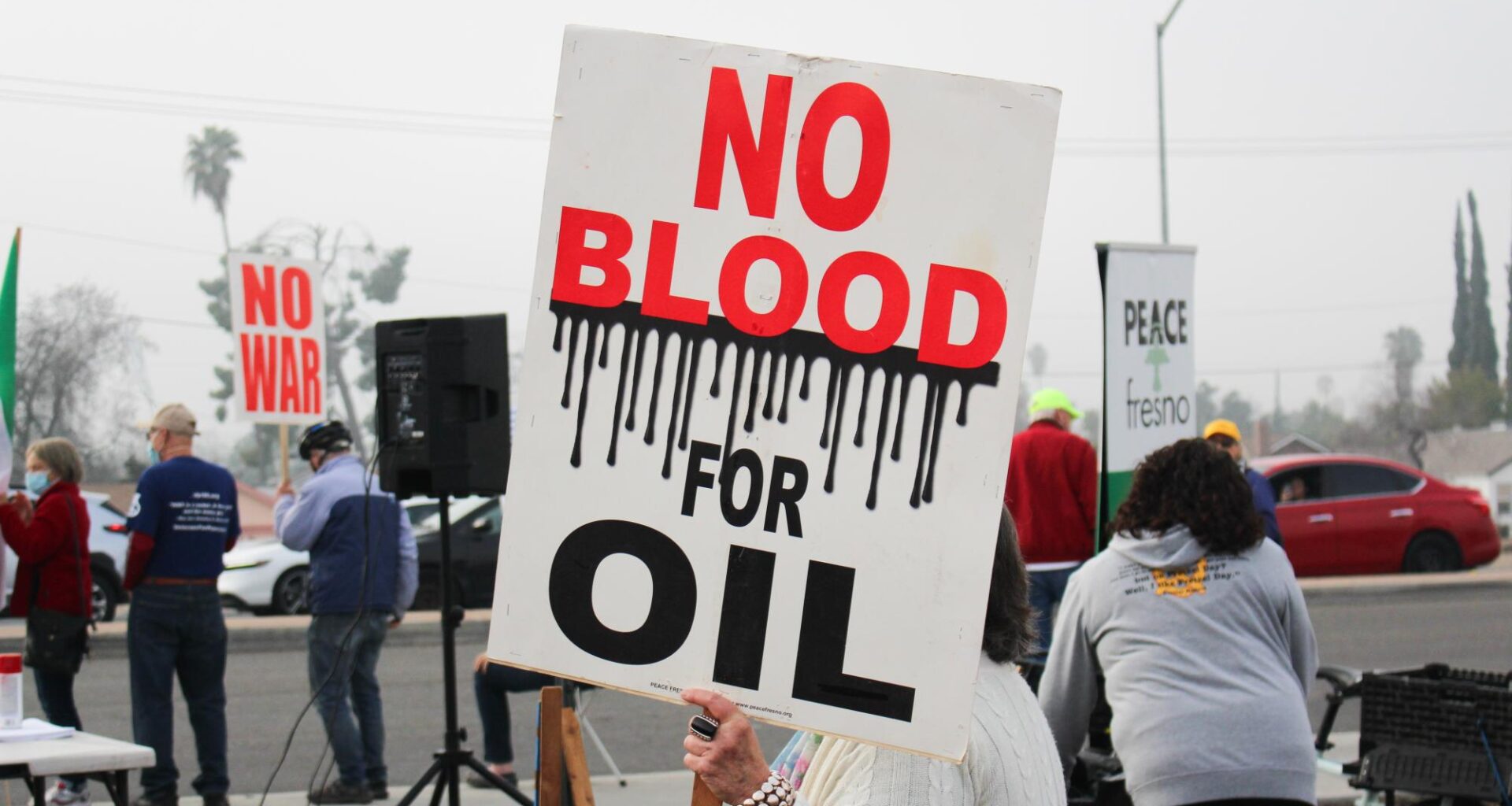
Roughly 120 protesters stood on the northeast corner of Blackstone and Shields avenues holding picket signs and waving flags as they called for an end to U.S. intervention in Venezuela on Saturday.
“They are making it seem like they are saving these countries from themselves, but it’s always been to the convenience and benefit of the United States,” said Stan Santos, a member of Raza Against War.
The demonstration was coordinated by several organizations, including Peace Fresno, Raza Against War, Women’s International League for Peace and Freedom, Veterans for Peace Chapter 180, Kings Canyon Indivisible, Fresno Center for Nonviolence and Back From The Bink.
The organizations were united by their concerns about the increased involvement of the Trump administration in using military violence to seize resources of otherwise impoverished and developing nations, according to the Raza Against War Instagram.
“I’m actually here with my friends; they invited me,” said protester Ethan Gonzales. “I didn’t know this was happening until the day before. I just came with my friends to support. [Protesting] doesn’t cost much, just do it.”
Santos said that many protesters saw the actions taken in Venezuela not only as a distraction from domestic issues, but also to set a warning for what could come next to many other countries in the Americas, including Colombia, Cuba, Nicaragua and even Mexico.
Over the course of the protest, several people gave speeches through a microphone, delivering their message to anyone passing by the intersection.
Many of those who attended the protest had encouraging words for people who did not attend themselves.
Santos said that while there is no support for an American boots-on-the-ground occupation of Venezuela, the government could continue to take action in other ways.
“That won’t stop them from doing what’s already been done to Gaza, and to a certain Iran, where they’ll just bomb the hell out of them and then impose economic sanctions and starve people to death,” Santos said.
Santos then referenced a study published by The Lancet, which reviewed the health toll of economic sanctions, to refer to how deadly the effects of economic sanctions can be.
“How is the United States government going to audit that money?” Santos said. “How are we going to know where it’s going and where it’s being spent? It’s quite possible that it could become a huge slush fund with literal millions of dollars in it that they could use however they want.”
Another protester, Mark Etheridge, shared a similar sentiment.
“In the simplest terms, it’s money laundering,” Etheridge said. “There’s going to be no oversight, as with many things with the Trump administration. They’re going to get their first cut off the top.”
When asked what they thought about those who are glad that the U.S. invaded Venezuela, both Santos and Etheridge had their own responses.
“I understand the people saying, ‘we need to celebrate that Maduro is gone,’ and that is true, but what comes next?” Etheridge said. “The same people are still in power, the same organizations, people with the same outlooks and tactics, a corrupt government is still in power.”
Santos pointed to the recent pardon Trump granted to Juan Orlando Hernández, the former president of Honduras and a convicted drug trafficker, as evidence that the capture of Maduro was not to free Venezuela of a dictator.
Despite the emotional weight felt by many of the attending protesters, the gathering remained peaceful as those present demanded change.