
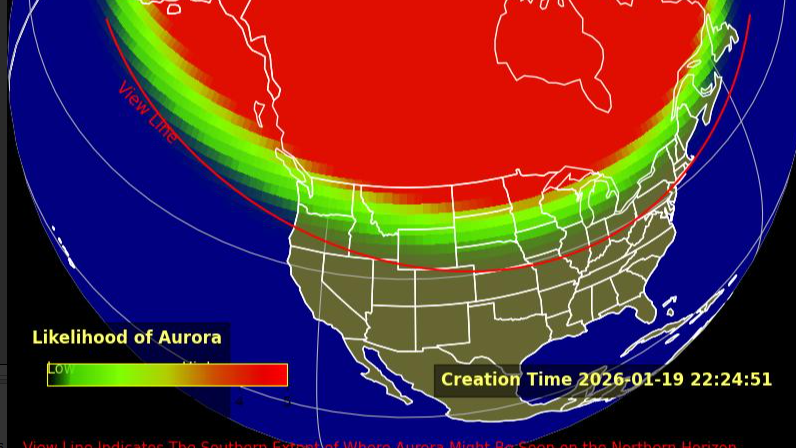
The Northern Lights could return to Northern California on Monday. A coronal mass ejection, known as a CME, arrived from the sun earlier than expected on Monday and was creating a strong geomagnetic storm in Earth’s magnetic field, which has the potential to impact power grids, space operations and radio and satellite communications. It also can spawn aurora, which may be seen as far south as Southern California, weather permitting, Meteorologist Dirk Verdoorn said. As of Monday afternoon, the aurora forecast dashboard from the Space Weather Prediction Center (SWPC) showed a view line for southern Oregon. “Aurora seen from Northern California is possible tonight due to the intense nature of the CME arrival (that already happened) here at Earth and as its passage continues tonight,” Shawn Dahl, a SWPC Service Coordinator, told KCRA 3. NOAA’s Space Weather Prediction Center uses a rating system to forecast and track the strength of different geomagnetic solar storms. The scale ranges from G1 to G5, the strongest level. The current storm is rated a G4. “Due to the strength of this CME, we have a chance for G5 as well,” Dahl said. The geomagnetic activity is also forecast to be at a KP 8 level out of a range of 0-9. According to NOAA, KP levels in the range of 8 or 9, means “the aurora will move even further towards the equator and it will become very bright and very active. These are the events that create the best aurora and the extended auroral oval will be observable by the most people. At these levels, aurora may be seen directly overhead from the northern states of the USA.”Fog could limit the view in the Valley Fog in the Central Valley will make it difficult to see any aurora, but areas above the fog should have great viewing with mostly clear skies, Verdoorn said. The potential to see aurora should last Monday night and even into Tuesday night above the fog, he said. Meanwhile, Dahl with the Space Weather Prediction Center said another event besides the CME that was associated with a solar flare, a severe solar radiation storm, was also causing impacts. “The severe solar radiation storm is the strongest seen since 2003 and we reached a level not seen since 1991,” he said. “These events are important for satellite operations at geo orbits, for space related launches, astronaut health, aviation interests for flights near the polar regions.”The solar radiation storm does not play a role in the development of an aurora, he said. See news happening? Send us your photos or videos if it’s safe to do so at kcra.com/upload.See more coverage of top California stories here | Download our app | Subscribe to our morning newsletter | Find us on YouTube here and subscribe to our channel
The Northern Lights could return to Northern California on Monday.
A coronal mass ejection, known as a CME, arrived from the sun earlier than expected on Monday and was creating a strong geomagnetic storm in Earth’s magnetic field, which has the potential to impact power grids, space operations and radio and satellite communications.
It also can spawn aurora, which may be seen as far south as Southern California, weather permitting, Meteorologist Dirk Verdoorn said.
As of Monday afternoon, the aurora forecast dashboard from the Space Weather Prediction Center (SWPC) showed a view line for southern Oregon.
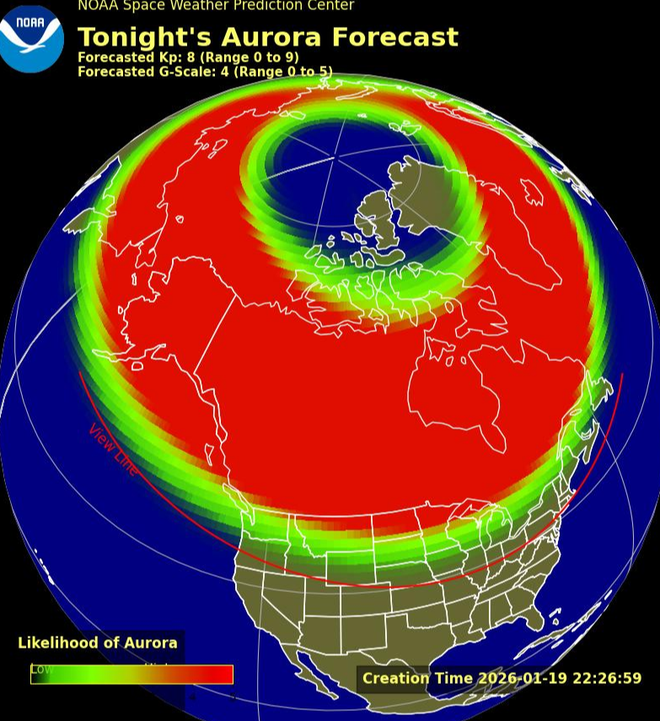
“Aurora seen from Northern California is possible tonight due to the intense nature of the CME arrival (that already happened) here at Earth and as its passage continues tonight,” Shawn Dahl, a SWPC Service Coordinator, told KCRA 3.
This content is imported from Twitter.
You may be able to find the same content in another format, or you may be able to find more information, at their web site.
SWPC Video Update from Shawn Dahl, SWPC Service Coordinator about the severe G4 and S4 ongoing storms. Apologies for the hastiness of this, but we have been very busy notifying aviation, power grid, FEMA, and more about these storms. Stay aware at https://t.co/TV7Yw6Lq1Y pic.twitter.com/rT0iNTng4B
— NOAA Space Weather Prediction Center (@NWSSWPC) January 19, 2026
NOAA’s Space Weather Prediction Center uses a rating system to forecast and track the strength of different geomagnetic solar storms. The scale ranges from G1 to G5, the strongest level. The current storm is rated a G4.
This content is imported from Twitter.
You may be able to find the same content in another format, or you may be able to find more information, at their web site.
“Due to the strength of this CME, we have a chance for G5 as well,” Dahl said.
The geomagnetic activity is also forecast to be at a KP 8 level out of a range of 0-9.
According to NOAA, KP levels in the range of 8 or 9, means “the aurora will move even further towards the equator and it will become very bright and very active. These are the events that create the best aurora and the extended auroral oval will be observable by the most people. At these levels, aurora may be seen directly overhead from the northern states of the USA.”
Fog could limit the view in the Valley
Fog in the Central Valley will make it difficult to see any aurora, but areas above the fog should have great viewing with mostly clear skies, Verdoorn said.
The potential to see aurora should last Monday night and even into Tuesday night above the fog, he said.
Meanwhile, Dahl with the Space Weather Prediction Center said another event besides the CME that was associated with a solar flare, a severe solar radiation storm, was also causing impacts.
“The severe solar radiation storm is the strongest seen since 2003 and we reached a level not seen since 1991,” he said. “These events are important for satellite operations at geo orbits, for space related launches, astronaut health, aviation interests for flights near the polar regions.”
The solar radiation storm does not play a role in the development of an aurora, he said.
See news happening? Send us your photos or videos if it’s safe to do so at kcra.com/upload.
See more coverage of top California stories here | Download our app | Subscribe to our morning newsletter | Find us on YouTube here and subscribe to our channel