
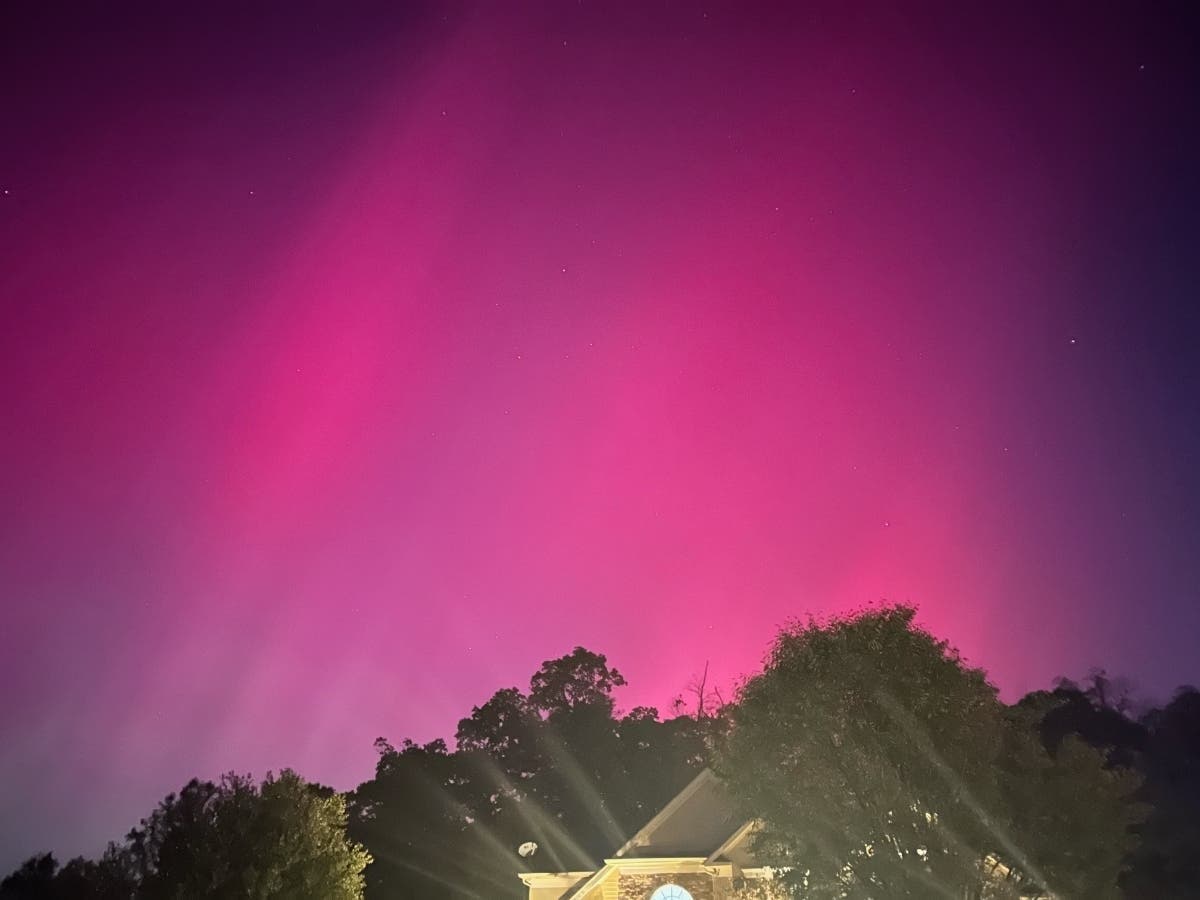
Residents across dozens of states, including California, may have an opportunity to view the Northern Lights on Monday night due to a significant solar eruption that happened on Sunday.
The sun released a powerful burst of charged particles, known as a coronal mass ejection. When these particles interact with Earth’s magnetic field, they have the chance of creating vibrant aurora displays.
The National Oceanic and Atmospheric Administration’s Space Weather Prediction Center had issued a “severe” geomagnetic storm watch for Monday night. The event was anticipated to reach a level 4 out of 5 on NOAA’s space weather scale. Such a rating indicates a strong potential for widespread aurora visibility.
Severe storm conditions were first reached shortly after 11:30 a.m. Monday, upon coronal mass ejection shock arrival, according to the center.
Also Monday, a level 4 out of 5 severe solar radiation storm was in progress as of about 10:30 a.m., which the center described in a social media post as “the largest solar radiation storm in over 20 years,” with similar levels last seen in October 2003. Potential effects were mainly limited to space launch, aviation and satellite operations, according to the center.
According to NOAA, areas as far south as Northern California might be able to observe the aurora during its peak. In regions even further south, cameras may be capable of capturing faint colors, even if the lights are not easily discernible to the naked eye.
Forecasters say this represents one of the best opportunities in several months to witness the natural phenomenon.
In the Bay Area, the overnight forecast calls for patchy fog after midnight and increasing clouds, while Southern California will have clear skies in some areas and patchy fog in others, according to the National Weather Service.
The chance to see auroras is likely to be a one-night event, although it could linger into Tuesday night in parts of Canada and the far northern U.S., AccuWeather said.