
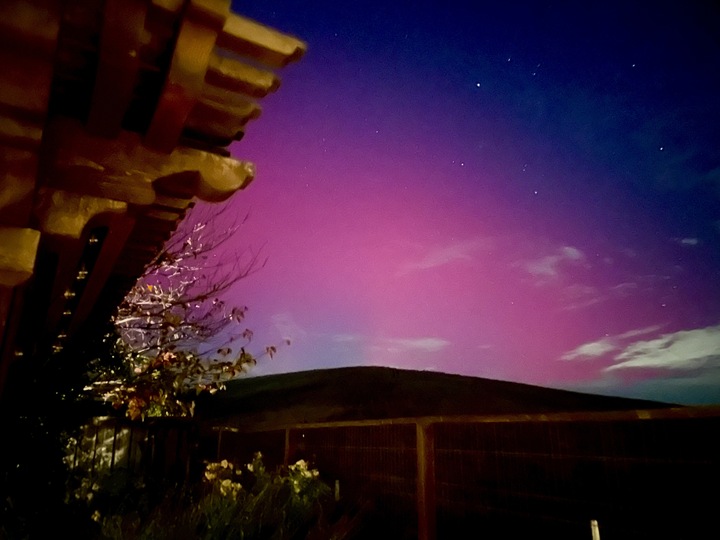
The northern lights may be visible in parts of California on Monday night thanks to a solar storm that is being described as the most severe in more than two decades.
But clouds around the Bay Area and elsewhere in Northern California could make the phenomenon difficult to observe locally.
The ejection is linked to a massive solar flare that erupted Sunday, triggering a severe solar radiation storm that produced the highest radiation level since the famous Halloween solar storms of October 2003. Those storms made the northern lights visible in California, and NOAA says that could happen again Monday. Californians last caught a glimpse of the northern lights in November.
NOAA said a G4 “severe” geomagnetic storm watch is in effect for Tuesday, a designation the agency described as “very rare.” Minor to moderate geomagnetic storm levels are possible late Monday.
NOAA said auroras could be visible over much of the northern half of the country, extending as far south as Northern California to Alabama.
The latest reports from NOAA and the United Kingdom’s Met Office are indicating that the impact on Earth’s magnetic field is already surpassing earlier predictions.
Northern and Central California have strong chances of seeing visible auroras during the expected geomagnetic storm, but a mix of high altitude and low level clouds in the overnight hours will make it harder to see around the Bay Area. The Central Valley and much of Northern California will also be impacted by clouds that could obscure the northern lights, though communities in the Sierra Nevada should be under clear skies.
In Southern California, which is expected to see mostly clear skies Monday, viewers could see a reddish glow visible on the northern horizon, especially with long-exposure photography.