
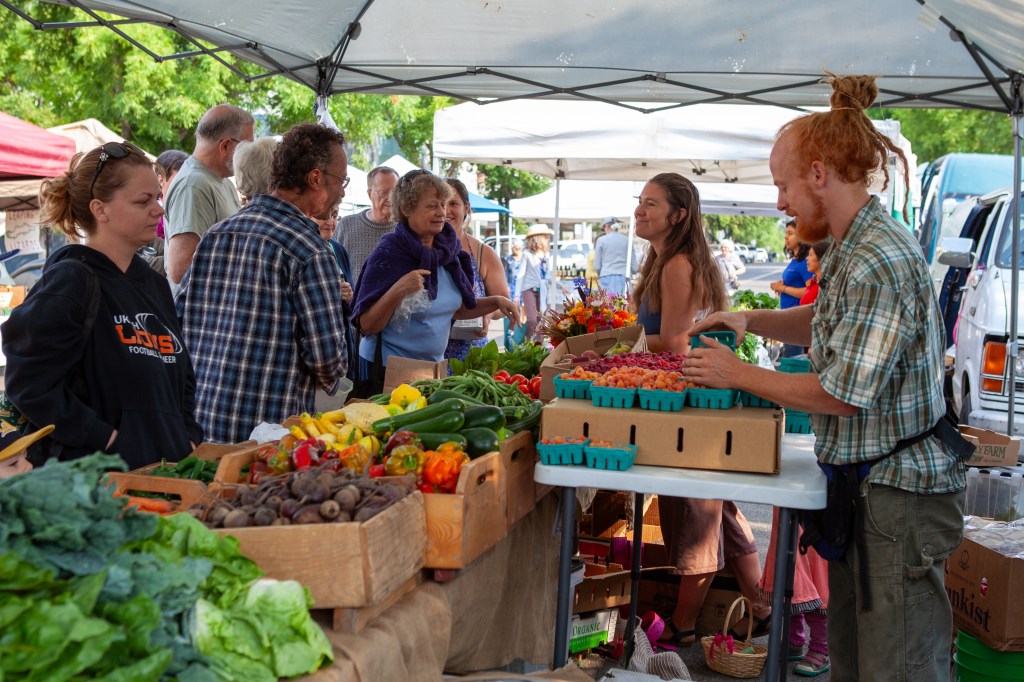
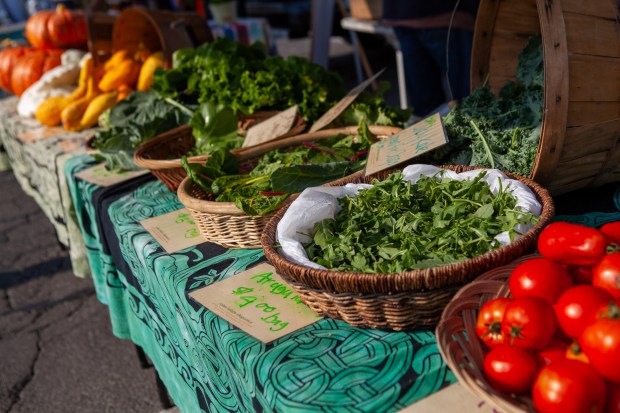
 Fresh produce, including leafy greens, tomatoes, and squash, is displayed for sale at the Ukiah Farmers Market on August 8, 2015. (Chris Pugh — Ukiah Daily Journal)
Everyone is aware that Federal HR1 cuts to SNAP (CalFresh) are reducing monthly nutrition benefits to an estimated 444,000 Californians.
But, according to Market Match and the California Nutrition Incentive Program (CNIP), just at a time when the need is skyrocketing, the Governor’s proposed January budget did not include allocations to sustain a critical program for farmers and those who use CalFresh dollars to shop at Farmers’ Markets.
Historically, the CNIP program has addressed higher food costs by doubling shoppers’ dollars when purchasing fresh fruits and vegetables directly from California farmers.
Without inclusion in the 2026/2027 budget, this program will run out of funds in 2027.
“California needs to ensure essential food resources are available for the thousands of Californians who rely on CalFresh and Market Match for fresh, healthy food at certified farmers’ markets. Market Match helps to nourish our most vulnerable populations while providing economic stimulus to our small-scale farmers who play a crucial role in our state’s agricultural landscape,” said Assemblymember Damon Connolly, who represents the North Bay’s 12th Assembly District.
Market Match is California’s healthy food incentive program that matches customers’ CalFresh nutrition assistance benefits at farmers’ markets and other farm-direct sites across the state. The program empowers customers to make healthy food choices and benefits hundreds of small and mid-size California farmers. Led by the Ecology Center, Market Match is currently offered at more than 300 sites statewide, in partnership with over 50 community-based organizations and farmers’ market operators.
Market Match supports CalFresh shoppers in making healthy food choices by lowering the cost of fresh food. The program can help close persistent crises in diet-related health issues such as heart disease, diabetes, and cancer. CNIP also supports other programs, including CalFresh access to extra farm-direct fruits and vegetables at a select number of small corner stores in low-income areas.
In Mendocino County, Market Match dollars are available year-round at Farmer’s Markets in Laytonville, the Little Lake Grange in Willits, Ukiah, and Fort Bragg- and seasonally at the Redwood Valley Farmers Market, Mendocino, Oz Farm in Manchester, and the Filigreen Farm in Anderson Valley
In 2025, 627,597 Market Match shoppers spent $22,467,928 in combined CalFresh at 303 market locations across 38 counties. The program delivered 44,935,856 servings of California-grown fruits and vegetables, while keeping food dollars circulating in local farm economies throughout the State. The program is the financial backbone of many markets in low-income communities where fresh foods are otherwise scarce and overpriced.
With recent federal changes under President Trump’s HR1 already shrinking SNAP benefits, the absence of Market Match funding will further reduce families’ ability to buy nutritious food. At the same time, small and mid-sized farmers—who rely on these purchases for stable, local sales—will lose a critical source of income. Research shows that these dollars have a 3-to-1 economic multiplier effect, sustaining farming families, workers, and the communities surrounding California’s small farms.
“Being a specialty produce farmer, we see a majority of our sales income specifically from EBT, and two-thirds of those EBT users also use the Market Match. The Market Match program helps small farmers to compete with bigger supermarkets. If the market were to lose the program, we would lose almost half of our income,” said Paul-Zen Lee, a farmer from Davis.
Market Match currently reaches 40% of California’s 650 farmers’ markets, with many more locations throughout the state interested in offering the program in their communities. Without renewed state funding, the program is projected to run out of funds in early 2027, jeopardizing a decade of progress in food access, public health, and farm viability.
Advocates are seeking $50 million to fund every market in the state that wants to participate, and to increase the match from $15 to $20 per market visit. This is part of a campaign to ensure Market Match is a continuous allocation in the budget. The advocacy push is occurring this year, with staff hoping that their efforts will inform the 2027 budget.
“We are reaching out to many legislators this year to encourage them to be advocates for our push,” says Sara Leaverton, Business Development Director of the Ecology Center. If approved, the funding would be passed through to all of the markets that operate Market Match. Advocates are also seeking an ongoing allocation- such that the program is not reliant on annual legislative budget requests. There is an additional option for state funds to draw down federal matching dollars through the Gus Schumacher Nutrition Incentive Program at the USDA.
“Market Match is a win-win- leveraging state and federal dollars to address food insecurity, health equity, and farm sustainability through local food systems,” says Martin Bourque, Executive Director of the Ecology Center, which administers the Market Match Program. “California can’t afford NOT to fund this program; the cost of losing its benefits is simply too high.”
According to Market Match staff, California has been a national leader in building a statewide healthy food incentive program—one administered by farmers’ market operators, supported by significant state investment, and matched with federal funding. Launched in 2015, Market Match is well past the pilot phase, and supporters feel it should be treated as part of the state’s core food system infrastructure. Currently, funding is distributed through partnerships with farmers’ markets across California, which operate to distribute fresh fruits and vegetables to CalFresh shoppers.
“I have a 5-year-old daughter with autism. She is very picky, and this program has allowed me to buy things and explore new veggies and fruits with her. She has tried so many new things just because of Market Match, and I’m very thankful. Market Match helps me have more money to last through the month. I really depend on it,” said Market Match consumer Iveliz Rodriguez of San Leandro.
Participating Market Match sites can be found with the Ecology Center’s Farmers’ Market Finder at https://ecologycenter.org/fmfinder/.