
Tuesday, Jan. 27, is International Holocaust Remembrance Day.
Growing up, Lori Klisman Ellis did not have grandparents. She had one aunt and one uncle and two cousins. At celebrations and gatherings, she was used to seeing close family friends, who similarly had small families. It all seemed normal.

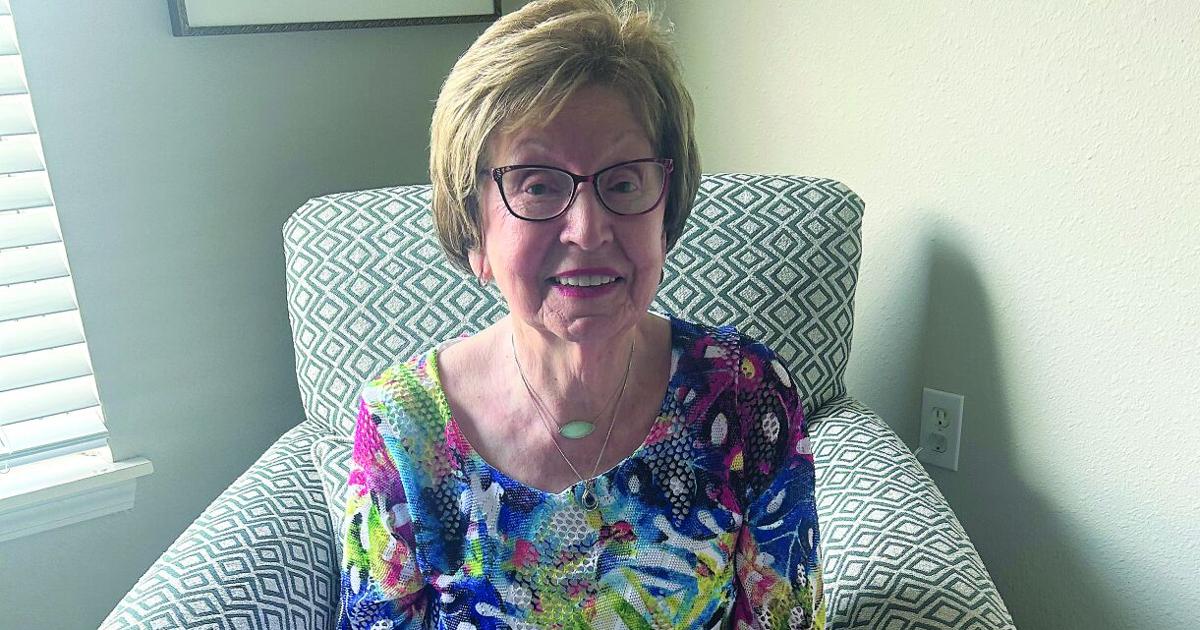
Eleven years ago, shortly following the death of her father, Ellis’ mother Sophie Klisman said to her, “I hope you won’t be mad at me, Lori. I finally decided to share my story at the Holocaust Memorial Center.” Ellis remembers feeling thrilled. At that point, she knew next to nothing about her mother’s story of surviving the Holocaust.
Sophie Klisman was born on July 6, 1929, to Liba (Rozrazoska) and Icek Berek Tajch in Piotrkow, Poland. Her childhood name was Zysla Tajch. Prior to the outbreak of World War II on Sept. 1, 1939, the Tajch family moved to Lodz, Poland. By February 1940, the Lodz ghetto was established.
“More than 20% of the ghetto’s prisoners died, including my grandmother Liba, my grandfather Icek Berek, my uncle Moszek, and thousands more,” wrote Ellis in her book 4,456 Miles: A Survivor’s Search for Closure. “They died due to starvation and disease.”
After surviving five years in the Lodz ghetto, Klisman and her sister Felicia and brother Israel/Srulek were forced into boxcars and deported to Auschwitz-Birkenau. By 1944, so many people were being sent to their death at Auschwitz-Birkenau that prisoners were no longer tattooed.
Klisman and her sister miraculously survived three concentration camps. In addition to Auschwitz-Birkenau, they were also at Bergen-Belsen and Salzwedel.
“The Holocaust began with prejudice and antisemitism, and when those ideas were allowed to grow, they resulted in the loss of millions of innocent lives,” said Klisman, 96. “The resurgence of antisemitism today is frightening because I know firsthand where it can lead, and it must never happen again!”
Resistance During the Holocaust
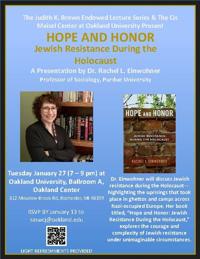
Tuesday, Jan. 27, is International Holocaust Remembrance Day. The Judith K. Brown Endowed Lecture Series and the Cis Maisel Center at Oakland University are co-sponsoring a free event featuring Dr. Rachel L. Einwohner, professor of sociology at Purdue University, who will discuss her book Hope and Honor: Jewish Resistance During the Holocaust.
Einwohner’s areas of expertise are protest and resistance. During the past 20 years she has focused on Jewish resistance during the Holocaust.
Often resistance is studied within
democracies. Instead, she sought to study what resistance looks like without resources and without political opportunities.
“Many people ask, ‘Why didn’t Jews resist during the Holocaust?’” said Einwohner. “The truth is that they did resist, in many different ways.”
In her book, one of the three ghettos Einwohner studied was the Lodz ghetto. She found the Lodz ghetto, which Klisman survived, was unique from Warsaw and Vilna, the other two ghettos she examined. Unlike the Warsaw and Vilna ghettos that had some, though limited, access to the outside, the Lodz ghetto was completely separated from the surrounding world. Neither information nor goods could be or were smuggled in.
“As a sociologist who studies protest and resistance, I use cases of resistance in the ghettos of Warsaw, Viln and Lodz not simply to remind us all that Jews did resist, but also to understand variations in resistance, and why armed resistance happened in some ghettos but not others,” Einwohner said. “The stories of these ghettos, and the people who lived here, illustrate brave decision-making under impossible conditions.”
“Much like relationships, Judaism emphasizes connection, community and resilience — finding strength even through devastating struggles such as the Holocaust,” said Dr. Terri Orbuch, distinguished professor of sociology at Oakland University.
When asked by Ellis, “Why does remembering still matter?” Klisman replied, “With fewer survivors left, I believe remembrance becomes essential, so the suffering and the lives lost are never forgotten.”
DETAILS
Hope and Honor: Jewish Resistance During the Holocaust by Dr. Rachel L. Einwohner
Date: Tuesday, Jan. 27
Time: 7-9 p.m.
Location: Oakland University, Ballroom A, Oakland Center, 312 Meadow Brook Road, Rochester
The Detroit Jewish News has been supported by readers like you since 1942. Support independent, local, Jewish journalism with a donation today.