

Grace Longmire, 17, is no stranger to civic engagement. Appointed District 8 youth commissioner in August 2024, Longmire has spent the past year-plus connecting Sacramento youth and local lawmakers.
“I realized my voice matters after watching the BLM protests back in my teens,” Longmire says. “My parents taught me that real change comes from lawmakers, and I wanted to be part of that.”
A major focus of Longmire’s work is Vote 16, which seeks to lower the voting age for local and school board elections to 16 and 17.
Longmire’s advocacy is rooted in her family. Her mother helps survivors of sex trafficking, domestic violence, and foster children. Longmire volunteers in her community, now communicating directly with youth and bringing their views to city leaders. City Council District 8 includes the South Area neighborhoods Meadowview, Parkway and North Laguna/North Laguna Creek.
“I’m someone that youth can talk to,” Longmire says. “Sometimes, adults in power can be intimidating, but I can share the perspective of the youth and advocate on their behalf.
Longmire and other Sacramento youth advocates are in early talks with City Council members about the local implementation of Vote 16 , aiming for a 2028 ballot measure.
“Everything elected officials do locally affects youth directly. If we have policies on education, resources, or safety, we should have a say in who’s making those decisions,” Longmire says.
LaJuan Allen, executive director of Vote 16 USA, points out the movement’s national significance.
“Young people have some of the most innovative solutions to their communities’ most pressing issues,” Allen says. “Voting at 16 helps instill the habit of civic participation early, making our democracy stronger, more just, and more representative.”
Vote 16 USA, founded in 2015 by Generation Citizen, now operates independently, supporting youth-led advocacy and providing resources nationwide.
“Voting is habitual,” Allen says. “The earlier we establish that habit, the stronger and more representative our democracy becomes.”
The movement has been successful in several cities. Berkeley and Oakland allow youth to vote in school board elections, while Albany allows them to vote in all municipal elections.
According to Vote 16, nearly 1,500 youth voters were registered in 2024 by Election Day in Berkeley and Oakland, with about a third casting ballots.
Brattleboro, Vermont, also approved a voting age of 16, and Newark, New Jersey, allows youth to vote in school board elections. Maryland allows 16- and 17-year-olds to vote in school board, city council, and mayoral elections.
“Research shows that young voters often turn out at higher rates than older counterparts in areas like Maryland, where the voting age has been lowered, and their participation encourages wider community engagement,” Allen says.
Vote 16 also has succeeded internationally. The Vote 16 USA timeline highlights how countries, states, and communities worldwide have adopted a 16-year-old voting age, from early Latin American and European adopters to recent U.S. expansions.

The timeline shows how the movement has spread across time and borders. Each step represents a community empowering its youngest citizens, proving that trusting youth with the ballot strengthens democracy for all.
Reyes Rios, 16, vice chair of the Sacramento Youth Commission, says his interest in politics grew from witnessing conflict at school.
“I saw fighting between Black and brown communities,” Rios says. “They were dealing with the same issues, but they weren’t connected.”
Rios argues that civic participation is most effective when introduced earlier.
“At 16, you still have structure,” he says. “You’re in school, you have routines. That’s the best time to build the habit of voting, not when you’re 18 and everything hits you at once.”
Beyond youth commissioners, other local organizations have begun to engage as well. Celine Qin, founder and executive director of The Reclamation Project, says her organization recently joined discussions on how Vote 16 could start locally. The nonprofit is a globally recognized, youth-led social justice organization, empowering historically marginalized communities and youth to battle systems of oppression, trauma, violence, and poverty in Sacramento.
“This is really the genesis of the effort,” Qin says. “Right now, it’s about outreach and education, helping people understand what Vote 16 actually means.”
Qin emphasized that political education already exists within much of youth organizing.
“Young people are already dealing with the consequences of political decisions every day,” she says. “Voting is just one piece of civic power, but it matters.”
Elected officials are also engaging in the effort. Councilmember Mai Vang, who is campaigning for Congress, echoes the importance of youth involvement.
“Young people will inherit a world they didn’t create. They need to be at the table making decisions, and that starts with being able to elect their representatives,” she says.
Vang highlights Sacramento’s youth-led initiatives, noting that programs like the Sacramento Children’s Fund demonstrate the impact of centering youth in policymaking. She is optimistic about adopting Vote 16 locally.
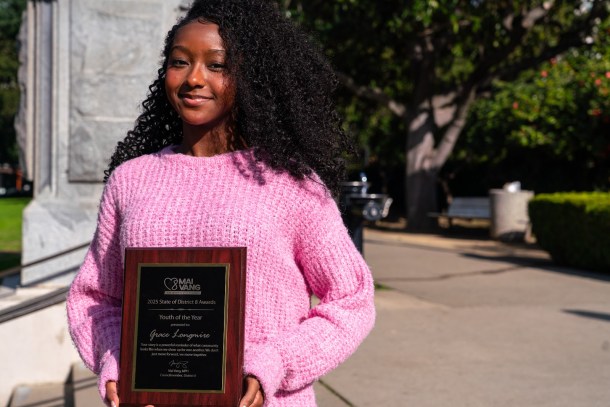 Valley High School senior Grace Longmire, pictured Jan. 13 at the Capitol, believes youth engagement is about developing young voters who are informed, empowered and involved. Louis Bryant III, OBSERVER
“This could be a potential ballot measure in 2028,” Vang says. “The voters who supported the Sacramento Children’s Fund understand the importance of investing in our youth, and I strongly believe they will support this measure as well.”
Still, the movement faces skepticism. Not everyone believes lowering the voting age will affect turnout.
Wesley Hussey, a political science professor at Sacramento State, says studies regularly show that younger voters participate at lower rates than older voters, regardless of generation.
“Younger voters are less likely to vote,” Hussey says. “That’s not because they don’t care, it’s because they’re young. They’re in school, working, trying to establish themselves.”
On global issues, Hussey adds that international conflicts tend to influence politically engaged voters rather than draw new ones.
Longmire, Rios, Qin, LaJuan, and Vang all emphasize that youth engagement is more than lowering the voting age. It is about developing a generation that is informed, empowered, and involved.
“This is your moment,” Vang says she tells young people. “Time waits for no one, and we need your brilliance at the table.”
“Just be authentically you. Speak up, participate, and make sure your voice is heard. Youth representation matters, and it’s our responsibility to engage in shaping the policies that affect us,” Longmire adds.
As Sacramento youth push forward with Vote 16, the city leads the way in a movement that could transform civic engagement and amplify the voices of the next generation.
Related