
The recent termination of federal tax credits for zero-emission vehicles delivered a body blow to end-of-the-year sales across California.
According to figures released Tuesday by the California Energy Commission, registrations for electric vehicles, plug-in hybrids and hydrogen fuel-cell vehicles came to 79,066 in the fourth quarter of 2025.
That works out to a drop of 36.6% compared to 124,755 sold in the third quarter, when many Californians rushed to buy or lease EVs before the federal tax credit expired on Sept. 30.
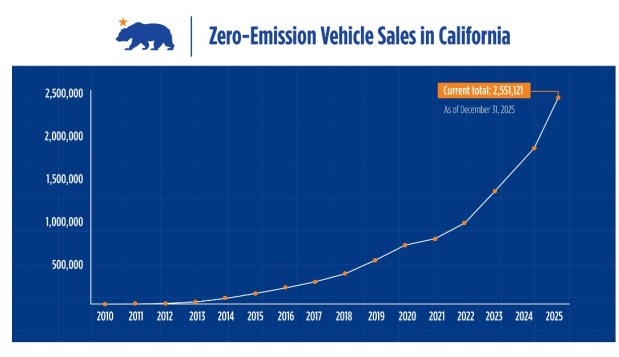
State policymakers and Gov. Gavin Newsom on Tuesday emphasized the long-term expansion of zero-emission vehicles, pointing out that cumulative sales in California have surpassed 2.55 million and have grown 300% since the end of 2019.
“California didn’t reach 2.5 million zero-emission vehicles by accident — we invested in this future when others said it was impossible,” Newsom said in a statement while at the World Economic Forum in Davos, Switzerland.
Last year, the massive 940-page federal budget dubbed the “One Big Beautiful Bill” backed by Republicans on Capitol Hill and signed into law by President Donald Trump included provisions that eliminated the federal tax credit of up to $7,500 on the purchase or lease of a new EV, or $4,000 for a used one.
The elimination of the tax credit has raised questions about the long-term adoption rates of zero-emission vehicles across the nation’s auto sector.
Last month, Cox Automotive estimated that EV sales in the U.S. in November dropped 41.2% compared to one year earlier.
Ford recently discontinued its all-electric F-150 Lightning pickup truck and Stellantis ceased production of its plug-in hybrid models of the Jeep Wrangler 4xe, Jeep Grand Cherokee 4xe and Chrysler Pacifica Hybrid. Ford and GM also reported write-downs in the billions on its EV assets.
But California officials say they are undeterred.
“Each quarter, even in the face of increasing federal headwinds, tens of thousands of consumers are purchasing a (zero-emission vehicle) in the Golden State, enjoying a great driving experience, and knowing they never have to go to a gas station again,” California Energy Commissioner Nancy Skinner said in a statement.
 California Energy Commission
California has more zero-emission vehicles on the road than any other state. In 2020, Newsom issued an executive order mandating the elimination of sales of all new gasoline-powered passenger vehicles throughout California by 2035.
While sales of EVs and plug-ins have grown, the rate of adoption in California has slowed in the past couple of years, before the federal tax credit was abolished.
Last June, Trump signed three Congressional Review Act resolutions that rescinded California’s electric vehicle rules — as well as mandates related to diesel engines.
California and 10 other states have responded by filing a lawsuit, arguing that Trump’s actions are unconstitutional and beyond the authority of Congress.
Newsom recently announced plans to set aside $200 million to bring back a rebate program for California drivers who buy zero-emission vehicles.
Specifics — including the size of the rebate and eligibility requirements — still need to be worked out, and the program will require approval by the Legislature in Sacramento.
“Gov. Newsom’s new rebate proposal sends a clear message,” California Air Resources Board Chair Lauren Sanchez said Tuesday. “California isn’t slowing down, we’re still leading the pack. It’s not just about clean air, it’s smart economic policy.”
Ivan Drury, senior manager of auto insights at Edmunds.com, said the state’s drop in fourth-quarter sales did not surprise him.
“If anybody thought that there would be a sustained level of sales, post-federal tax credit, they would have to be insane,” he said. “It was destined to happen.”
The 79,066 registrations of zero-emission vehicles in the last three months of 2025 represented the lowest number in California since the third quarter of 2022.
Drury and other auto analysts will keep a sharp eye on EV sales figures in the next few quarters to see if the numbers have bottomed out and then rebound or not.
“This consumer base wasn’t buying in the friendliest conditions” in the fourth quarter, Drury said, “and going forward it should get better. … If the numbers (in succeeding quarters) come back and they’re very high, fantastic. But if it’s kind of murky and it looks very similar to Q4, then yeah, there will be a lot of questions.”
Zero-emission vehicles in the fourth quarter accounted for 18.9% of the market for all new car sales in California. In the third quarter, its share soared to 29.1%.
By comparison, in the second quarter of 2025 — prior to the rush to buy before the federal tax credits expired — the percentage stood at 21.6%.