
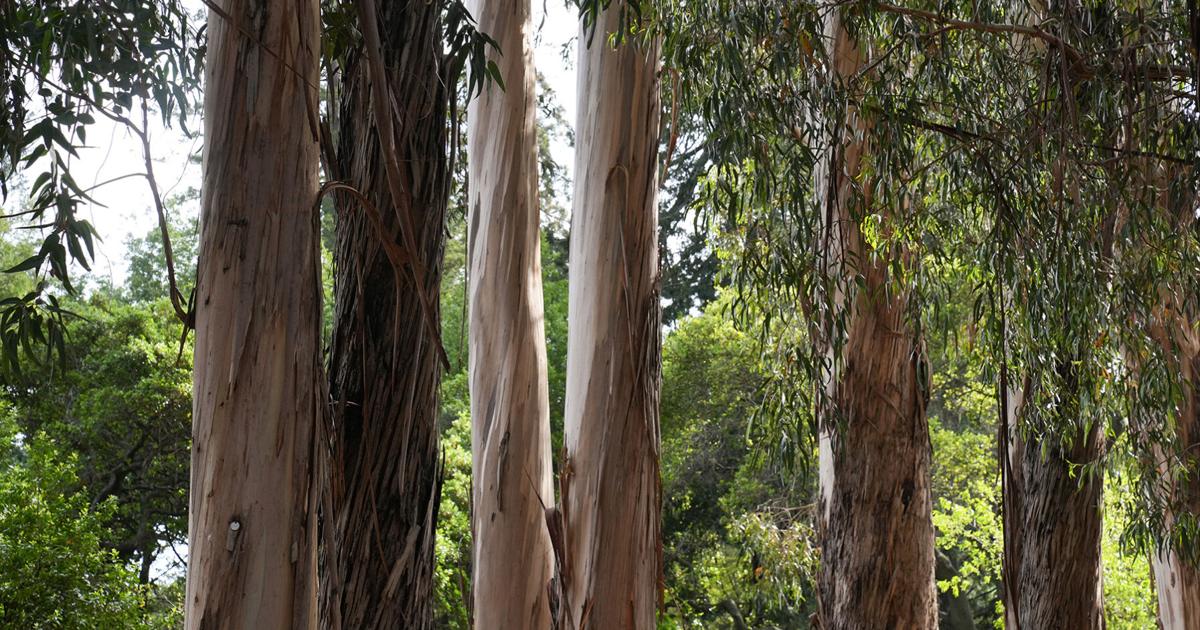
When walking by the Valley Life Sciences Building, you will be met with the aromatic smell of the tall eucalyptus trees. Native to Australia, these sweet-scented trees are well-known for their usage in essential oils and as food for koalas. Though the shaggy leaves and tall trunks of the eucalyptus are easy on the eye, a smoky reality lies behind its beauty.
Naturally, eucalyptus is both dry and oil-rich, making the tree extremely flammable. These trees along the northern boundaries of the Lawrence National Berkeley Laboratory and UC Berkeley groves create a “line of fire,” potentially fueling a catastrophic fire that could ignite the eucalyptus groves on campus, along with hundreds of houses that stretch all the way down to the bay.
Eucalyptus trees were introduced from Australia in the mid 1800s due to their rapid growth to meet the rising demand for wood. However, Americans soon realized the trees’ tendency to warp and break when dry, abandoning efforts to use eucalyptus as lumber. Yet the trees themselves remained, causing more problems than solving them.
On the weekend of Oct. 19, 1991, a deadly firestorm devastated the Oakland Hills, leaving 25 people dead and causing an estimated $1.5 billion in damage. The National Park Service attributed 70% of the total energy released from the combustion of vegetation during the fire to eucalyptus trees.
Thirty-three years later, the improper mitigation of eucalyptus continued to ravage the Oakland Hills, with the Keller Fire temporarily displacing 500 residents on Oct. 18, 2024.
The city of Oakland recognized the risk posed by eucalyptus trees in 2015 and was keen on accepting a $4 million federal grant to clear eucalyptus and other non-native plants from the area. But this faced widespread opposition from Oakland residents, so the city decided to “thin” the smaller non-native trees in the area over a 10-year period instead.
Similarly, UC Berkeley planned to cut a firebreak in Claremont Canyon in 2013, but was unable to because of opposition.The campus was finally granted permission in 2023 to clear dozens of acres of trees after years of legal roadblocks.
What fueled this widespread opposition to cutting down eucalyptus trees was the misconception that low-lying brush posed a greater fire risk than trees. People claim that removing smaller, younger invasive plants near the forest floor is a more effective way to reduce fire risk than cutting down older, taller eucalyptus trees.
However, eucalyptus has flammable peeling bark, which it sheds in long, hanging strands as it grows. These dangling pieces can carry fire all the way up into the canopy of a large tree, making clearing the understory alone practically ineffective at reducing the risk of fire.
Alarm bells should be ringing. The sweet-scented eucalyptus trees that populate our neighborhoods may someday instead carry the heavy smell of smoke. To best protect our neighborhoods and the ecosystem, these invasive plants must be removed and replaced with fire-resistant, native plants.
To accomplish this, the city and the university must act quickly by cutting down these hazardous trees, and we residents must also do our part in helping out.
As an ecosystem management and forestry major, I am very involved with habitat restoration and recently volunteered for the Berkeley FireSafe Council — a non-profit organization that removes fire risks in Berkeley, including eucalyptus trees. I helped plant native fire-resistant trees such as California buckeye and coast live oak, along with various native shrubs, in a recently cleared eucalyptus grove. The program requires more volunteers, and it is a wonderful opportunity to help protect our home from the risk of fire.
Even though it is not possible to restore California’s landscape to what it was before the introduction of eucalyptus, the more we can remove and replace it with fire-resistant native species, the better it will be for the environment and the residents of the Bay Area.