
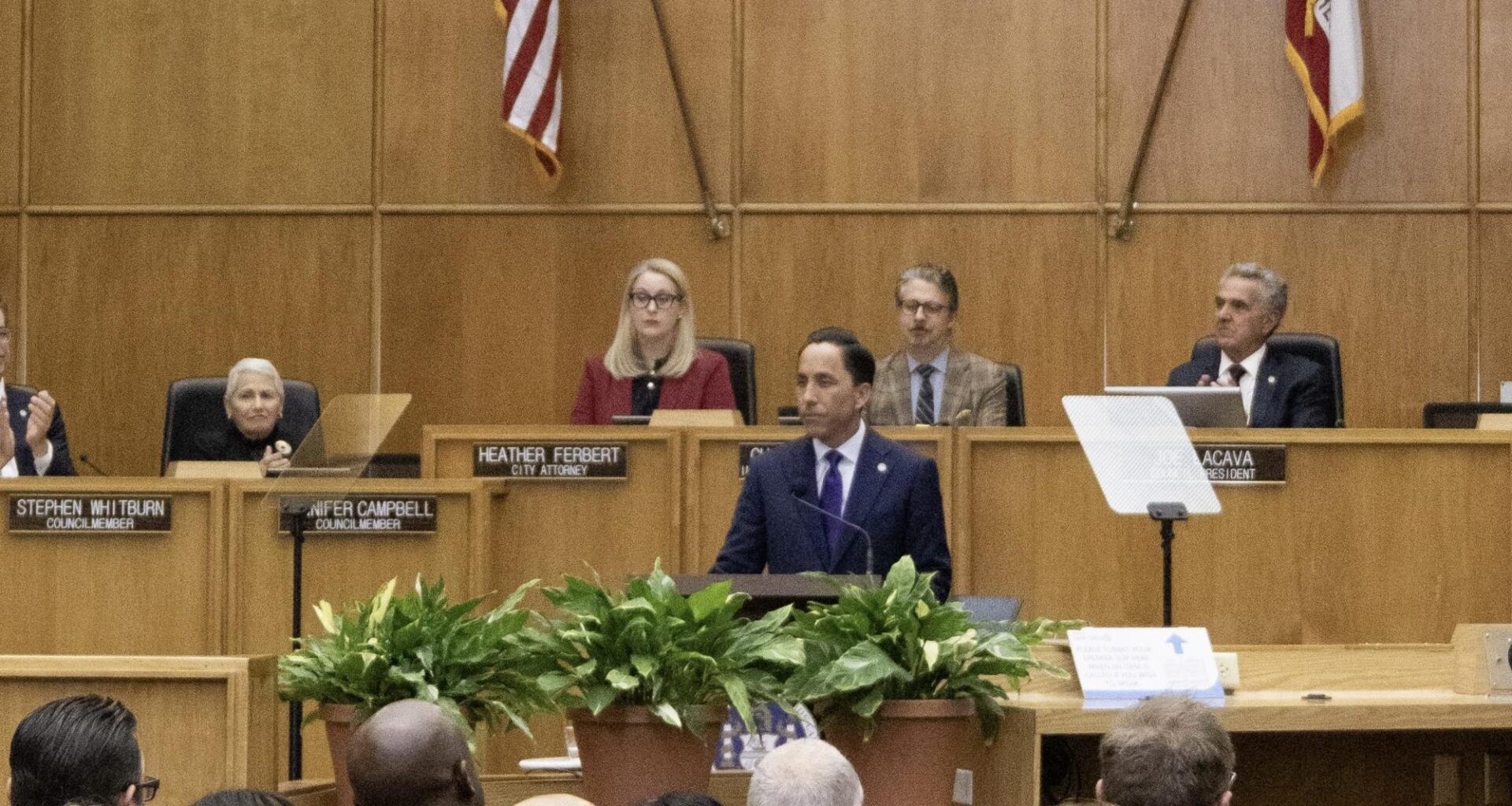
Hours after hundreds of people protested against Immigration and Customs Enforcement outside San Diego’s federal courthouse on Thursday, Jan. 15, Mayor Todd Gloria delivered his 2026 State of the City address. In his speech, Gloria briefly commented on immigration enforcement and covered issues such as housing, homelessness, and infrastructure across the city.
Gloria said that the city of San Diego is “moving with intention” and “building with purpose.”
Protestors gathered outside of City Hall during the mayor’s address, holding signs criticizing ICE’s presence in the city and advocating for a “Free Palestine.” At least five individuals interrupted the mayor’s address and were escorted out of the meeting room by police officers.
During his approximately 30-minute speech, Gloria criticized the current ICE operations encouraged by the Trump administration for two minutes.
“Through its ICE operations, the Trump administration is [waging] a campaign of fear that is terrorizing communities in this country,” he said. “And I know that you can see it, in the families that have been torn apart, in the neighborhoods thrown into chaos, in innocent bystanders put at risk, and local police officers forced into volatile situations that they did not ask for and didn’t create.”
Gloria acknowledged federal immigration raids in South Park and the recent fatal shooting of Renee Good in Minnesota, saying, “A life that was lost because of the callous and reckless actions of a federal agent, which outraged all of us.”
Gloria referenced his July 23 executive order that restricts the San Diego Police Department from cooperating with federal ICE operations in accordance with existing California law.
“SDPD is here to protect and serve our communities — all of our communities, including our immigrant communities,” Gloria said.
Gloria also addressed San Diego’s $318 million structural budget deficit, which he said accumulated over decades of underfunding and undermining the city services people rely on.
“A great city cannot be a place just for the very wealthy who can afford to live here, while the rest of us get priced out,” Gloria said. “A great city is one where anyone who works hard and plays by the rules can afford to live here.”
Gloria said that housing is a key point of his agenda and a basic responsibility of the city. He spoke about increasing housing permits to nearly 10,000 units, citing a UC Berkeley study that found San Diego to be a leading city in housing policy reform.
In 2025, according to preliminary data collected by the city of San Diego, the city permitted the construction of roughly 7,500 homes and helped fund 2,676 new affordable homes. Gloria aims to transform underused public property into housing, especially the redevelopment of the Sports Arena’s 48-acre site into over 42,000 affordable homes.
Gloria did not mention the legal blockade this project is facing, following two consecutive failed appeals to the appellate court in October 2025 and the California Supreme Court in December. Both courts held the area’s 30-foot height limit on buildings, refusing to exempt this project, finding that “the city did not adequately assess in its environmental review how taller buildings could affect air flow, construction noise and Peregrine falcons’ ability to nest, among other issues.”
In a joint statement earlier this month, Gloria and City Attorney Heather Ferbert responded to the December ruling. “This procedural decision does not change our commitment or our momentum to redevelop the Sports Arena site,” the statement read. “The City is actively pursuing options that will provide a clear and durable path forward for this transformational project.”
Gloria then turned to homelessness, discussing the Regional Task Force on Homelessness report that found an approximate 14% reduction in unsheltered homelessness in the city of San Diego in 2025. According to the report, the city connected more than 1,350 people with housing last year and housed “nearly 7000 people over the 5 years” of Gloria’s administration.
He also reported that the city cleared 208 tons of trash and connected 95 people living on state property to shelters or services, as per the city and state Sen. Catherine Blakespear’s agreement with the California Department of Transportation
Gloria pointed to the Trump administration’s “illegal and reckless” changes to the Department of Housing and Urban Development’s funding for reasons why people are pushed out of shelters and onto the streets. He also criticized California’s budget instability for cutting state funding toward housing assistance and homeless prevention programs.
“When a person is suffering in the open, unhoused, untreated, in crisis, it affects not only their life, but it shapes whether people feel safe in our city,” Gloria said.
Under Gloria’s stated agenda to promote safety, he reported that the city of San Diego’s overall crime rates decreased by 6%, murder by 22%, sexual assault by 7%, and vehicle thefts by 22%.
“A key part of upholding public safety means restoring dignity in communities that have endured harm for far too long,” Gloria said.
In relation to safety, Gloria highlighted that San Diego resurfaced or repaired 468 miles of roads and filled more than 44,000 potholes this past year. This upcoming year, his administration is on track to repair over 370 additional miles of road and 2,000 street lights.
With Measure C — a citizen initiative designed to increase “hotel visitor tax for convention center expansion, homelessness programs, street repair” — generating $35 million since May 2025, Gloria aims to invest $119 million to modernize the San Diego convention center.
Gloria also intends to propose a five-year $118 million modernization project for the San Diego Convention Center, with the first $21 million used to launch this work “almost immediately.”
“This is about growth, this is about opportunity, and this is about building a stronger San Diego for the next generation,” Gloria said. “This city becomes more than a place people visit. It becomes a place people choose again and again … a place where you can see a bright future ahead.”
Gloria’s address was delayed by 20 minutes as Councilmember Vivian Moreno attempted to add additional seats to accommodate more individuals. Gloria discussed this disruption after his speech, telling Moreno to “smile,” which she called “a very sexist comment.”
“Our goal at that point was to begin the event as quickly as possible, when we were already running behind schedule. The overflow room remained available for attendees,” Gloria’s spokesperson Dave Rolland said.