
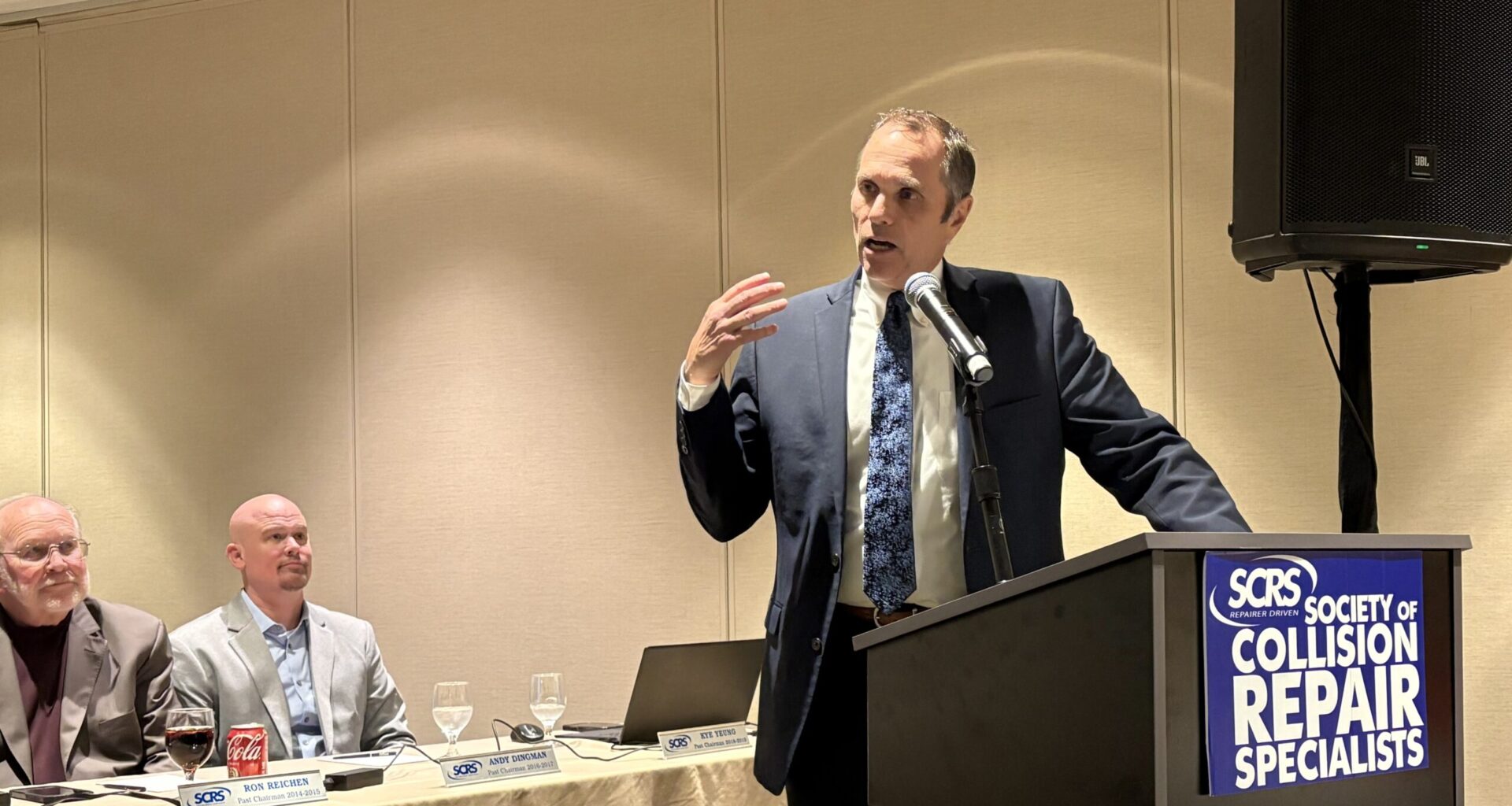
California Bureau of Automotive Repair (BAR) leadership discussed a proposed towing and storage regulation during a Society of Collision Repair Specialists’ (SCRS) open meeting Tuesday.
Patrick Dorais, BAR chief, and Bill Thomas, BAR deputy, explained the evolution of towing and storage fees in the state, a topic that has become hot, not only in California, but nationwide via insurance lobbying.
While pressure on the issue might be mounting recently, Dorais explained that the issue dates back to the 1960s in California.
The California Appellate Court issued an opinion on the storage fees in Owens v. Pyeatt in 1967, Dorais said. It said that storage fees cannot begin to accrue until all estimated and approved repairs by the customer have been completed and the customer has been notified that the vehicle is ready to be picked up.
Dorais said that the court decision happened before BAR came into existence in 1971.
“I want to tell you this was not something we were looking to jump into,” Dorais said. “Nor did we have a statutory legislative established authority to jump into this area.”
During the 2017-2018 session, California passed AB2392, which established that storage rates and fees shall be deemed reasonable if they are comparable to storage rates charged by other facilities in the same locale.
Dorais said the words ‘comparable’ and ‘locale’ weren’t extensively defined in the act.
Assembly Bill 294 was proposed during the 2021-2022 legislative session, Dorias said. The failed bill would have created a new towing and storage board that worked entirely separately from BAR to regulate towing and storage. It also would have deleted the fact that automotive repair dealers (ARD) can have rates that are found reasonable if comparable to other ARDs in their locale.
“This was a big bill, and the insurance industry was pushing this,” Dorais said. “One of the things that they were saying at the time is that, ‘BAR does nothing about this, they have storage fees that are going unchecked, they don’t seem to care about the industry that they regulate.’”
Dorais said BAR didn’t have jurisdiction at that time. He said this is why the bill was proposed to make a new board.
BAR realized that it needed to act because another bill could be proposed in future sessions, he said.
A referral program was created by BAR in 2022. It provided a dedicated email for insurers to contact BAR about ARD storage rates.
“We just mediate,” Dorais said. “We do our best to represent what the laws are on the subject at this time.”
After four years, there have been 1,522 referrals, with an average of 30% ending in a storage fee reduction. BAR has filed four cases that resulted in three revocations of ARD registrations, with one of those pending.
Dorais said ARDs can lose a registration by using false or misleading statements and fraudulent behavior.
Thomas added BAR frequently tells the insurance company that the ARD’s rates are reasonable.
“More often than not, that is the message that we give insurers,” Thomas said.
He added that often these ARDs don’t have the equipment needed to do collision repairs, such as a spray gun.
Dorais said BAR has witnessed several ongoing issues since starting the referral program. This includes some ARDs attempting to charge storage fees that are unreasonable or storage fees without having completed a teardown.
BAR has also observed insurance companies delaying initial or supplemental inspections that are negatively impacting ARD and consumers’ ability to make repair decisions. Insurance companies are also delaying the retrieval of total loss vehicles, which is negatively impacting ARDs and consumers.
Dorais noted that ARDs also continue to treat insurance companies as their customer and vice versa, when the state code explicitly excludes them from being the customer.
Assembly Bill 1263, passed in 2023, gave BAR the ability to regulate towing and storage fees, Dorais said. He said typically BAR focuses on business and professions code, but the law gave them the ability to regulate this specific section of the vehicle code.
BAR has held four workshops since the passage of the bill to gather public feedback on the proposed storage and fees regulations, he said. He said typically the state holds one, maybe two workshops, on proposed regulations.
“That takes a lot of time to prepare for, to hold and digest those comments,” Dorais said.
The last workshop was held in Jan. 2025.
After fielding the comments and making changes, the proposed regulation was filed with the Office of Administration Law (OAL), and a 45-day public comment period was held. The period closed at the end of last year.
Dorais said BAR is still digesting all the comments that were received during the comment period.
Thomas added that there will likely be some small clarifications made to the proposed regulations.
If minor changes are made to the proposed regulation, the regulation would be reopened for public comment for at least 15 days. Major changes would require another 45-day public comment period.
According to the OAL website, proposed regulations typically become effective on April 1 if filed between Dec. 1 and Feb. 29. However, effective dates can vary.
Image
California Bureau of Automotive Repair Chief Patrick Dorais speaks at SCRS open meeting in Palm Springs Jan. 20.
Share This:
Related