
For years, college students have been complaining about textbook costs. Rightfully so, as a new physical textbook can cost upwards of $150 to $200. Digital copies are often not much cheaper, since publishers pair them with online learning suites that contain homework assignments and study tools. According to the California Student Aid Commission, 50% of California college students reported paying $200 or more for course materials each semester. Even after substituting new books for used copies and short-term rentals, textbook costs remain high and have been found to be a barrier to student success.
Thankfully, skyrocketing textbook costs have not gone unnoticed. Due to various advocacy efforts, California elected officials have come to recognize textbooks as one component of the college affordability crisis. In 2021, Gov. Gavin Newsom called textbooks a “racket” that needed to be disrupted. Later that year, the Legislature allocated $115 million to California community colleges to reduce the burden of textbook costs. At many community colleges, this has meant compensating faculty members to develop textbooks and other course materials that will be freely available to students. I am one of those faculty members.
At San Diego Mesa College, we are in the process of converting several degree programs into zero-textbook-cost (ZTC) pathways. This includes the political science degree program, which I teach in. By December 2026, all 10 of our political science courses will have become zero-textbook-cost. That means any student who takes a political science course at Mesa College will not have to purchase a textbook or other course materials. Instead, all students will have access to their learning materials on the first day of class. Imagine that — a student logs into their course website and sees the entire textbook available to them at no cost.
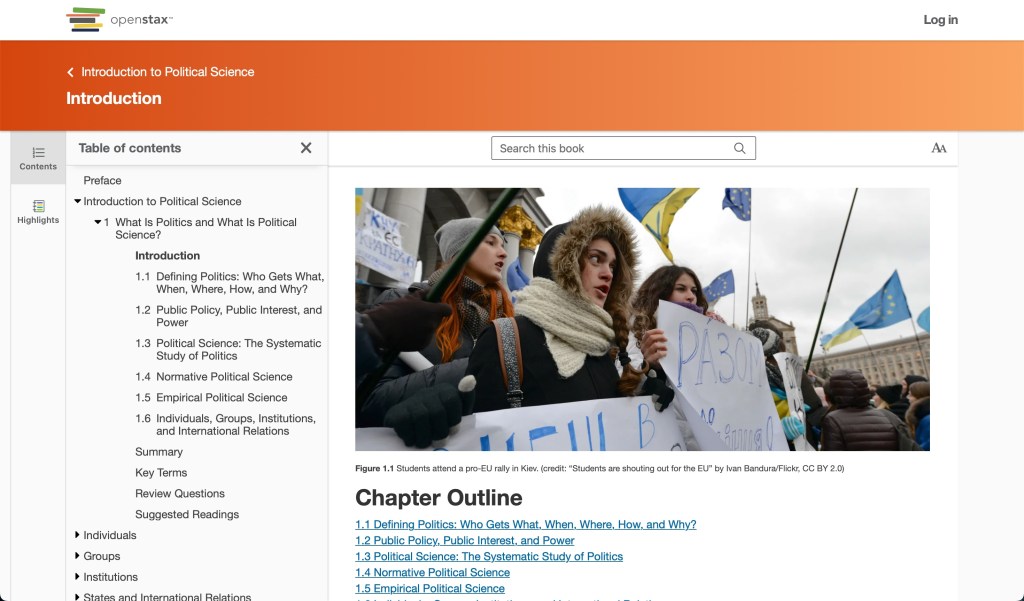
How does the zero-textbook-cost conversion work? For our most common general education courses (such as American Government), there are already high-quality no-cost textbooks available. This has made it relatively straightforward for me to adopt one of these textbooks in lieu of traditional publisher materials. For courses where there are very limited no-cost textbook offerings (such as International Politics), I am working with several community college instructors across the state to develop our own textbook, complete with supplementary materials that traditional textbook publishers offer, such as lecture slides and test banks.
Yet this work is not limited to just textbook writing. Some faculty members are using their zero-textbook-cost funds to develop animated videos, interactive quizzes and other active learning projects that will replace costly publisher materials. I myself am developing an audiobook for an existing no-cost political science textbook, so that students have a second way to engage with the course content. Whether they prefer auditory learning or simply want to listen to a chapter on their commute to school, students in my Introduction to Political Science course will have access to a free audiobook version of the course textbook.
While the entire zero-textbook-cost conversion process is not without its challenges (since many of us instructors working on these projects still have full-time teaching duties to complete), this work is necessary. Many of our students are already concerned with stretching their paychecks to cover food, rent, transportation and child care. Paying for a new textbook should not be added to that list.
Barraza is an assistant professor of political science at San Diego Mesa College.