
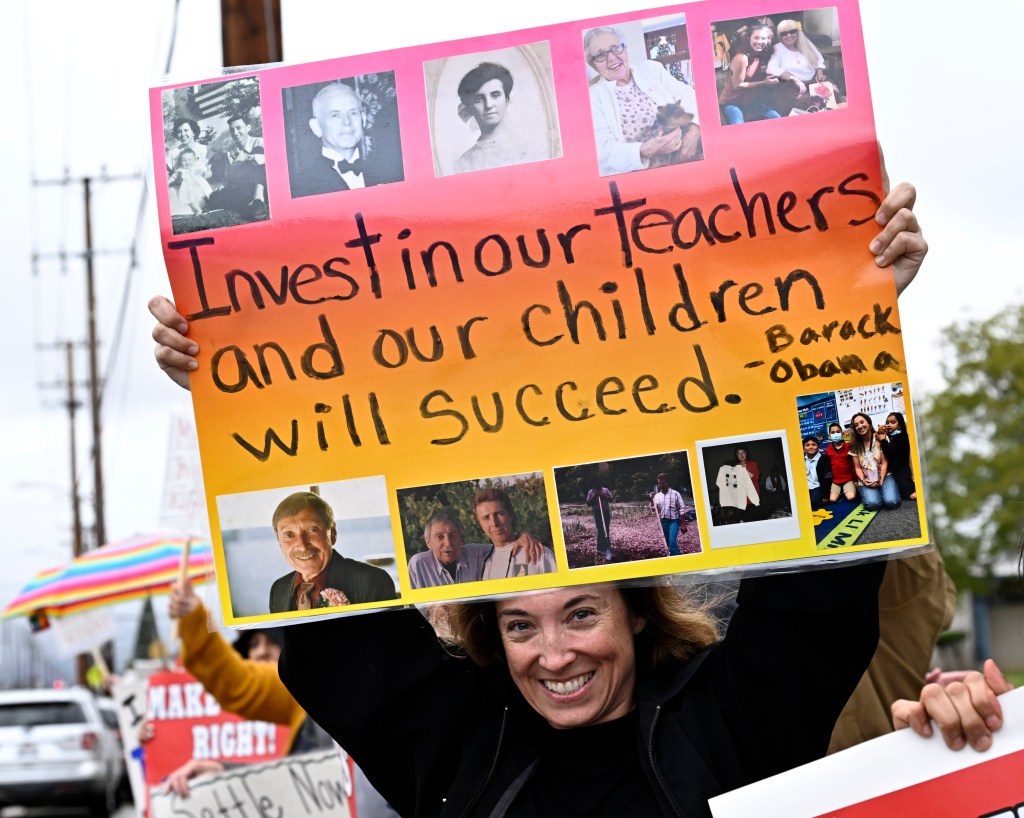
Teachers unions around the state are attempting to negotiate for higher compensation, many coordinated by the California Teachers Association as part of its “We Can’t Wait” initiative. At the same time, school districts around the state are in dire financial condition, with four on the verge of requiring state and county intervention and 20 more being watched closely for signs they will not be able to pay their bills.
San Diego Unified’s union, the San Diego Education Association (SDEA) is one of those asking for higher pay and benefits. SDUSD is not on the list of financially endangered districts, but is heading that way. Projections in the district’s 2025-26 first interim financial report predict it will need to use money from its reserves to avoid insolvency.
According to these projections, SDUSD will need to pull $29.7 million from reserves this year to pay its bills, and make cuts of $47.7 million in 2026-27 and another $113.1 million in 2027-28. With 90% of the district’s budget going to employee compensation, there is no way to make such cuts without impacting programs and services that help educate kids.
Meanwhile, the SDEA is proposing a new contract that would raise its members’ pay and benefits by 8%. In 2024, full-time certificated employees in the district made a median total compensation of $156,482, according to public pay records obtained from the district and published by Transparent California. An 8% raise would increase this to about $169,000.
SDUSD’s total cost of certificated pay and benefits in the current school year is expected to be $806 million. Agreeing to SDEA’s demands would add $64.5 million to that cost. There is not enough money to fund existing programs without cuts, and approving those raises would require even larger cuts.
The SDEA has now scheduled a strike for Feb. 26. Union officials say this is related to violations of their contract on special education staffing. SDEA Union President Kyle Weinberg is quoted as saying they want the district to “prioritize staffing that directly supports students.”
Improving services for special education is certainly a worthy goal, but is that really the union’s priority? Its words are contradicted by the actual numbers, which clearly prioritize higher pay and benefits for adults. And those numbers define the money needed to educate kids.
The SDEA bargaining updates page claims if this raise is not approved teachers will get “no raise this year.” That ignores the fact that the salary schedule — still in place — gives most educators a raise every year.
This makes both statements blatant deceptions. These are not disagreements over facts, because both the cost of their demands and the normal raises in their salary schedule are black-and-white numbers. Isn’t deceiving the community and parents to take money away from funding for the education of their kids and giving it to yourself particularly bad?
To paraphrase the SDEA’s December bargaining update, it’s pretty clear their negotiating positions actually “reflect priorities that are deeply out of touch.” Out of touch with what parents want for their kids, and out of touch with what kids need from their school.
State testing shows barely 56% of SDUSD’s kids are proficient in English, and slightly over 45% are meeting standards in math. Improving special education should be done, but perhaps instead of forcing the district to make even deeper cuts in education to improve the bank accounts of well-compensated adults, the San Diego Unified board should consider improving funding for programs and services that actually improve education for kids.
The common talking point in these negotiations is that teachers deserve “fair pay.” Teachers are essential and work hard. Whether $156,000 is “fair” for this is in the eye of the beholder, but damaging the education of kids by striking for more money for adults is certainly not fair to them.
Maddison, an Oceanside resident, is a founder of both the San Diego Schools and Parent Association advocacy groups as well as the director of research at Transparent California.