
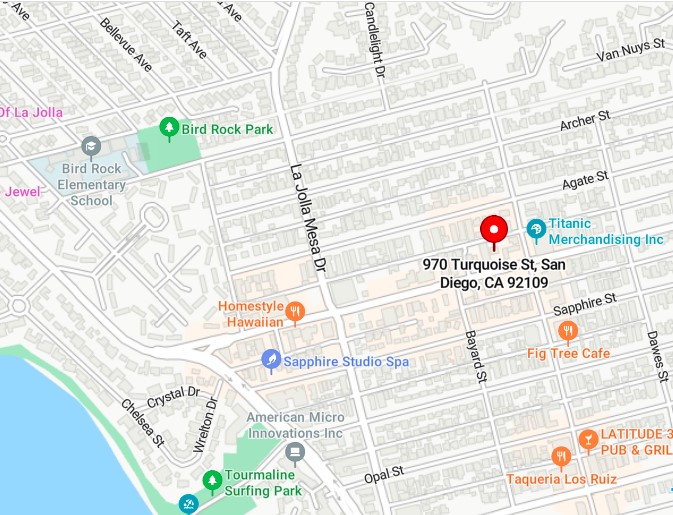
Coastal residents waiting for a decision on a controversial 239-foot-tall residential-commercial building proposed for Turquoise Street in north Pacific Beach got some news when a letter from the San Diego Development Services Department calling the application “incomplete” and questioning the number of residential units proposed was circulated by a local group opposed to the plans.
The three-page letter by department assistant directors Keely Halsey and Gary Geiler tells applicant Kalonymus LLC that “the project cannot be approved at this time” because of “insufficient and incomplete information.”
“The plans lack necessary information or contain errors that need to be corrected in order to conform with the code,” according to the letter, which adds that additional information is required before further analysis can be done.
Kalonymus filed a permit application with Development Services in August 2024 for the 22-story, $185 million project planned for 970 Turquoise St., not far from La Jolla’s southern boundary.
Locals have dubbed it the “Turquoise Tower,” and many have protested its size, which would dwarf the city’s 30-foot coastal height limit.
Ten of the proposed 214 residential units are designated for very-low- to middle-income households. A large portion — 139 units — is described as visitor accommodations, or hotel rooms, though the developer has said it plans to use those units as market-rate apartments. The plan also includes ground-floor shops and 311 parking spaces.
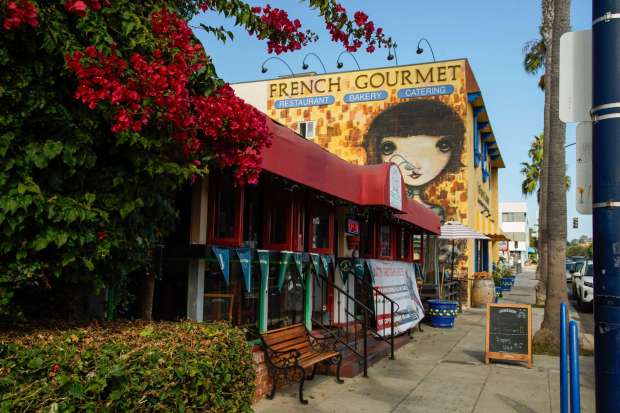 This area on Turquoise Street in north Pacific Beach, including The French Gourmet restaurant, would be the site for a 22-story mixed-use building if approved. (Alejandro Tamayo / The San Diego Union-Tribune)
The project would bypass San Diego’s Proposition D, which city voters approved in 1972 and generally limits the height of new buildings to 30 feet in coastal areas west of Interstate 5. It would do so via a state density bonus law that supersedes local voter initiatives and planning rules, allowing developers to add to their projects for including certain quantities of housing considered affordable for lower-income residents.
However, the project is subject to Development Services approval, and the state Department of Housing and Community Development said in a “technical assistance” letter in December 2024 that San Diego could deny the project by proving that some or all of the developer’s requested bonuses, waivers and incentives are not necessary to create the 10 affordable housing units.
The letter from Halsey and Geiler, dated Dec. 23, was circulated via email by Neighbors for a Better California, a group headed by Pacific Beach Planning Group Chairwoman Marcella Bothwell. Neighbors for a Better California, which has been leading much of the community opposition to the Turquoise Street development, said the PB Planning Group obtained the letter Jan. 14.
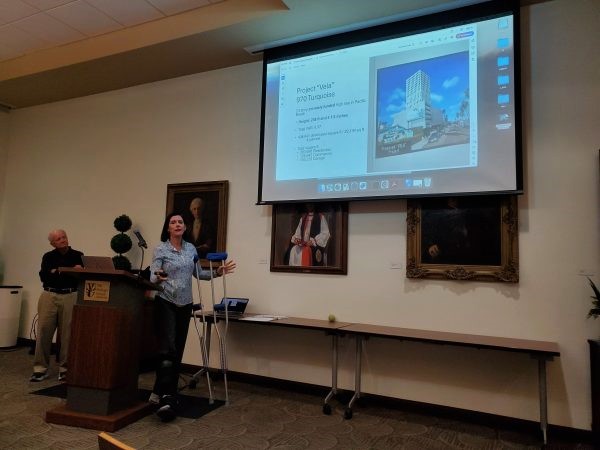 Neighbors for a Better California Chairwoman Marcella Bothwell, speaking to the La Jolla Community Planning Association in November 2024, shows what she called “our representation” of the development proposal for 970 Turquoise St. (Ashley Mackin-Solomon)
Bothwell told the La Jolla Light that the letter is important for its use of plain language to convey key concerns.
“For the public, the takeaway is straightforward: The city is asking for clear, consistent, fact-based project information before it can complete its review and evaluate any requests for incentives or waivers,” Bothwell said. “We appreciate DSD putting these issues in writing so residents can better understand what is under review.”
Kalonymus — a real estate investment and development firm that is active in the San Francisco, Los Angeles, Central Coast and Miami markets — says the Turquoise development would “truly move the needle” in meeting San Diego’s need for more homes.
A company representative could not immediately be reached for comment for this story.
Halsey and Geiler wrote in their letter that:
• “The matter of insufficient and conflicting information has … frustrated the city’s ability to make a determination as to the applicant’s requests for incentives and waivers under state density bonus law.”
• “The project relies on an interpretation of [density bonus law] that, coupled with its proposed utilization of a previous version of a local land-use regulation, is both expansive and novel.”
• “The height presented throughout the first several cycles was not stated in accordance with the applicable rules for calculation and measurement” and “statements regarding floor area ratio [FAR] have been and remain inaccurate.”
• “The plans have been and remain unclear and inconsistent as to intended use, which impedes staff’s ability to perform the necessary analyses.”
• “The application presents a project that contains significantly more units than are allowed under local and state law.”
For visitor accommodations in particular, they wrote, units in the building are “indistinguishable as to land use” and are “all designed to function as residential dwelling units.”
“The plans assign the land-use label ‘visitor accommodation’ (a type of commercial use) to refer to 139 … units and use the label ‘dwelling unit’ (a type of residential use) to refer to the other 75 units,” according to the letter. “The applicant’s strategy is to call the units commercial for some purposes and residential for other purposes, but the city needs clarity in order to perform its duties. … In its next resubmittal, the applicant needs to choose which is accurate. … The applicant may revise its project … or demonstrate how the non-residential units would in fact be used for visitors.”
Proposing 214 dwelling units, they said, would far exceed even the most lenient density calculations allowed by law.
“While the city welcomes applications for new housing and offers substantial incentives to encourage housing development, the number of units must observe the generous maximums allowed by law,” Halsey and Geiler wrote.
Therefore, they concluded, adjustments have to be made and submitted.
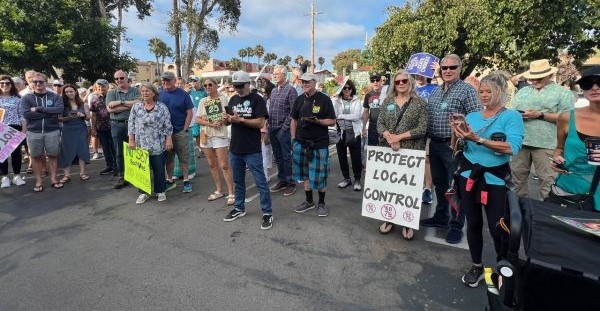 A crowd gathers in Pacific Beach last summer to protest the 239-foot residential-commercial development proposed for 970 Turquoise St. (Trudy Grundland)
In La Jolla, where the Turquoise proposal set off shock and anger because of the site’s close proximity, resident Janie Emerson shared the Development Services letter with La Jolla Shores Association board members before their meeting Jan. 21, and excerpts are available on the LJSA website at lajollashoresassociation.org/upcoming-events.
“We are moving forward in a good direction here,” Emerson said of the letter. “The city of San Diego still needs to step up, but we’re getting there.” ♦