
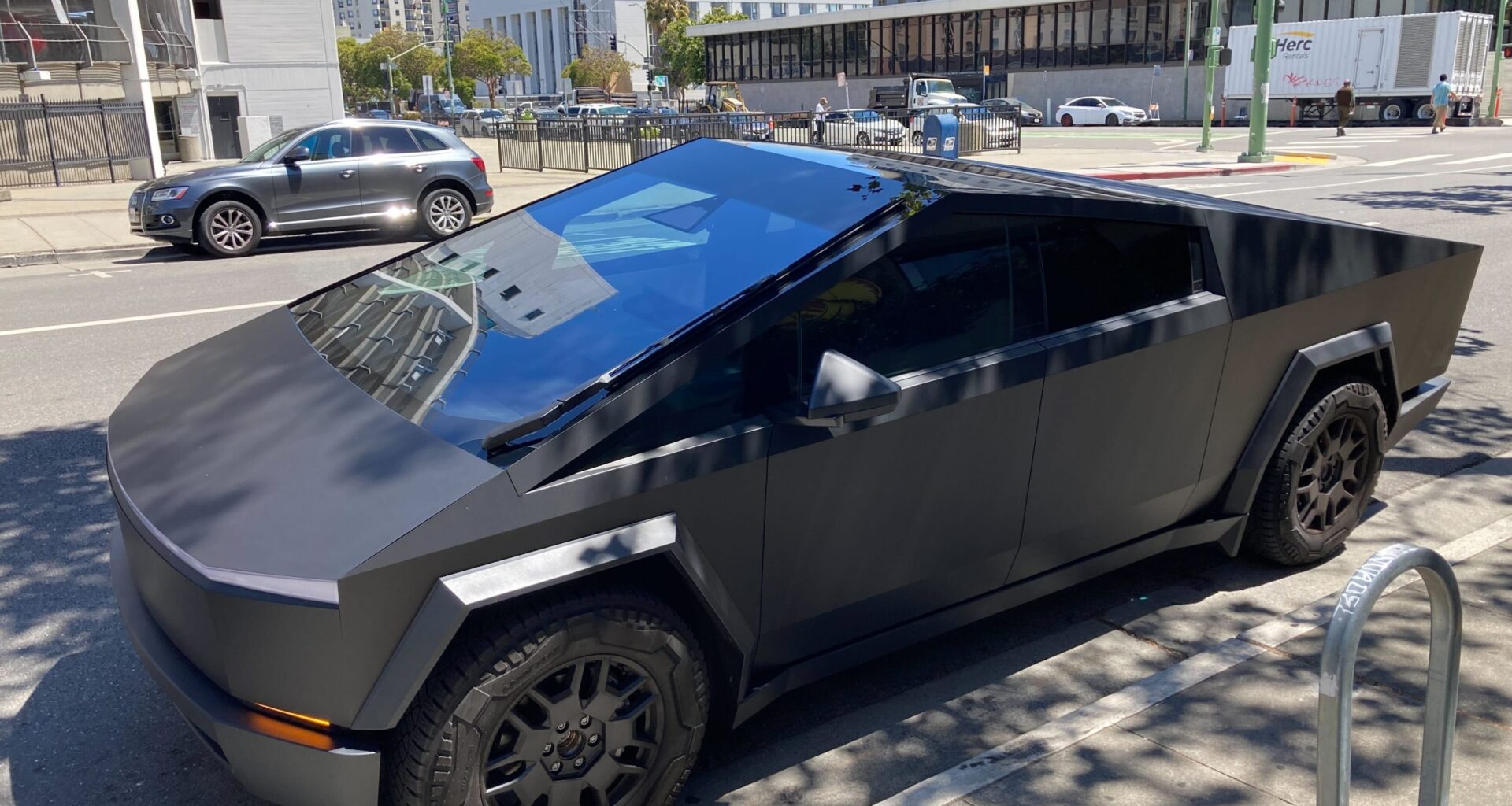
On September 3, 2024, Oakland resident Viral Shah, his wife, and their one-year-old baby daughter headed off from Orinda Theater Square in their Tesla Cybertruck after enjoying an evening of shopping together as a new family.
They were looking forward to a quiet evening and a chance to do a bit of work before bedtime. But that wouldn’t happen.
As they headed toward Highway 24 from Camino Pablo, their child was strapped into her car seat, looking sleepy.
Then, in a fraction of a second, something frightening happened. As Shah turned the car onto the horseshoe curve of the ramp, he said, the back passenger door next to their baby swung open violently, all 60 pounds of it, much of it “ultra-hard” stainless steel.
Shah and his wife screamed out in shock, and Shah immediately pulled onto the shoulder to see what had happened.
The baby had stayed in place and, by a stroke of luck, she had not reached into the door opening with her hands, and the door had not violently swung shut.
Only the car seat had protected her from tumbling out onto the roadway. And it looked to the Shahs like their daughter had narrowly missed having her hand or arm crushed by the door’s weight.
If anyone had been sitting back there unbelted, Shah said, “They would’ve been mush on the street.”
In the darkness, they could see that the latch of the huge door was loose. They moved their daughter’s car seat to the other side of the car, behind the front passenger seat, and then his wife buckled herself in and held the problem door closed with her hands for their drive home to Rockridge.
“This is fucking nuts,” Shah remembers saying.
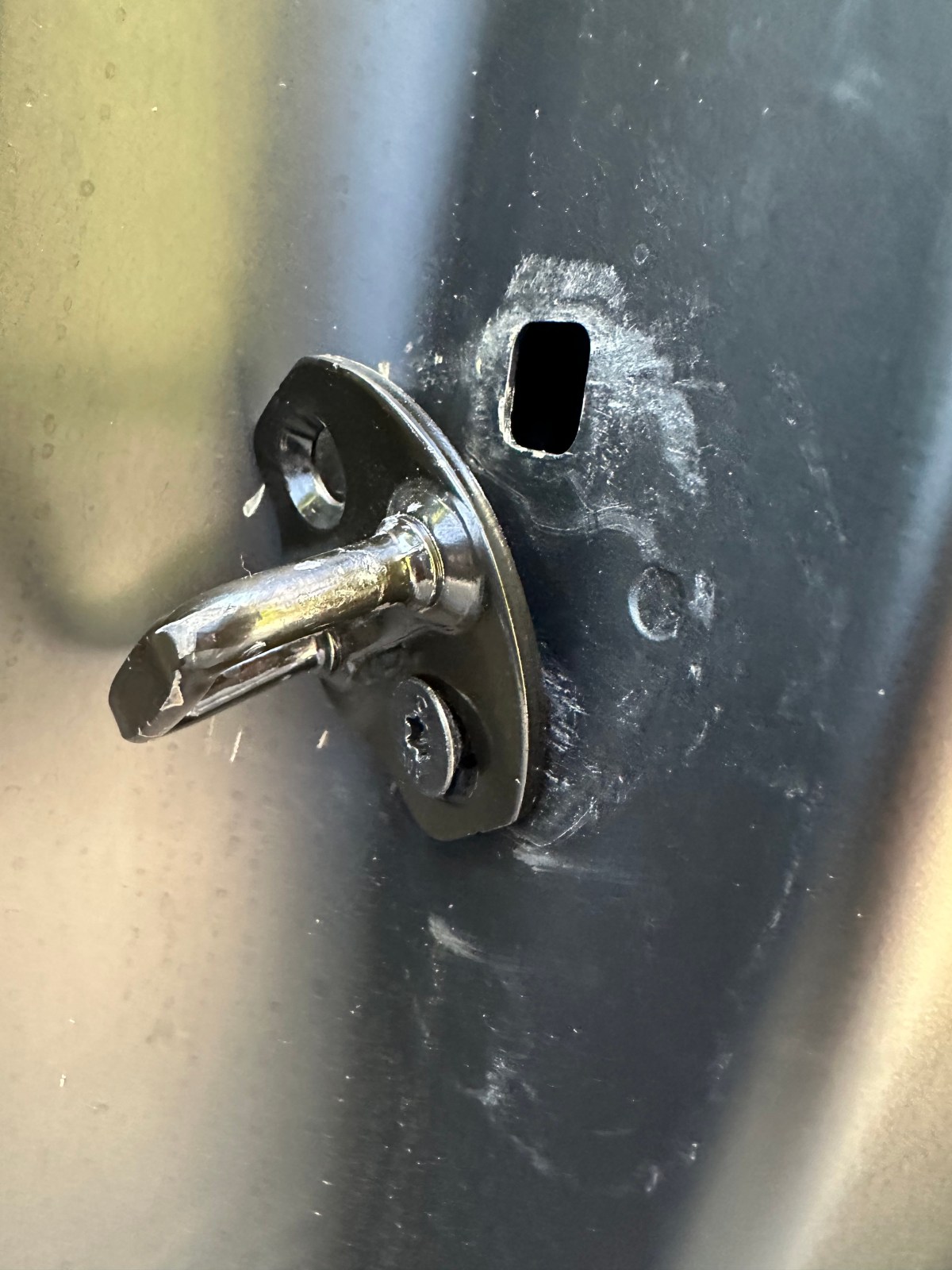 Oakland resident Viral Shah said this striker — what the Cybertruck door latches onto — came loose during a September 2024 outing with his family. Source: Viral Shah
Back at home, after they put the baby to sleep, Shah examined the door, which opens and closes via an electronic mechanism. He noticed that the metal striker, a small metal loop that the door latch clamps onto, had come loose. As photos he shared with The Oaklandside show, one latch screw had fallen into a hole in the door frame, and another was loose. Shah went to check out the driver’s side latch, and it also had a screw loose, as documented in his photos. “That latch was also rattling when I drove and wasn’t perfectly affixed,” he said.
“That’s what made me really scared and furious, because this wasn’t a simple defect,” he said. “This wasn’t an oversight with one thing where shit happens. This was a systemic design flaw that was affecting those two doors because they were the most heavily used. There’s no doubt in my mind the same thing would happen to all four doors had they been used with the same level of frequency.”
Shah submitted a federal complaint to the National Highway Traffic Safety Administration the next day, outlining what had occurred. That complaint concluded, “My guess is that all four door latches are defective and at immediate risk of causing harm, injury, or death to those Cybertrucks on the road with the same latch.”
Tesla did not respond to interview requests or detailed written queries.
His isn’t the only complaint about a Tesla Cybertruck door latch malfunctioning and opening unexpectedly. Just two and a half weeks ago, someone in Ocala, Florida, filed a complaint to the NHTSA that their passenger door had unlatched “completely by itself without pressing the unlatched button or pulling the manual release.” The complaint says the door later opened on its own again in the driveway.
“And this can be a very serious issue,” the complainant writes, “if it worked to unlatch while driving and the door swings open and causes an accident or hits an object or person which can in terms caused serious injury, or property damage.”
Shah said he recorded this video minutes after the Cybertruck door next to his infant flew open. Credit: Viral Shah
As we have previously reported, Cybertruck door mechanisms appear to have malfunctioned in other ways. In the last year and a half, apparent flaws with the truck’s electronic door system have been cited in collision reports that led to deaths.
During the 2024 Thanksgiving holiday, three college students from Piedmont died in a Cybertrack collision after the driver, who was later found to have been driving under the influence of drugs and alcohol, crashed into a retaining wall. According to wrongful death lawsuits filed by the parents of the two young passengers who were killed, Krysta Tsukahara and Jack Nelson, design flaws in the truck doors’ mechanical release mechanisms helped prevent their escape from the vehicle.
In August 2024, a 47-year-old nurse, Michael Sheehan, died after a Cybertruck collision in Harris County, Texas. In that case, Sheehan’s widow and parents claim Sheehan died inside the truck partly due to defects in the door handles’ design. The Cybertruck has been recalled repeatedly over other safety issues, such as acceleration pedals that get stuck.
An engineering expert told Bloomberg a few months ago that Tesla’s “design of the door locks was overlooked.”
Expert: ‘This should never, ever happen’
In this video recorded by Shah, a latching issue appears to prevent one of the Cybertruck’s doors from properly closing. Credit: Viral Shah
Sam Abuelsamid, a car engineer who is vice president of market research at Telemetry, in Novi, Michigan, told The Oaklandside that the design of the latch striker in the Cybertruck is “actually quite common.” He had never heard of a Cybertruck latch failing as it appears to have done in the Shahs’ case. But he said the problem fits in with Tesla’s other documented quality control failures. “I’m not surprised this happened,” he said.
After reviewing the Shahs’ photos, Abuelsamid said he suspects that the problem may lie with the “weld-nuts” — which he describes as “literally nuts welded onto the backside of the steel pillar” of the door. He said in this case it appears the weld-nuts may have been improperly welded and got knocked loose as the truck’s doors were shut repeatedly.
“This should never, ever happen, but weld-nuts do occasionally break free if there is a process or setup error in the welding equipment or if protective coatings that are used to limit corrosion during shipping of parts are not properly cleaned,” Abuelsamid said. He said a latch issue could also result when the lubricant used for stamping metal parts isn’t properly washed off before welding.
Alexander Slocum, a professor of mechanical engineering at Massachusetts Institute of Technology who has written extensively on precision machine design, also reviewed the Shahs’ photos for The Oaklandside. He said that bolts “do not come loose like that if they are properly installed.”
“It appears to be a manufacturing quality issue and/or a design detail issue,” he said.
Slocum located the torque instructions published by Tesla for installing the truck’s latch and striker. He said that if these instructions are not followed exactly, the bolts could come loose. After an incident like this, he said, the company should conduct a “careful top-to-bottom detailed review of the design and manufacturing.”
While many car manufacturers have switched to screwed-in door strikers, Slocum said, Cybertruck engineers should have scaled the size of the striker and bolts to be appropriate for the weight of the Cybertruck door.
A rapid buy-back offer, with strings attached
When the incident at the off-ramp occurred, Shah recalled, a manager from his local Tesla service center in Berkeley came to his house the next day.
“He said, ‘Oh my God,’” Shah said, before tying the door closed and driving the car to the dealership. “He didn’t take any time to ask questions, to diagnose what happened, or to send a tow truck. Nothing. It was clear to me that Tesla did not want this vehicle in my custody in its condition.”
Documents Shah shared with us show that the service center checked the Cybertruck in for service on September 4, the day after the incident. An invoice we reviewed from the center, on Gilman Street in Berkeley, confirms that the left rear door was “damaged due to a loose striker.”
“The concerns with your vehicle were immediately escalated to our higher-level engineering team this morning,” an associate service manager at the dealership emailed Shah on September 5.
“My main concern is how I actually trust driving my family in a car that literally could have killed my child,” Shah wrote back. “If that door hit anything when it swung open, it could have killed her. And if she was older and out of her car seat, she could very possibly have fallen out.”
Shah recorded this Tesla software display, which appears to show that the Cybertruck’s rear passenger door was not closed during the family’s trip back to Oakland, even as his wife held the door in place. Credit: Viral Shah
Five days later, the service manager wrote to say that Tesla headquarters has approved the vehicle’s repurchase.
We reached out to the two employees of the Berkeley service center who corresponded with the Shahs; one did not respond and the other would not comment on the record.
A document we reviewed from Tesla headquarters in Austin dated September 19 — just 16 days after the incident — formally offers to buy back the vehicle for $117,609, nearly the full purchase price.
Shah said he and his wife left the car with the dealer for a while, but eventually they decided to accept the repurchase agreement.
That agreement included a clause requiring him to agree not to sue Tesla over the incident.
Telemetry’s Abuelsamid told us that a repurchase agreement like this is not common, because it usually requires a dealer to go through multiple levels of corporate approval.
“This would be a way for Tesla to quietly get these trucks off the road without a potential NHTSA investigation and recall,” he said. “Tesla hates recalls that involve hardware, and inspecting all of the trucks for bad welds would be very time-consuming and costly.”
A Tesla dream ends in disappointment
Shah, a design and investing professional, said that he closely followed the Cybertruck’s development progress for years. He appreciated its unique design and found it beautiful. He was such a believer in Tesla’s mission to create emission-free, sustainable cars that he bought company stock. And he became one of the first people in the world to purchase a Cybertruck, paying around $120,000 for one in the Foundation series, which began shipping in late 2023.
By the time the door incident occurred, Shah said he had already lost faith in the Cybertruck. He told The Oaklandside he now sees his purchase as an exercise in disappointment. He’s come to believe the Cybertruck’s design was “poorly thought out” and that production had been rushed without the thorough quality assurance he expected from a top manufacturer.
The day he picked up his purchase, he said, the interior of the windshield was covered with an oily film. He later realized that it may have been residue from off-gassing, a possible symptom of the automaker’s rushed production schedule.
“They’re rushing so much to get these parts into the vehicle, get the vehicle closed, sealed, onto a truck, put on a train, then to the dealer and get it off their hands, that these products, like the seats and the dashboards and all material inside, have not had time to off-gas appropriately,” he said. “For months, the gas would coat the windows within hours of cleaning them.”
He also said the doors were an issue right away. He had a hard time closing both his driver’s door and the passenger door behind it — the one that failed during the incident in Orinda. When he first brought up the issue with Tesla service, he recalls being told it would be fine. “‘Just give it a bigger push,’ essentially,” he said.
Abuelsamid, the engineer at Telemetry, said the current standards set by the NHTSA are insufficient, and risk these kinds of issues appearing with new models.
“The NHTSA is a failed, dysfunctional agency,” he said. “Unfortunately, in the US we have a system of manufacturer self-certification,” where carmakers certify that new models have met federal motor vehicle safety standards and those claims are not routinely verified.
He said Europe, by contrast, requires new models to be inspected by third-party regulators.
Shah says the NHTSA didn’t do a proper intake after he filed his complaint. He said it took months for a representative to reach out to him. When that finally happened, in November, Justin Smith, the person assigned to the investigation, wrote by email that he was unable to access the files Shah had sent to document the broken latch. Shah said Smith never reached back out after that.
An NHTSA spokesperson told The Oaklandside it was Shah who didn’t respond, saying she was unsure why the upload link didn’t work for Shah and that “our staff never heard back from the owner after our second attempt to reach him.”
Shah remains frustrated that the federal oversight agency appears not to have taken steps to identify whether his door incident was a systemic design flaw. “There’s no doubt in my mind the same thing would happen to all four of my doors had they been used with the same level of frequency,” he said.
“*” indicates required fields