
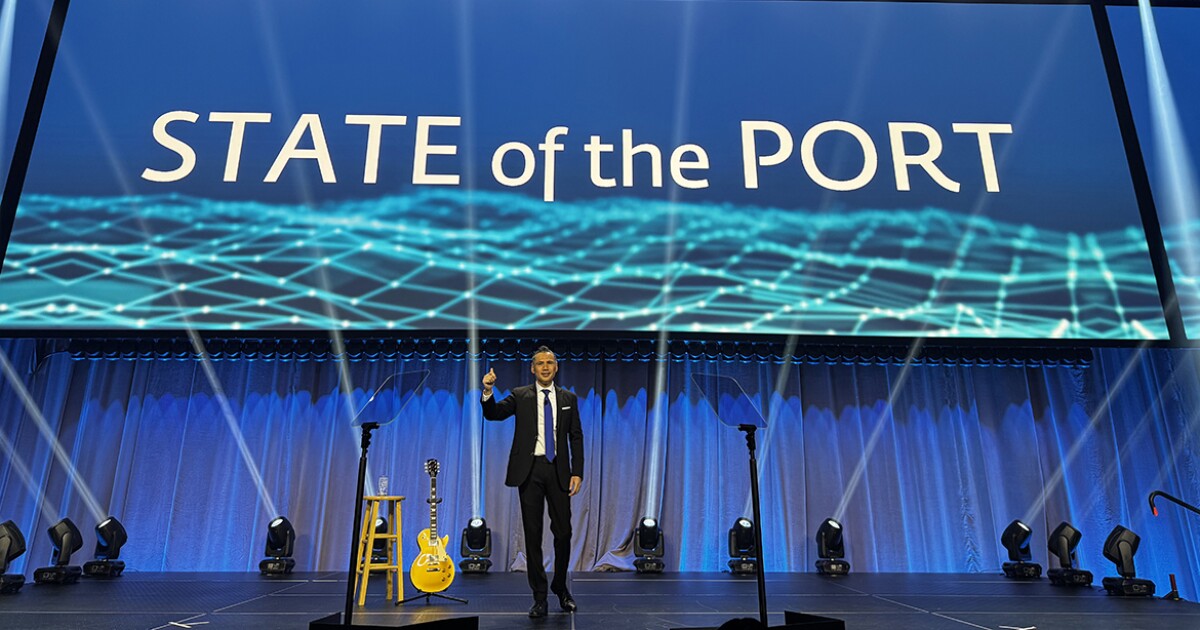
 “Yet, for all the predictions of doom and gloom, and against all odds — the port of Long Beach set an all-time record for container volume. Together we handled 9.9 million TEUs, making it our busiest year ever,” Long Beach Port Chief Executive Officer Noel Hacegaba said in his State of the Port speech on Jan. 15
Port of Long Beach
The twin ports of Los Angeles and Long Beach both notched strong cargo volume for 2026 despite the trade volatility brought on tariff spikes.
Processing Content
Port executive directors also outlined investments planned to improve infrastructure in their State of the Port speeches delivered separately.
“Every record set and every bar raised is a direct result of the dedication and commitment of the people who make this port work,” said Port of Los Angeles Executive Director Gene Seroka in a speech he delivered Thursday.
The Los Angeles port handled 10.2 million container units in 2025, the third best in the port’s 118-year history and the third time it has exceeded 10 million twenty-foot equivalent units (TEUs), Seroka said. The port’s busiest year on record was 2021, when it processed 10.6 million containers in the midst of the pandemic, according to port statistics.
The volume was a less than 1% decrease from 2024, which Seroka described as somewhat remarkable given the volatility in 2025, as manufacturers and store owners scrambled to keep up with President Donald Trumps’ tariff increases. Cargo volumes experienced dramatic swings as shippers frontloaded goods to get ahead of import taxes, he said.
Trump’s “Liberation Day, when the highest tariffs since the Great Depression were imposed on virtually very U.S. trading partner, was simply sweeping and unprecedented,” Long Beach Port Chief Executive Officer Noel Hacegaba said in his State of the Port speech on Jan. 15.
“Yet, for all the predictions of doom and gloom, and against all odds — the port of Long Beach set an all-time record for container volume. Together we handled 9.9 million TEUs, making it our busiest year ever,” Hacegaba said.
The Port of Long Beach moved a record-setting 9.9 million cargo containers with no backlogs or delays in 2025 and expects to move 20 million containers annually by 2050, he said.
The TEUs processed by the Long Beach port climbed 2.4% from the previous record of 9.6 million TEUs moved in 2024. Imports rose 1.1% to 4.8 million TEUs, exports declined 5.5% to 1.14 million TEUs, and empty containers moving through the ports increased 6.7% to 3.96 million, compared to 2024, port statistics showed.
To prepare for anticipated future demand, Seroka outlined the port’s investment priorities, which he said are focused on infrastructure, technology and climate resilience.
Among the projects Seroka highlighted was the proposed Pier 500 Marine Container Terminal, an expansion that would increase the port’s overall cargo capacity. A request for proposals was issued in October.
“Pier 500 would be the first new container terminal to be developed at the port in a generation,” Seroka said.
Other projects Seroka covered included the Maritime Support Facility, a dedicated hub on Terminal Island for chassis parking and container pick-up and drop-off, and expansion of Fenix Marine Services Terminal on Pier 300 and proposed wharf and rail upgrades at LA Til Container Terminal in the west basin.
The Los Angeles port, which had 1.6 million cruise ship passengers, also is working to transform the outer harbor with a cruise center. Seroka announced Pacific Cruise Terminals, a joint venture between Carris, Inc. and JLC Infrastructure, has been selected to develop the project.
Long Beach is working on its $1.8 billion Pier B On-Dock Rail Support Facility, which is expected to move cargo containers from ships to trains in less than 24 hours and improve connectivity with inland destinations when completed in 2032, Hacegaba said. The project will triple the volume of cargo moved by on-dock rail to 4.7 million TEUs, he said.
“We have 24 years to prepare to double our container throughput and figure out how we’re going to handle all that additional cargo quickly, safely and efficiently and sustainably,” Hacegaba said in his speech.